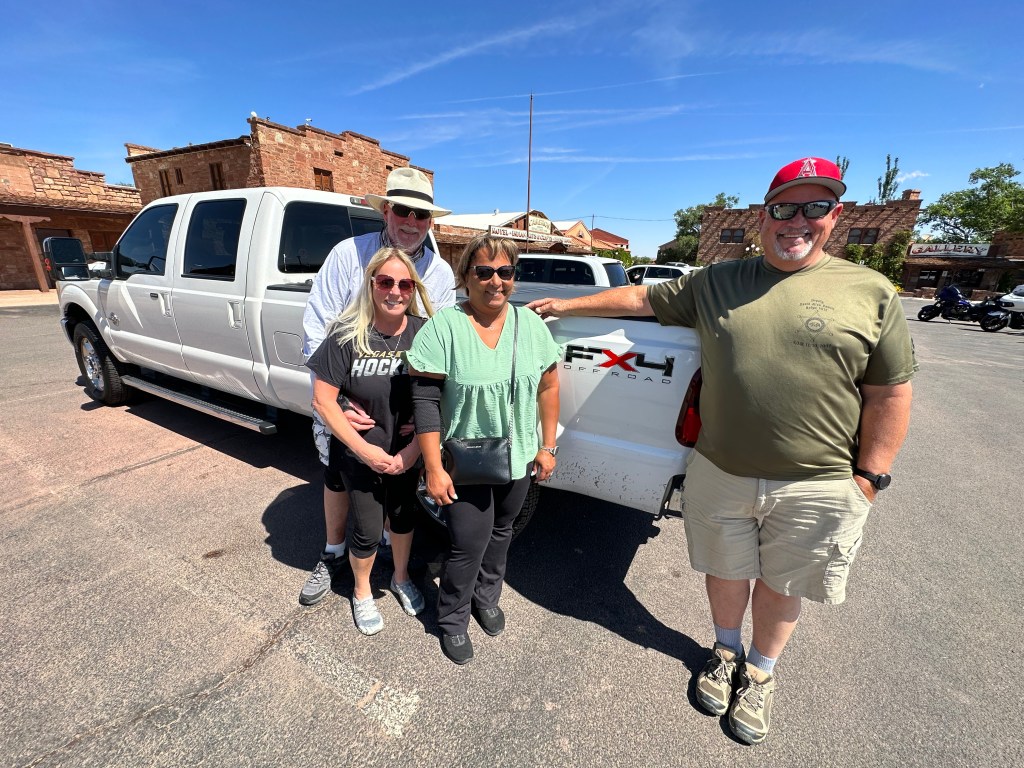
The newly-formed posse, three boys and three girls, leaves Page and heads south on US Highway 89. Today’s destination: Grand Canyon National Park, South Rim.
It’s about 135 miles to get there, two and a-half hours or so. We should be walking along the edge of the South Rim by late morning. Grand Canyon will be the first of 12 National Parks we’ll visit on this trip.
Here we go!
Antelopes Everywhere
About 20 miles out of Page, the road climbs steeply, gaining 1,000 feet of elevation in three miles of hairpin turns before bringing us to Antelope Pass. The pass sits at 6,194 feet. The road is carved into the side of a sandstone hill. Bouldering is a common activity here.
Antelope Pass is not to be confused with the far-better known Antelope Canyon, a few miles southeast of Page. Antelope Canyon is the number one tourist attraction in the Page area.
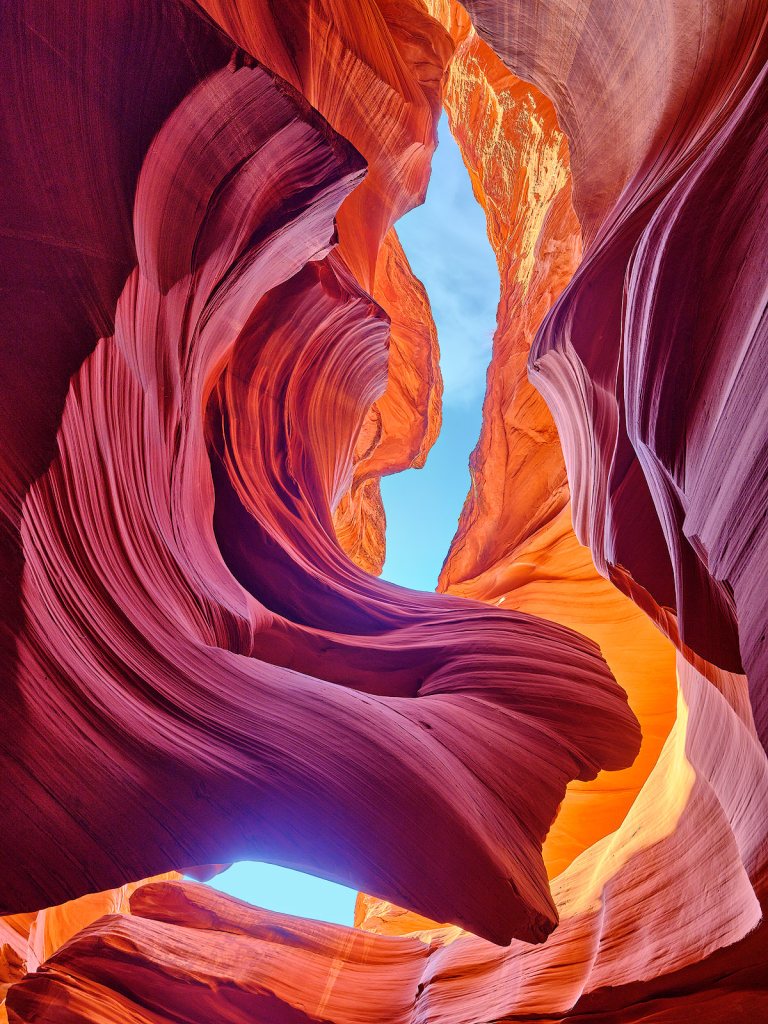
Guided tours are required to visit Antelope Canyon. It’s located on private land within the Navajo Nation. Several authorized tour operators in the area lead groups to the canyon and impart their knowledge about the area’s history and geology. Shaped by millions of years of water and wind erosion, the magnificent canyon was named for the herds of pronghorn antelope that once roamed the area.
Nature photographers head to this area of Northern Arizona to capture the natural beauty of Glen Canyon and Lake Powell. But the biggest prize for photographers is Antelope Canyon, one of the most photographed destinations in the Southwest. Professional photographers plan ahead to arrive at the canyon midday March through October. That’s when the position of the sun creates light shafts that reach the canyon floor and illuminates the pink, red, orange and gold patterns on the canyon walls.
Tours will take the better part of a half-day, and cost around $100 per person. Or, you can continue south with us, as we head for the Grand Canyon.
Nearing the Grand Canyon
Highway 89 takes us south for nearly 60 miles, past Native American jewelry stands and little else. It’s very desolate. We’re on the Navajo Nation. So is Cameron, our last stop before the Grand Canyon.
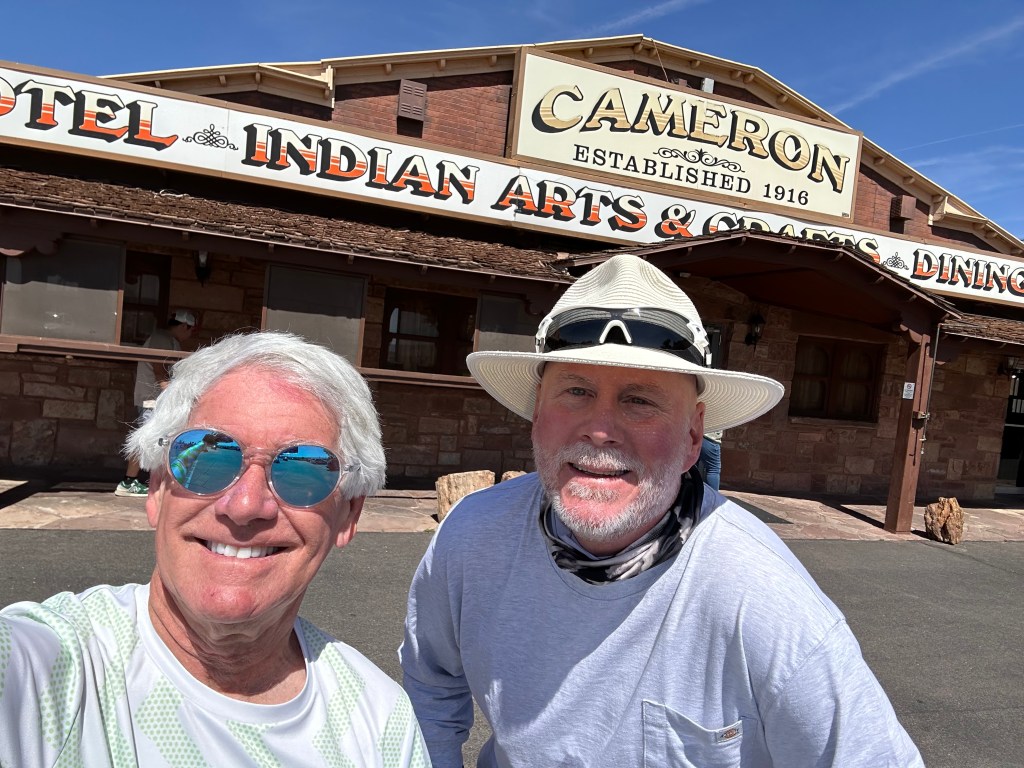
Here you’ll find the Cameron Trading Post, established in 1916. Most of Cameron’s economy is based around tourism – food, craft stalls, restaurants and other services for north/south travelers on Highway 89. The area is named after Ralph H. Cameron, Arizona’s first US Senator. He was Arizona Territory’s Delegate to Congress, and then became its Senator when Arizona was granted statehood in 1912, the forty-eighth state admitted to the union.
After a break in Cameron, we turn west on Arizona Highway 64 and head for the Grand Canyon, about 55 miles away. Other than a few places where you sneak a peak of the Colorado River gorge, you have no idea you’re approaching the Grand Canyon.
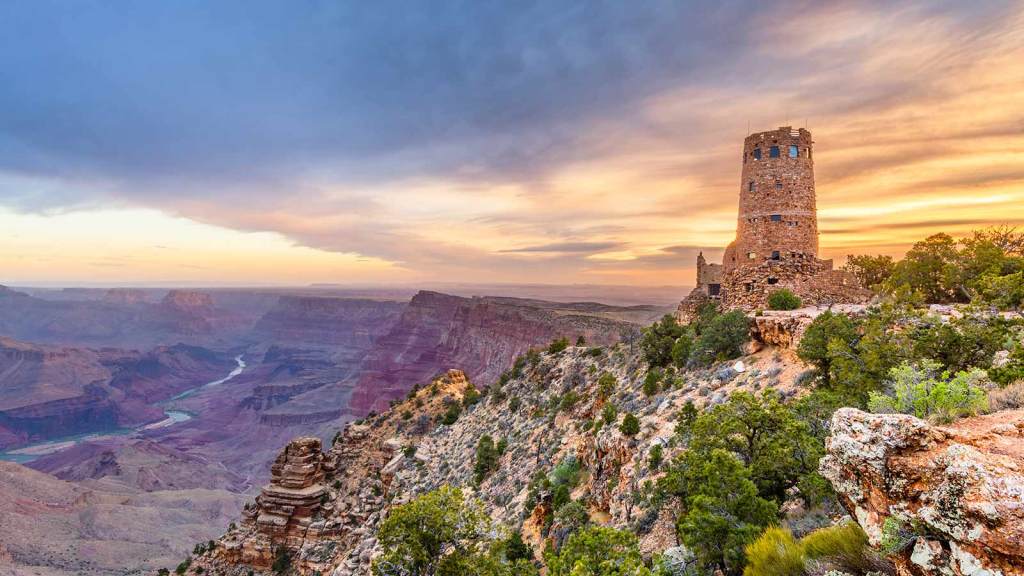
Near the eastern edge of the Grand Canyon, we roll past Desert View, a small settlement run by the National Park Service, with a visitor center and a watchtower at Desert View Point. The watchtower, one of the most iconic structures along the South Rim, can be seen from miles away.
Recognized as a National Historic Landmark, the Watchtower was constructed in 1932. Architect Mary Colter’s design takes its influences from the architecture of the Ancestral Puebloan people of the Colorado Plateau. This particular tower was patterned after those found at Hovenweep and the Round Tower of Mesa Verde. Colter indicated that it was not a copy of any that she had seen, but rather modeled from several.
The view from the Watchtower provides a unique perspective of the eastern portion of Grand Canyon. From here, looking to the northeast offers a distant glimpse of the Colorado River’s transition from the relatively narrow Marble Canyon to the north into the much wider, broader expanse of Grand Canyon.
The Artistic Moran Brothers
Desert View is our last stop before arriving at Grand Canyon Village, about 20 miles away. On our way, we roll past Moran Point, one of the most visited points on the east rim drive. The promontory is reached by a short spur road and was named after the landscape painter Thomas Moran, who came here for the first time in 1873. He helped popularize the canyon with his paintings, leading eventually to its incorporation as a national monument in 1908, and a national park in 1919. That’s what most people think.
The truth is that Moran Point is actually named for his brother, Peter Moran, an accomplished artist in his own right. Peter Moran traveled to the South Rim in 1881 with explorer and Army Captain John Bourke, who probably named the point in his honor. Thomas Moran never saw the South Rim until 1892, when he visited as a guest of the Santa Fe Railway. Either way, the Moran family has a point named after it.
One final tidbit about the Morans. Thomas took two years to paint “The Chasm of the Colorado,” a huge piece of art he completed in 1874, and sold to Congress for $10,000. The seven-foot by twelve-foot, oil-on-canvas masterpiece now is part of the Smithsonian Institution, and resides primarily at the National Gallery of Art in Washington, DC. The painting was based on Moran’s preparatory sketches and photographs during an 1873 visit, then completed upon Moran’s return to his New Jersey studio.
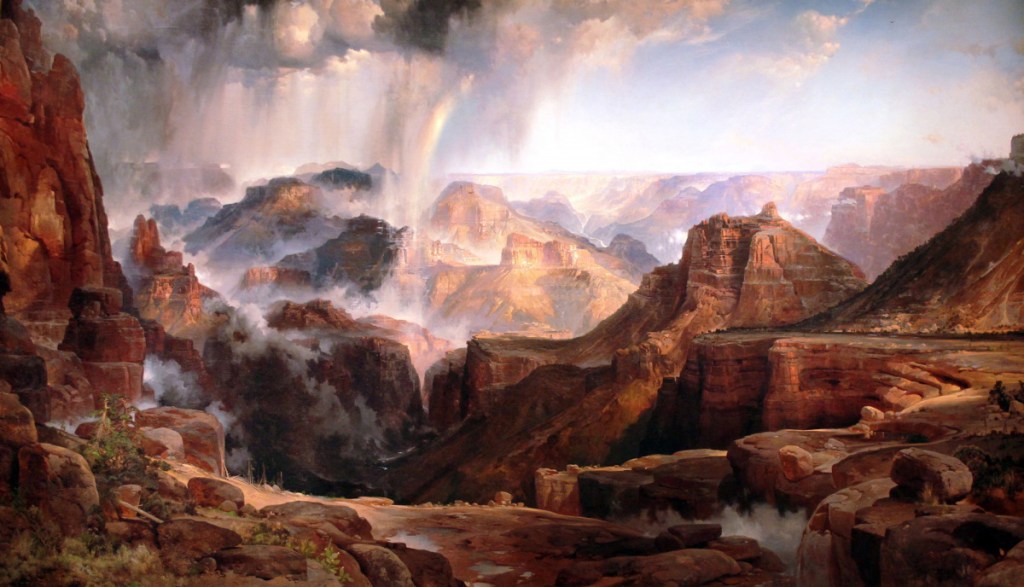
The “Chasm of the Colorado” was Thomas Moran’s depiction of the Grand Canyon. After four hours on the road, we finally roll into the Grand Canyon Village, so we can see the marvel of nature with our own eyes.
Grand Canyon National Park is the first of 11 national parks we’ll visit on this trip. It encompasses 278 miles of the Colorado River and adjacent uplands. The canyon is one of the most spectacular examples of erosion in the world. At its deepest point, the Grand Canyon has a depth of more than 6,000 feet, from canyon rim to the river below. And it’s 18 miles across at its widest point.
The park receives nearly five million visitors every year. Along with Mount Everest, Victoria Falls, and the Great Barrier Reef, the Grand Canyon is considered one of the Seven Natural Wonders of the World.
Worth mentioning: the so-called seven “New Wonders” of the world get a lot attention, but they’re man-made. You’ve probably visited some of them: Egypt’s Great Pyramids, the Great Wall of China, Rome’s Colosseum, Machu Picchu in Peru, the Taj Mahal. You know, the usual suspects. Honorable mentions include the Eiffel Tower, Statue of Liberty, the Acropolis and Stonehenge. Beautiful, all of them. Unique? Absolutely. But man-made, every one.
Here’s looking at you, real natural wonders, that only God could create.
Billions of Years in the Making
The gigantic Grand Canyon gorge represents nearly two billion years of geological history, as the Colorado River and its tributaries cut their channels through layer after layer of rock while the Colorado Plateau was uplifted.
For thousands of years, the area has been inhabited by Native Americans, who built settlements within the canyon and its many caves. Today, the park is populated by five Native American tribes: the Hopi, Navajo, Havasupai, Paiute, and Hualapai. Many Native Americans consider the Grand Canyon a holy site. They got that right. You take one look, and your first reaction is, “Holy cow!”
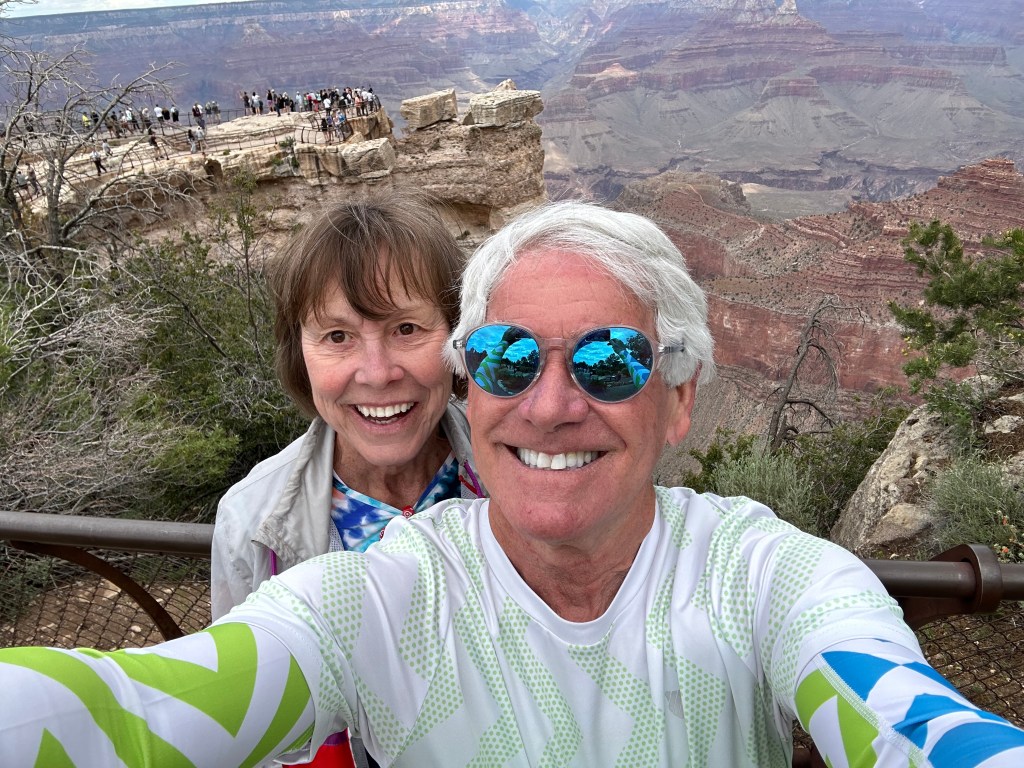
In 1869, Major John Wesley Powell set out to explore the Colorado River and the Grand Canyon in the first expedition down the canyon. His party of ten men set out downstream from Green River, Wyoming on May 24. The journey ended in late August. Despite a series of hardships, including losses of boats and supplies, near-drownings, and the eventual departures of several crew members, the voyage produced the first detailed descriptions of much of the previously unexplored canyon.
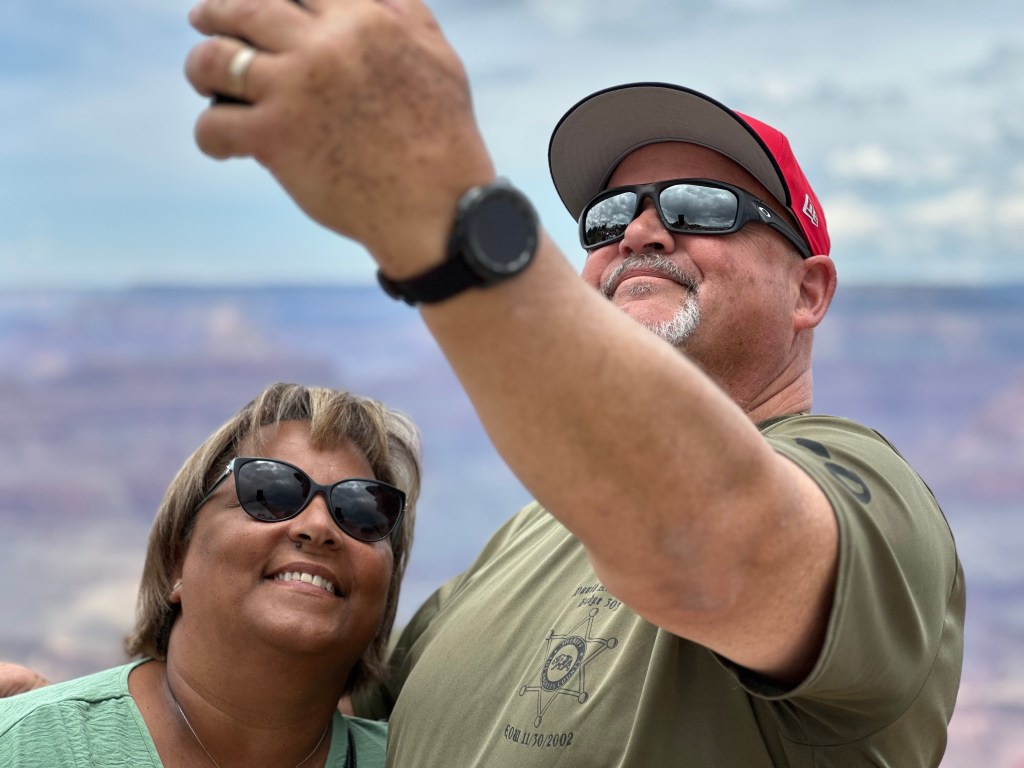
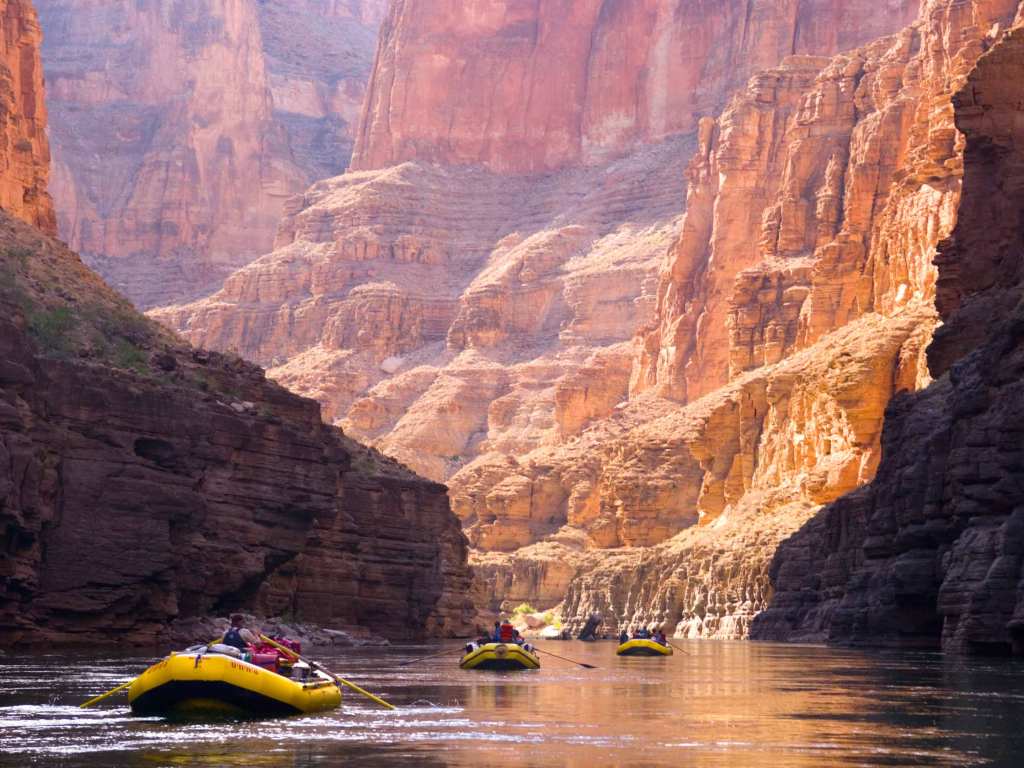
Given the technology of the time – more than 150 years ago – it was amazing anyone survived the expedition. Today, about 22,000 visitors a year float down the canyon, mostly on commercial raft trips. You can pay $346 for a one-day motorized journey, or as much as $7,000 for an 18-day oar trip. Most everyone who rafts the Grand Canyon calls it one of the most memorable and transformative experiences of their life.
Grand Canyon Village
Much of the civilization at the Grand Canyon South Rim is centered around the Grand Canyon Village, where visitors head to admire the canyon. This place gets a lot of visitors. In 2022, Grand Canyon National Park had 4.73 million visits, the second-most of all National Parks (Great Smokey Mountains National Park had the most visitors: 12.94 million!).
Grand Canyon Village includes the historic El Tovar Hotel, with its 78 guest rooms and a dining room with a killer view of the canyon. At the village you’ll also find art studios, gift shops and the Bright Angel Lodge. Near the lodge is the beginning of the Bright Angel Trail, which takes hikers down into the canyon, where they can begin their raft journeys.
Bright Angel Trail begins at 6,850 feet and drops about 3,000 feet to the river below. Most hikers take four to five hours to complete the nine-mile trek. The Park Service says, depending on how prepared you are, the hike can be either a revelation or an ordeal. It generally takes twice as long to hike out from the river floor, as to hike down from the village.
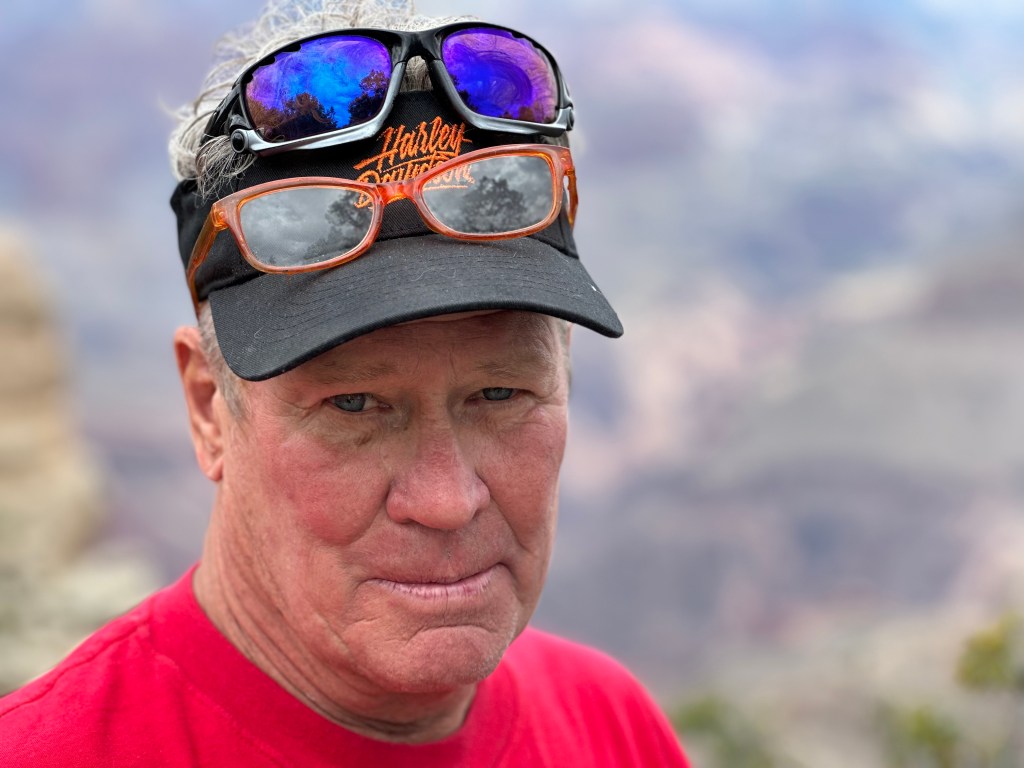
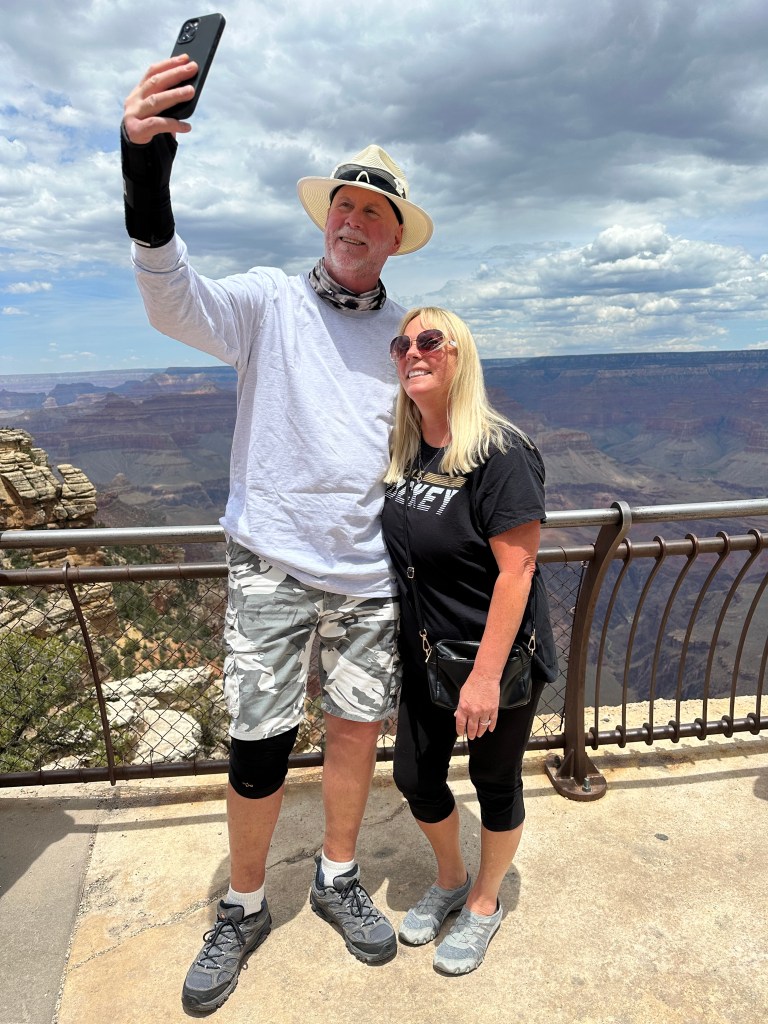
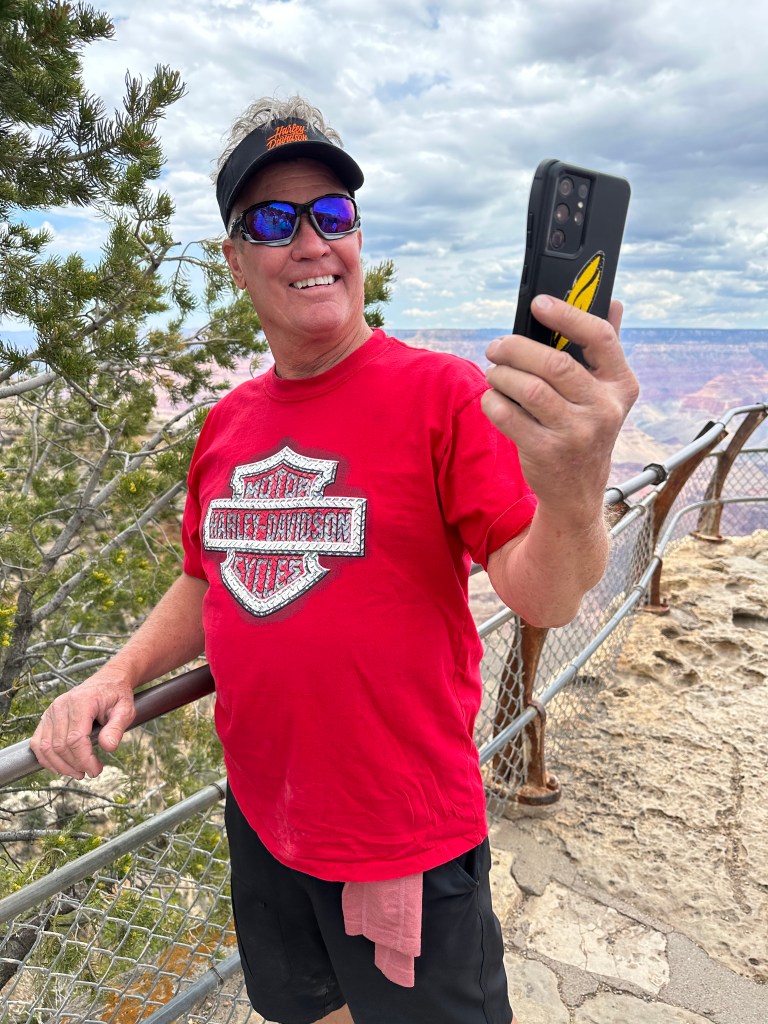
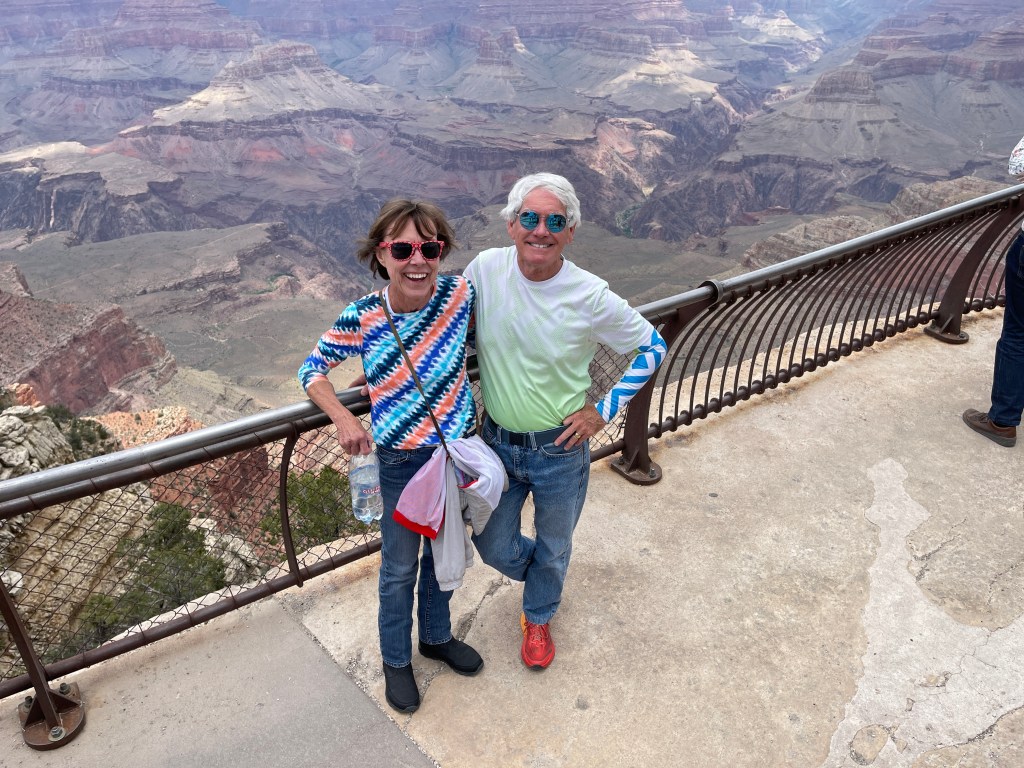
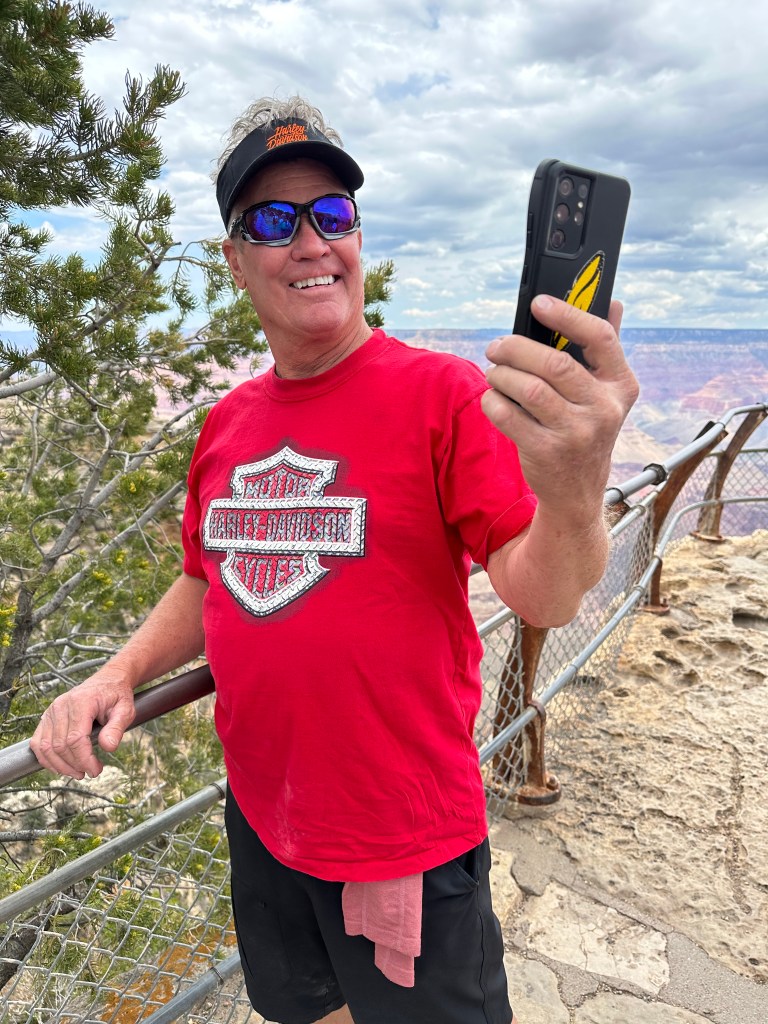
Those who want a short hike – for example, Harley riders from Colorado – can walk along the mostly paved and gently sloping trail that follows the South Rim.
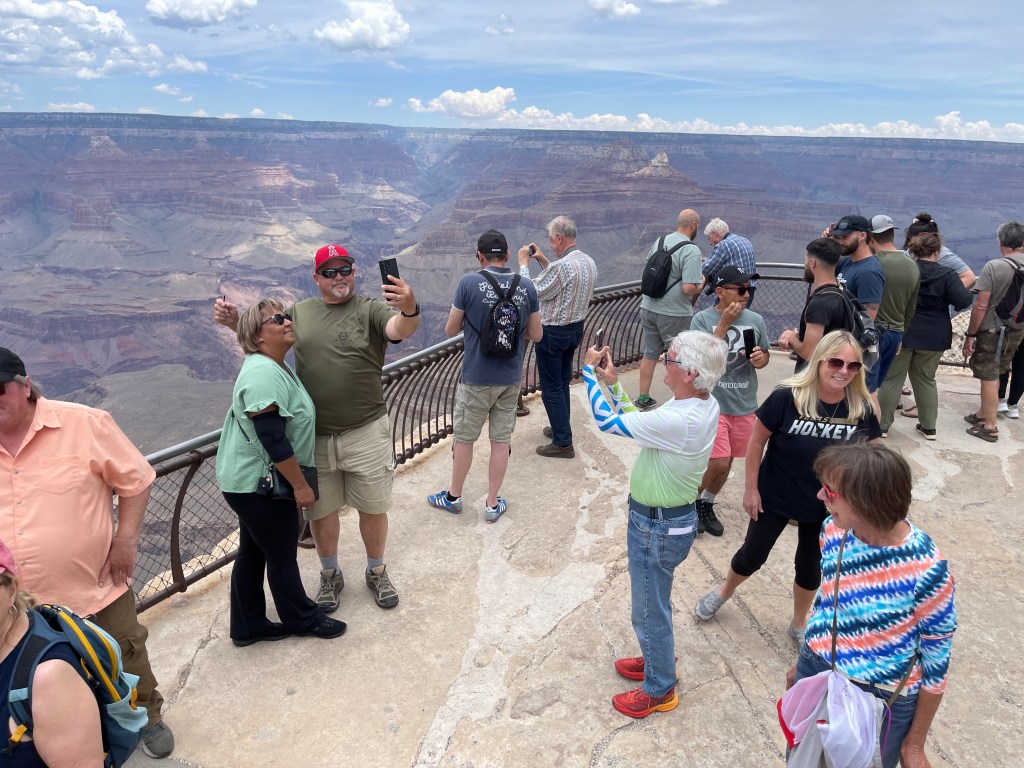
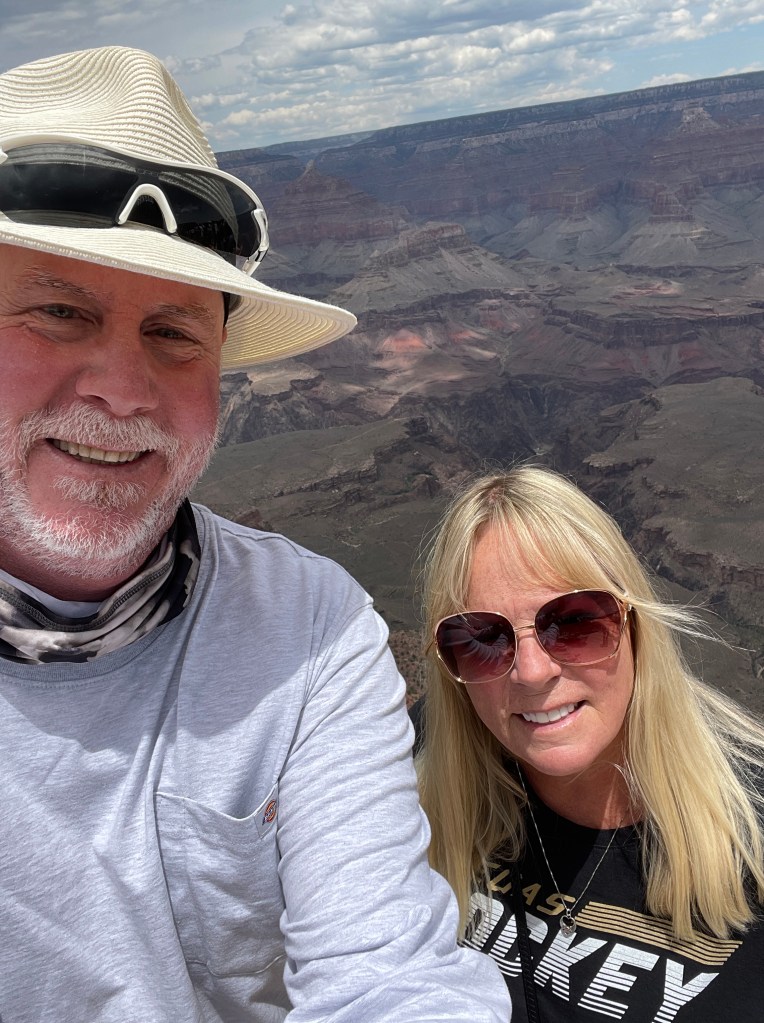
After a few hours exploring the village and South Rim trail, it’s time to saddle up and head back to Page. The return route is a mirror image of how we got to the Grand Canyon. Unlike this morning, we’ll go west to east, and south to north.
On our way into Page, about five miles from town, we pass by a turnoff to Horseshoe Bend, one of the most photographed settings on the Colorado Plateau. Tomorrow, we’ll visit Horseshoe Bend. Consider yourself teased.
***
The Day in Review:
Click here to see today’s complete route from Page to the Grand Canyon South Rim, and back to Page.
Today’s Takeaways:
- Antelope Pass or Antelope Canyon? The Pass is free; the Canyon is not.
- Thomas and Peter Moran. Two great artists, worthy of a point.
- Grand Canyon, a billion years in the making.
Today’s Trivia: Grand Canyon Pulitzer
In 1973, I got my first post-college job, as a writer at the Salt Lake Tribune. At the time, I knew little about the newspaper, except that it paid me $100 a week to represent the male point of view in its brand new “Lifestyle” section, the successor to what had been the “Women’s Department.”
I also was unaware of a significant event in the Tribune’s history 16 years earlier, when it was awarded the prestigious Pulitzer Prize. The newspaper was recognized for its “prompt and efficient coverage of the crash of two airliners over the Grand Canyon.” The Tribune’s coverage was led by Executive Editor Arthur Deck, who hired me in 1973.
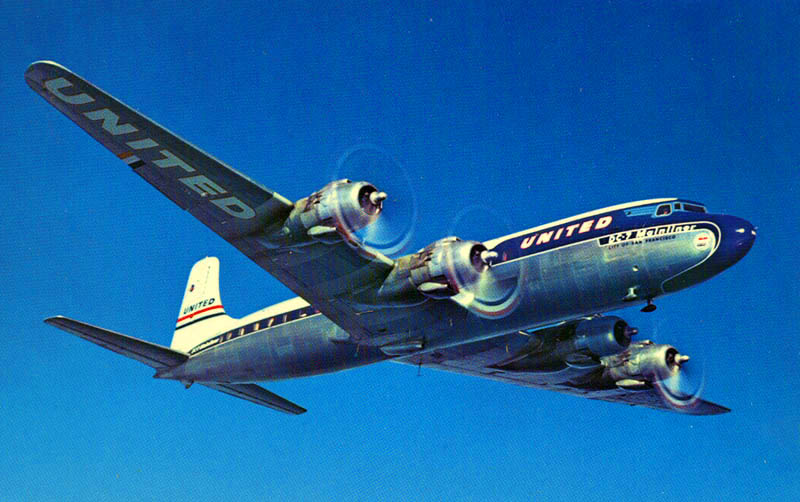
At 10:30 a.m. on July 2, 1956, a United Airlines Douglas DC-7 and a TWA Lockheed Super Constellation collided in mid-air. Both were cruising at 21,000 feet, flying over the Grand Canyon, near Chuar Butte. The two airplanes had departed Los Angeles International Airport, three minutes apart, and were on transcontinental routes, flying under Visual Flight Rules (VFR).
See and Be Seen.
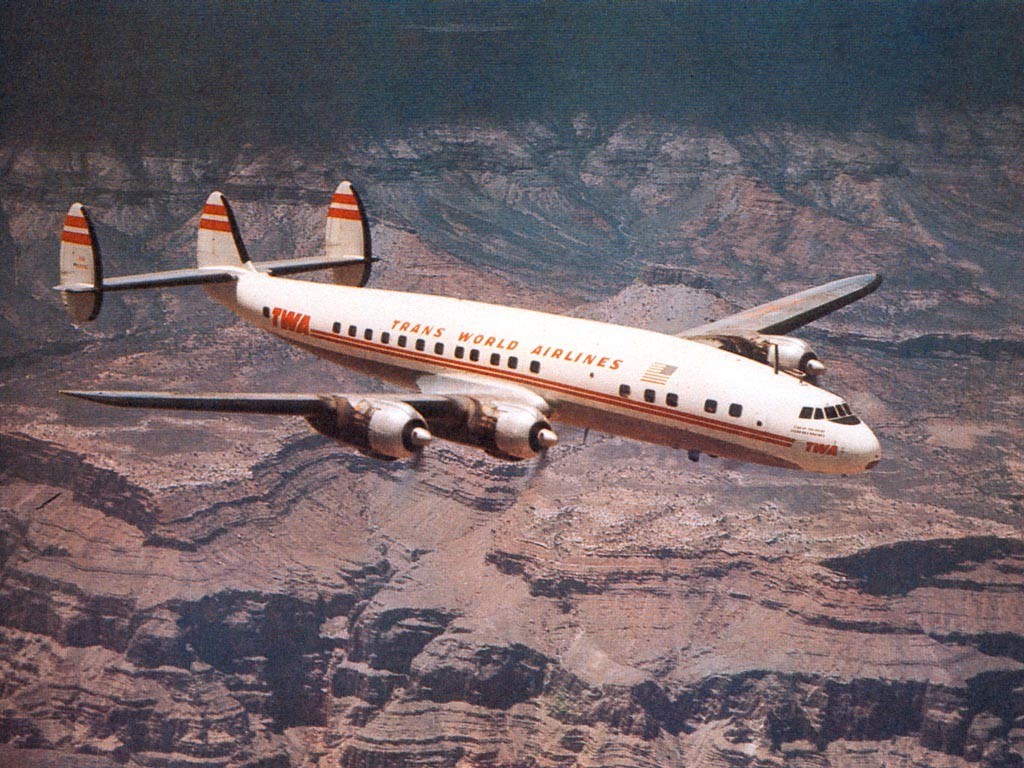
United Flight 718, with 58 people aboard, was bound for Chicago. TWA Flight 2, with 70 on board, was en route to Kansas City. At the time, it was the worst air disaster in the history of civil aviation. All 128 people on board the two aircraft were killed.
In 2014, the crash site was designated a National Landmark, meant to serve as a reminder of triumph, tragedy, public service and artistic beauty.

At the time of the crash, air travel was a shadow of the highly advanced operation it is today. The skies were largely uncontrolled, and pilots outside major US cities relied on sight to avoid catastrophes. It was known as “See and Be Seen.”
The investigative agency, the Civil Aeronautics Board, determined simply that the pilots of the United and TWA airplanes did not see one another. The agency speculated that the pilots were treating passengers to views of the Grand Canyon while flying through scattered cloud buildup. See and Be Seen.
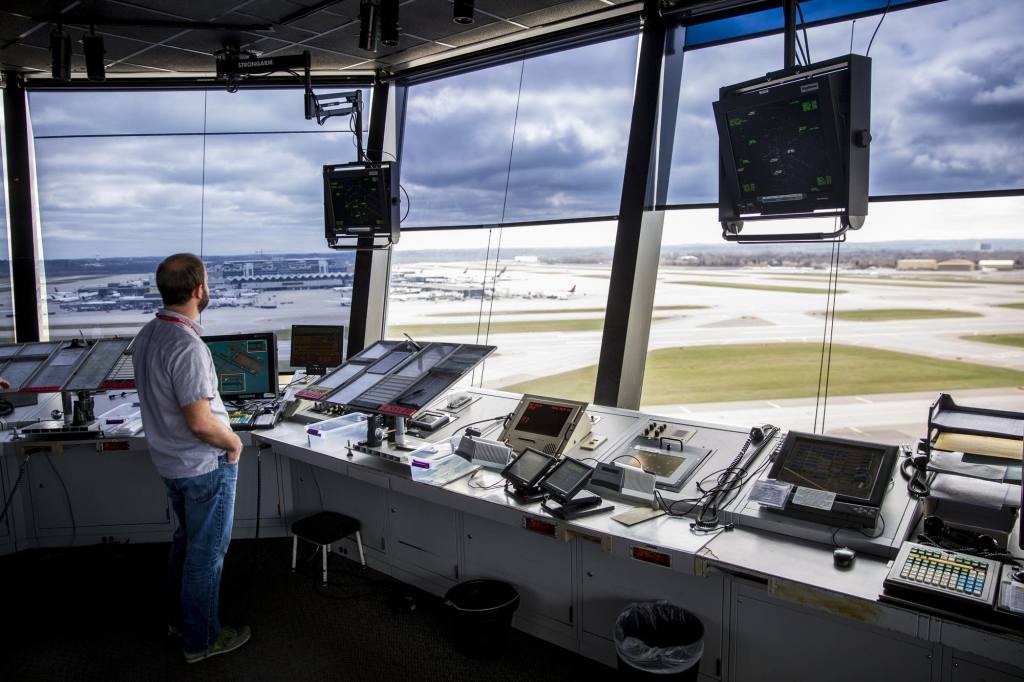
The Grand Canyon crash helped spur Congress to make commercial aviation safer, by improving air traffic control and radar systems, and creating a federal agency to regulate it. In 1958, Congress passed the Federal Aviation Act which created the Federal Aviation Administration as an investigatory and advisory entity. It also modernized air traffic control and implemented stricter flight rules. Today, commercial air travel is far safer than any other form of transportation; your chance of being in a fatal accident is one in seven million.
And now you know.
 Riding With Gary
What an epic day! Thank you Gary! You are forgiven for the F-150 post yesterday. 🤣
LikeLike
We will upgrade you to F-550 by tomorrow. You rate.
LikeLike
Gary, your narratives are always so interesting. Good to see Dave and Gail on this trip. Love you guys! – Brother Mark
LikeLike
Hey brother! Sorry we are not on a motorcycle as planned but God had other ideas. Just blessed to be with the posse for a while and enjoy such majestic nature together! Gail says hi too.
LikeLike
Go nature made! Taking vicarious pleasure.
LikeLike
Enjoying your trip! I appreciate the info about the formation of the FAA. My Dad was a FAA control tower operator for many years. Safe travels!
LikeLike
Miss riding this year.. Glad the old gang plus a new rider has carried on the tradition. Lots of info in these blogs Gary. Thanks
LikeLike
Miss you, Randy. Not the same without you 😢
LikeLike
Thought of you these past 2 days Randy. Great times when you, Gary and I did the rims in 2016. Miss you bro!
LikeLike
Fantastic, thank you Gary !
LikeLike