For the first time in two weeks, I wake up with no one to talk to. Ray’s probably halfway to Tennessee, and I still have two days of riding before arriving home in La Quinta.
Let’s get it started.
I head west on AZ-260, leaving the poker capitol of Arizona on West Deuce of Clubs. I ride through Sitgreaves National Forest, toward the town of Heber-Overgaard, situated atop the Mogollon Rim at about 6,400 feet.
Heber was founded in 1883 by Mormon pioneers; Overgaard was settled in the 1930s and named after the owner of its first sawmill. Someone found a surplus hyphen somewhere and decided to call the place Heber-Overgaard.
Today, Heber-Overgaard exists as a retirement and tourism locale.
***
I’m almost halfway to the mountain town of Payson, which sits at 5,000 feet in the Tonto National Forest at the intersection of AZ-260 and AZ-87. Payson is almost exactly in the geographic center of Arizona. It’s motto: “Arizona’s Cool Mountain Town.”
Payson had its first rodeo 130 years ago, in 1884. Payson considers the event to be the world’s oldest continuous rodeo, as it’s been held every year since.
In 1918, the author Zane Grey made his first trip to the area near Payson. He came back regularly over the next 10 years, purchasing several plots of land and eventually writing numerous books about the area.
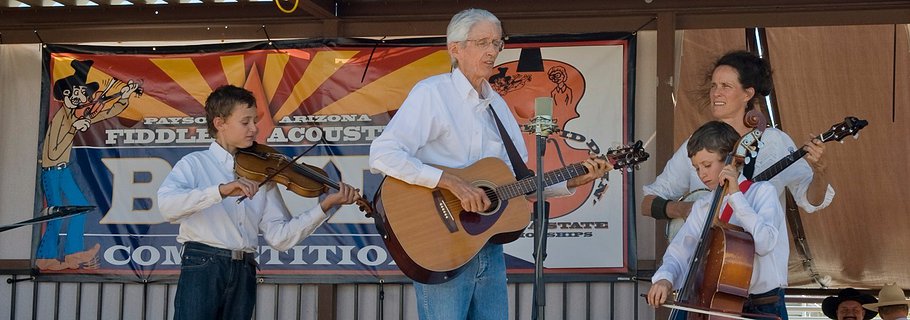
Every September, Payson hosts the annual Arizona State Championship Old Time Fiddlers Contest, featuring both local and nationally known players.
I have no time for fiddling around, so I continue northwest on AZ-260, the Zane Grey Highway.
I’m riding toward Camp Verde, home of a 32-foot-tall kokopelli, the world’s largest. A kokopelli is a fertility deity, usually depicted as a humpbacked flute player. The kokopelli is a big deal in many Native American cultures in the southwest. You’ll often see them in tourist shops in Arizona. Camp Verde’s ginormous kokopelli sits in front of the Krazy Kokopelli Trading Post.
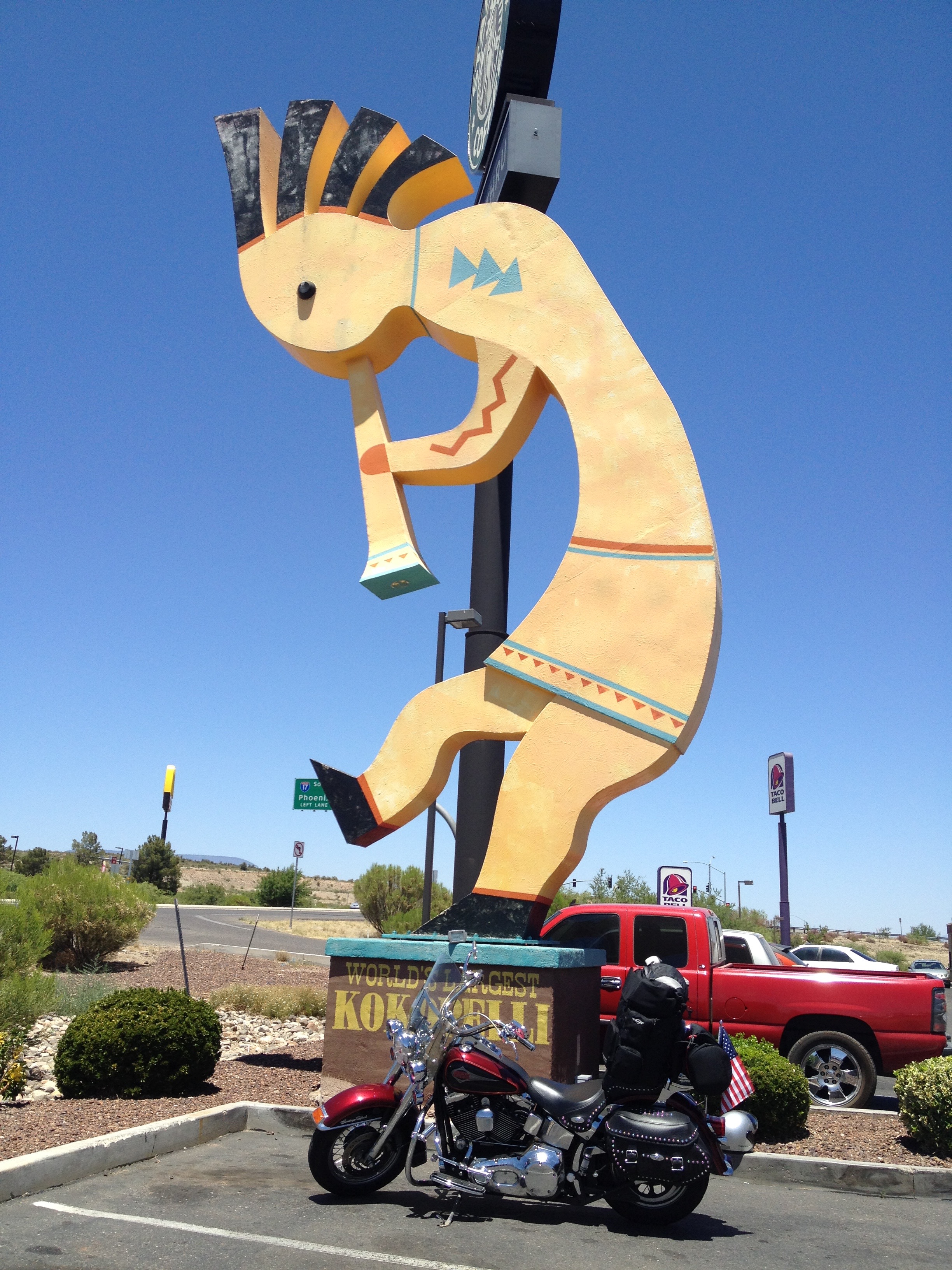
Camp Verde, at 3,147 feet, sits on the banks of the Verde River. The city doesn’t have much going on other than its kokopelli-on-steroids, and an occasional festival. It holds Fort Verde Days in October; the Pecan, Wine and Antiques Festival in February; and the Crawdad Festival, scheduled for later this month.
In Camp Verde, it’s noon, and the temperature is already in the 90s. I remember Sarah’s less-than-gentle reminders to hydrate adequately.
So I duck into the Starbucks at the foot of the giant kokopelli for a coffee frapuccino. It is just what I need to stay cool and saturated. That’s my idea of hydration!

***
I cross I-17, following the Verde River to the town of Cottonwood. Here, I turn west on AZ-89A and head 2,000 feet up the mountain for the steep 5-mile ride to the historic mining town of Jerome.
Jerome, elevation 5,066 feet, was named for Eugene Murray Jerome, a New York investor in the early mining operations on Cleopatra Hill, which dominates Jerome’s horizon. A prominent “J” is still visible on Cleopatra Hill.
Supported in its heyday by rich copper mines, Jerome was once home to 15,000 people. Today, its population is less than 500, but it’s big enough to have its own website, which says Jerome was once known as the wickedest town in the west.
Jerome sits above what was once the largest copper mine in Arizona, producing 3 million pounds of copper every month. As the ore deposits became exhausted in the 1950s, the mines closed and Jerome took on a new persona. It became a National Historic Landmark in 1967, and today is an art community, with coffee houses, wineries, and a local museum devoted to mining history.
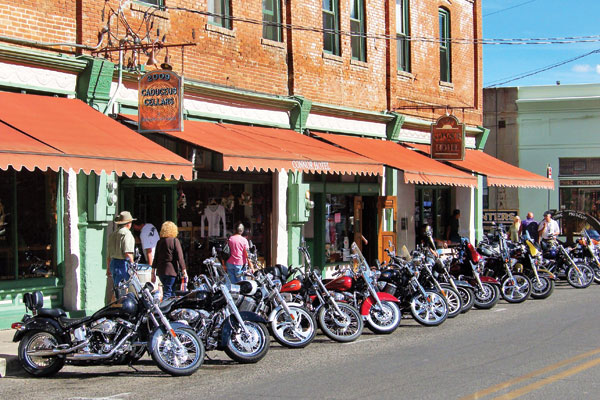
Jerome’s funky, artistic vibe attracts musicians, writers, and plenty of tourists – like me – who walk its narrow, winding streets.
Notable people with a Jerome connection:
- Fred Rico, former major league baseball player, born in Jerome on July 4, 1944. He made $6,000 playing for the Kansas City Royals in 1969, hitting .231 in 12 games while playing third base and right field.
- Maynard James Keenan, singer, songwriter and musician, best known as the vocalist for Grammy Award-winning progressive metal band Tool. Can’t honestly say I’m familiar with their music. Keenan owns Caduceus Cellars winery in Jerome.
- Katie Lee, 94-year-old folk singer who lives in Jerome. Lee, who studied under Burl Ives, had an early folk album called “Life is Just a Bed of Neuroses.” It’s out of print, but six of her CDs are still available. She’s in the Arizona Music Hall of Fame.
***
Again remembering Sarah’s hydration admonition, I stop at the Mile High Grill in Jerome for a large, cold diet Pepsi. It hits the spot, and gets me ready to continue my ride south.
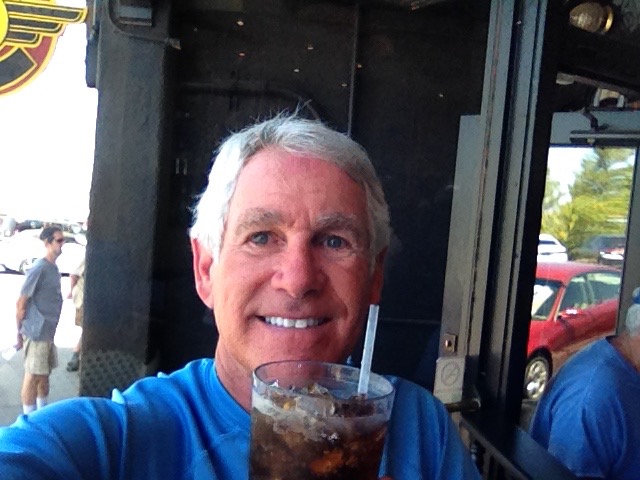
After exploring Jerome’s arty side, and filling up on diet Pepsi, I continue south on AZ-89A, alternately called the Prescott-Jerome Waterway. It looks nothing like a waterway to me.
I press on toward Prescott, a mountain town designated in 1864 as the capital of the pre-statehood Arizona Territory. With many Victorian-style homes, Prescott has 809 buildings on the National Register of Historic Places.
Known for its western and cowboy feel, Prescott annually hosts Frontier Days, a rodeo (featured in the 1972 film Junior Bonner), and a Bluegrass Festival. The 2014 Bluegrass Festival, which has free admission, will be held June 21 and 22 at the Yavapai County Courthouse Plaza. This year’s bands include The Sonoran Dogs, The Mars Hillbillies, and Marty Warburton and Home Girls.
Prescott has earned a number of designations and distinctions, including being named Arizona’s Christmas City in 1989 by then Governor Rose Mofford, “A Preserve American Community in 2004 by First Lady Laura Bush, and one of a “Dozen Distinctive Designations” in 2006 by the National Trust for Historic Preservation.
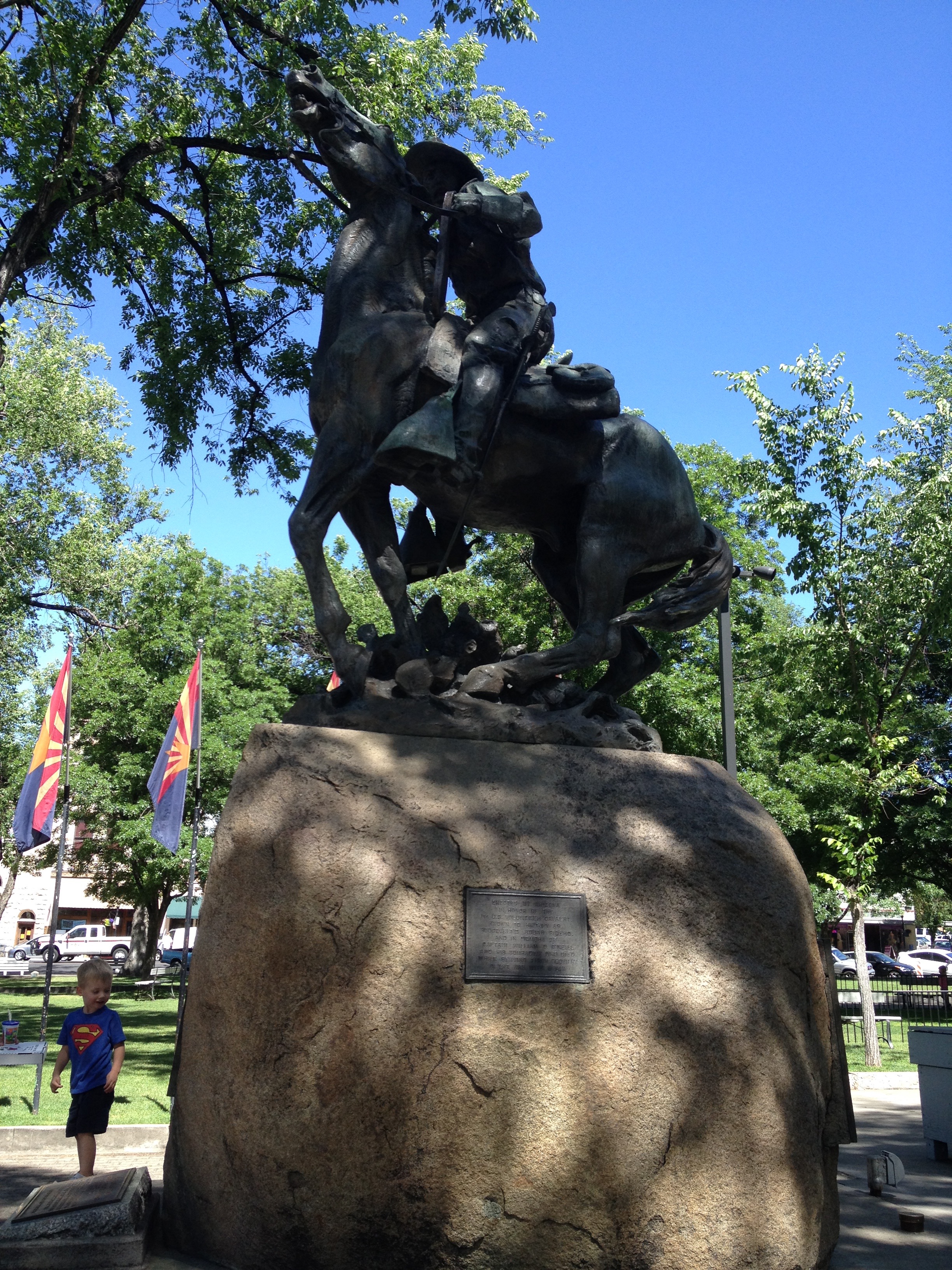
There’s a great statue in Courthouse Square, of a soldier on a horse. It honors the 1st US Volunteer Cavalry, also known as Roosevelt’s Rough Riders. The statue was sculpted by Solon Hannibal Burglum (1868-1922).
The statue is acclaimed by art critics as one of the finest equestrian monuments anywhere. At least that’s what the plaque on the statue says.
Notable residents of Prescott have included:
- Piper Stoeckel, Miss Arizona 2012, born in Prescott and now senior at the University of Arizona, majoring in Broadcast Journalism and Dance. That’s an interesting academic combo. To see Piper Stoeckel remind us what broadcast journalism has become, click here.
- Alan Dean Foster, science fiction author, best known for his novels set in the Humanx Commonwealth, an interstellar ethical/political union of species including humankind and the insectoid Thranx.
- William Ruger, founder of Sturm, Ruger & Company, a large firearms maker. Their first product was the Ruger Standard, the most popular .22 caliber target pistol ever made in the U.S.
At 5,368 feet, Prescott is the last true mountain town on my 2014 Ride Through the Rockies.
***
Leaving Prescott, the ride to La Quinta is all downhill from here.
AZ-89 south from Prescott is a fun, twisty mountain road. Parts of it are known as the White Spar Highway, just south of Yarnell. Yarnell Hill descends 1,300 feet in just four miles and has a very popular scenic lookout point at the top.
You may recall Yarnell as the site of a tragic 2013 forest fire that took the lives of 19 firefighters from nearby Prescott. The Yarnell Hill fire overran the firefighters known as the Granite Mountain Hotshots. Arizona’s Industrial Commission, which oversees workplace safety, blamed the state’s Forestry Division for the deaths, saying state fire officials knowingly put protection of property ahead of firefighter safety.
***
I continue south on AZ-89, through the former gold mining town of Congress, just a short ride from Wickenburg, elevation 2,050.
Wickenburg, another former gold mining town, is my last overnight stop before arriving in La Quinta tomorrow.
An Austrian named Henry Wickenburg was one of the first gold prospectors here, and the town is named after him. Wickenburg – the city, not Henry – once claimed to be the Dude Ranch Capital of the World.

Dinner tonight: Asian fare at the Sizzling Wok. Yum. Haven’t had a meal yet on this trip that calls for chopsticks. Tonight’s the night for Chinese.
I have Kung Pao chicken. Scrumptious.
***
Post Script: tonight, Ray is in Conway, Arkansas — not far from Little Rock. He rode 565 miles today and has 537 more to go before pulling in the driveway at his home in Farragut, Tennessee. Ray says he expects to be home tomorrow afternoon. Makes my butt sore just thinking about it.
I, on the other hand, have 275 miles to go before I see Sarah’s smiling face in La Quinta tomorrow.
Note to those of you who are betting Ray will get home first: the smart money is now on the short kid from California. I expect to be home by 1 or 2 tomorrow afternoon.
Mathematically, Ray’s gonna have a tough time edging me out in the “who-gets-home-first sweepstakes.”
Ray actually enjoys the solitude of riding long distances by himself. A large number of his 360,000 miles in the saddle are solo miles.
Some people are cut out for that. Over the past two days of riding — 600 miles over 15 hours — I’ve learned (or rediscovered) that I am NOT one of them.
I simply don’t enjoy the experience of riding alone. In fact, I find it, for me, undesirable.
So, all of you riders and would-be wannabe Harley-ites: who wants to ride with me next year? Yup, that was your invitation.

If you have a bike and know how to ride it, great. If not, you’ve got until next summer to figure it out.
***
Day Sixteen Summary: No time for fiddling, a larger-than-life kokopelli, an artsy vibe in Jerome, all ready for the Prescott Bluegrass Festival.
Click here to see today’s complete route from Show Low to Wickenburg.
What will tomorrow bring?

