Faithful and Reliable, Erupting on Cue

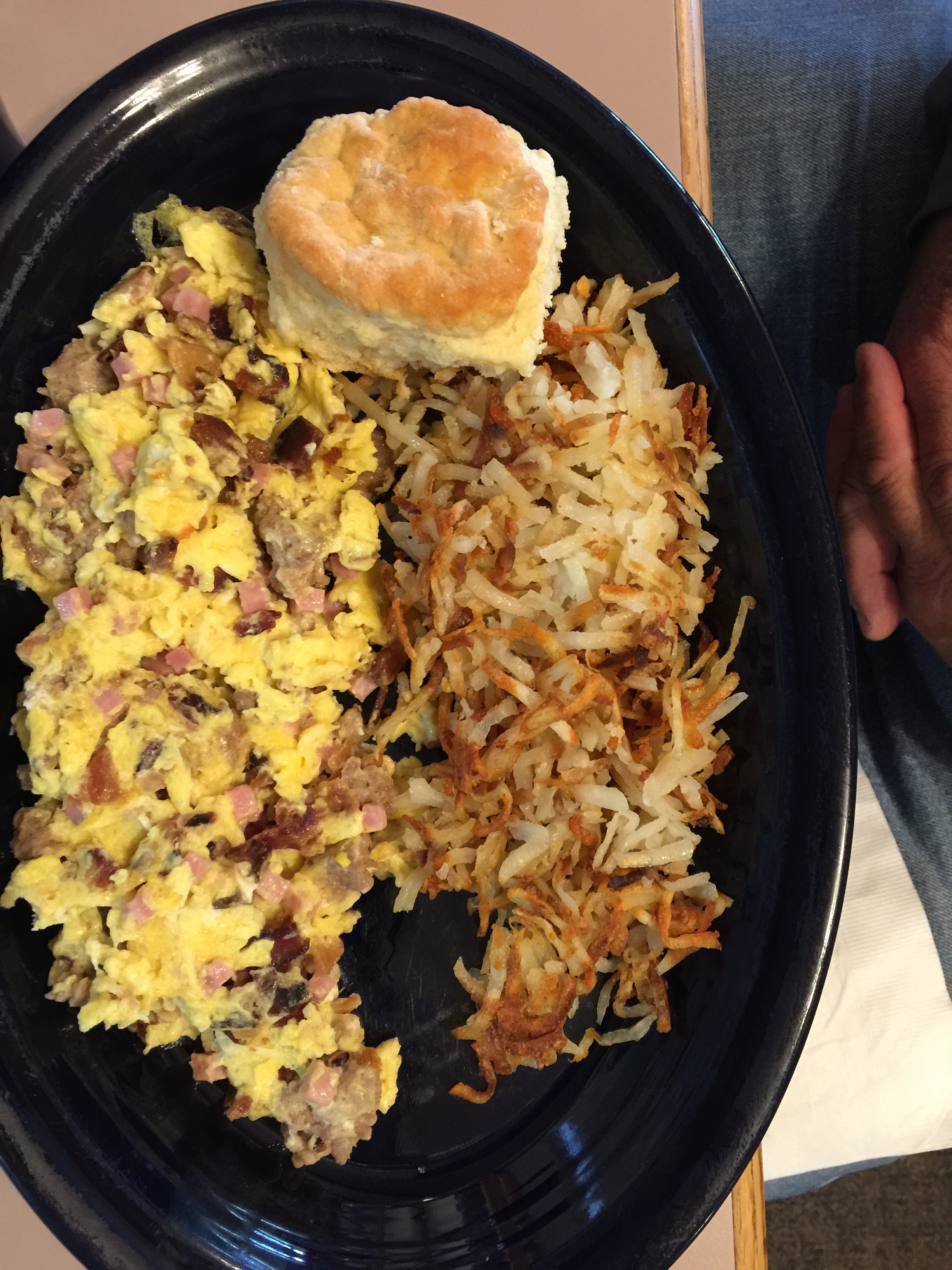
IMG_7605
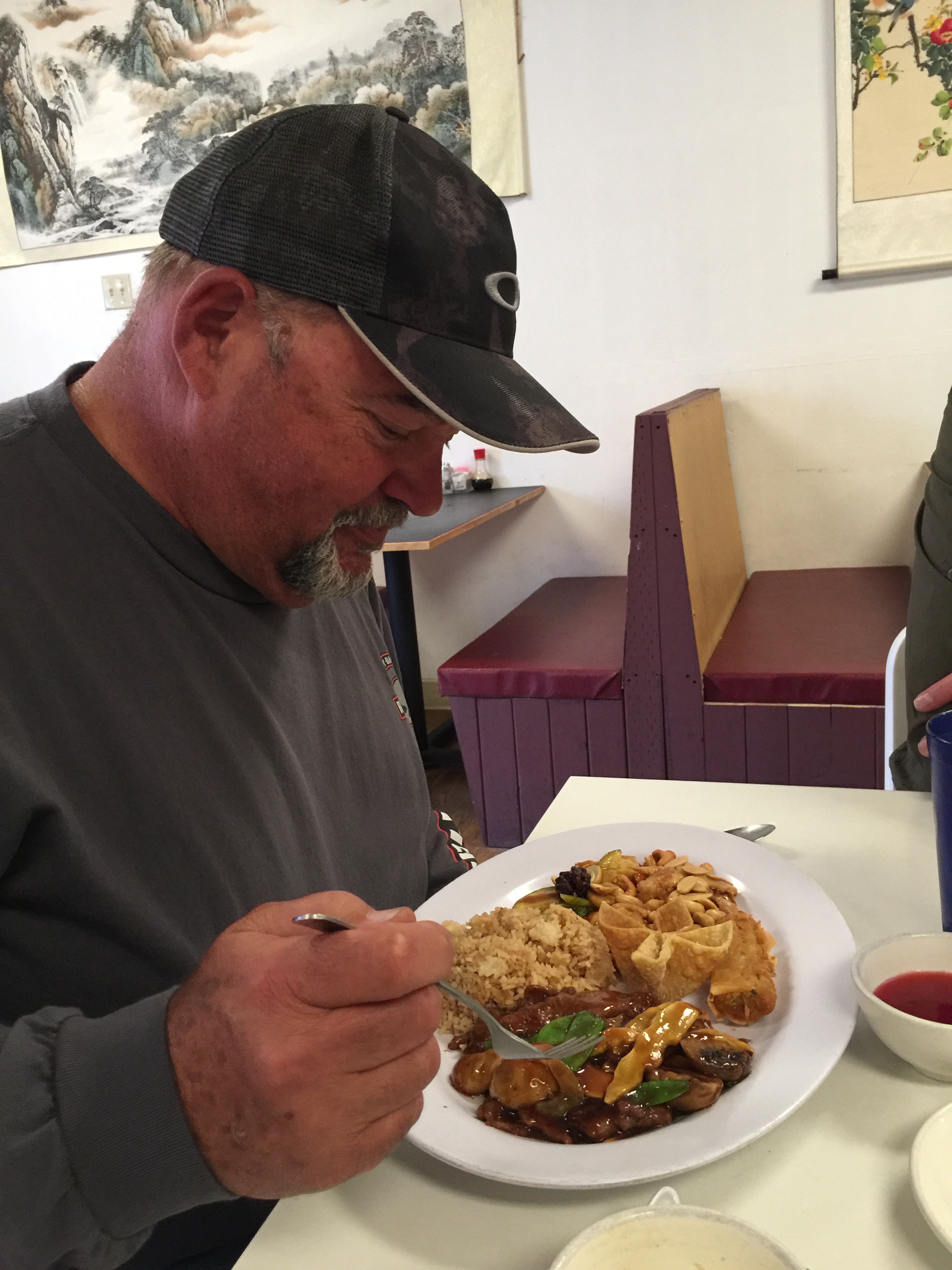
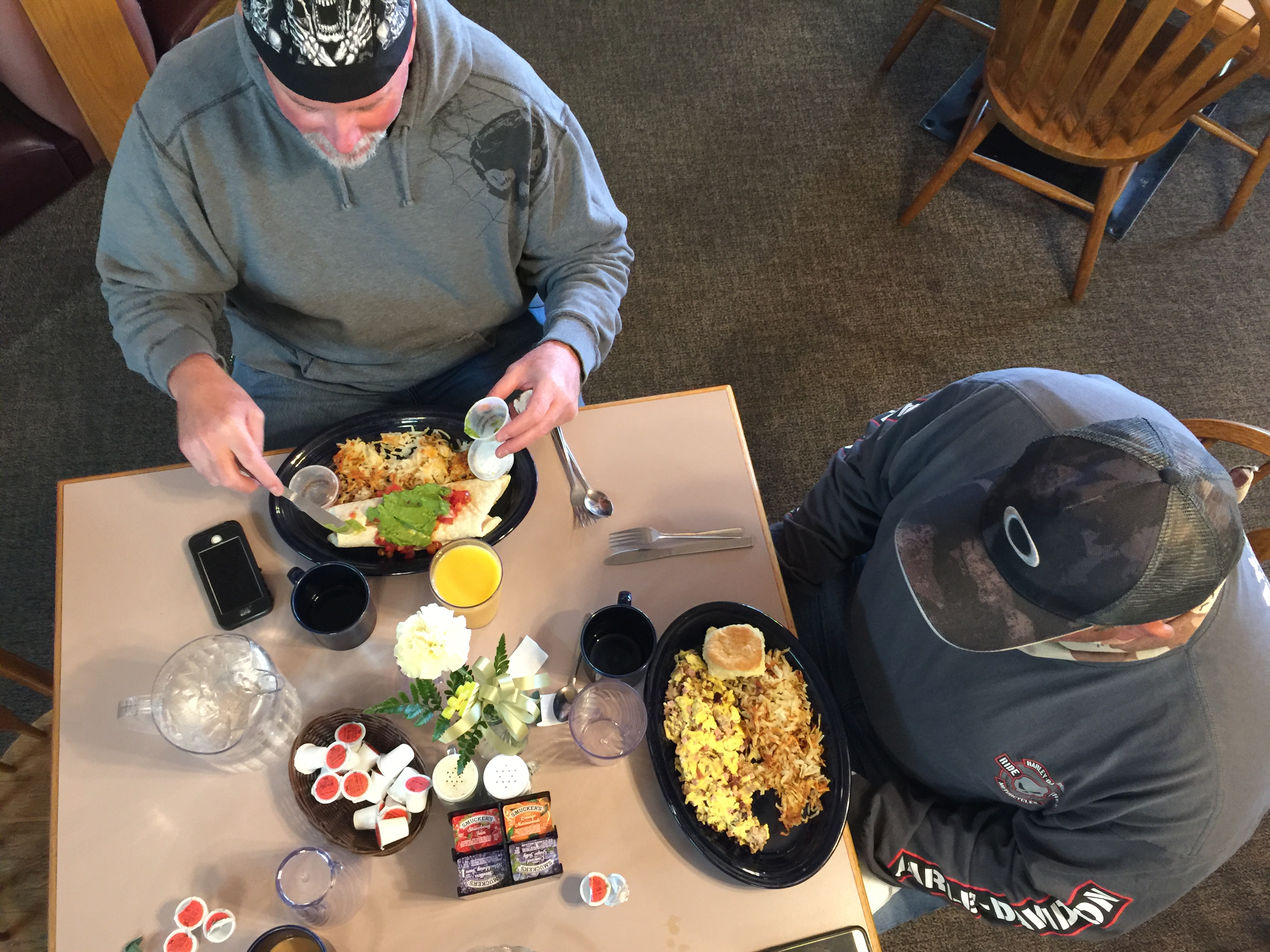
Breakfast in West Yellowstone. Guess who ordered (and ate) this?
IMG_7607
The third person at the table had this sorry looking breakfast. Guess who?
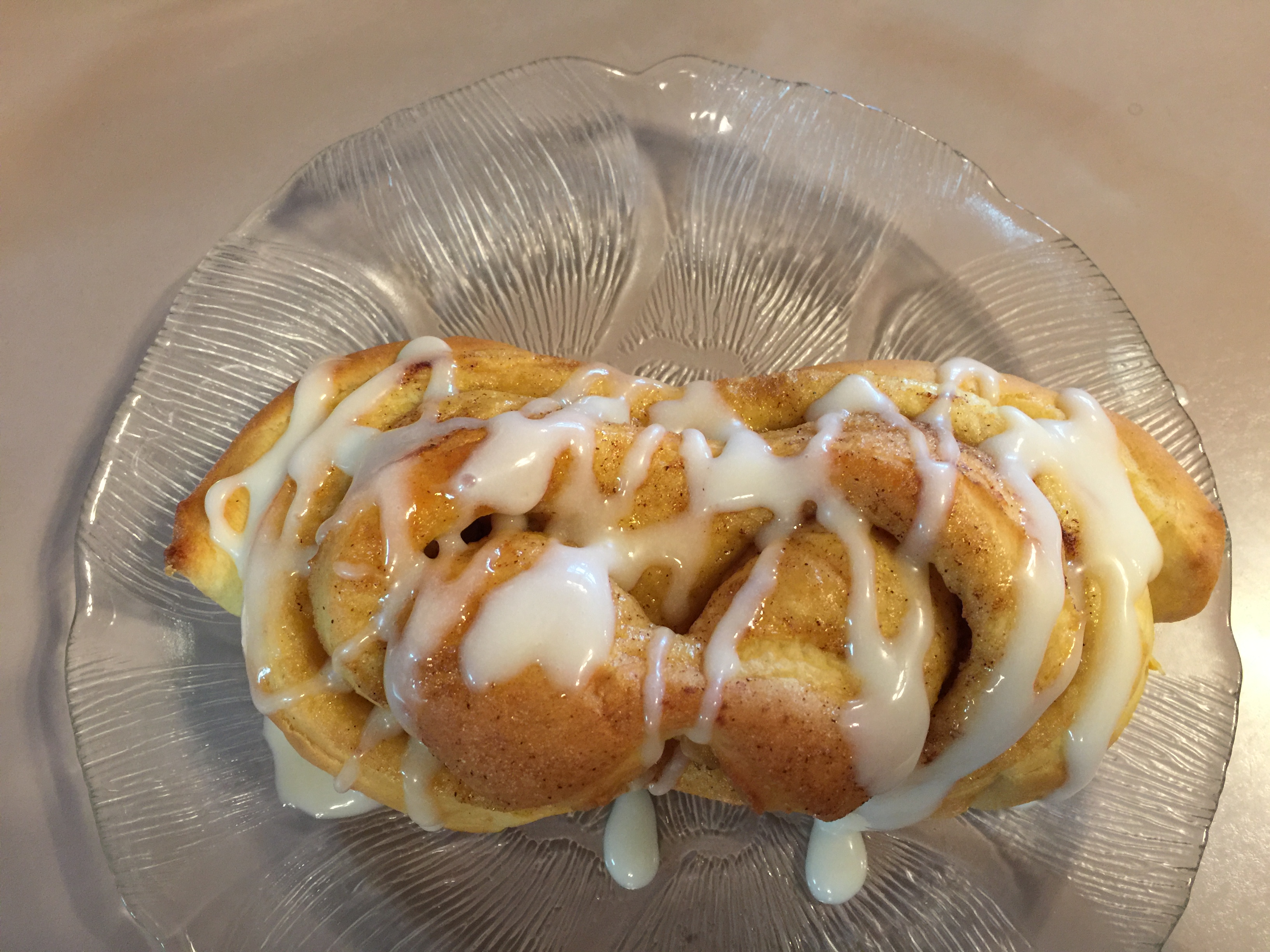
IMG_7608
Does this help answer your questions?

We leave West Yellowstone, just ahead of busloads of tourists doing the same thing we are today: visiting Old Faithful.

The west entrance to Yellowstone National Park is on the outskirts of town. Soon, Yellowstone Avenue transitions to US Highway 191, and we are in the park, riding east toward the Wyoming state line.

Within a mile, we cross into Wyoming. Ninety-six percent of Yellowstone National Park is in Wyoming. The rest is in Montana (three percent) and Idaho (one percent).

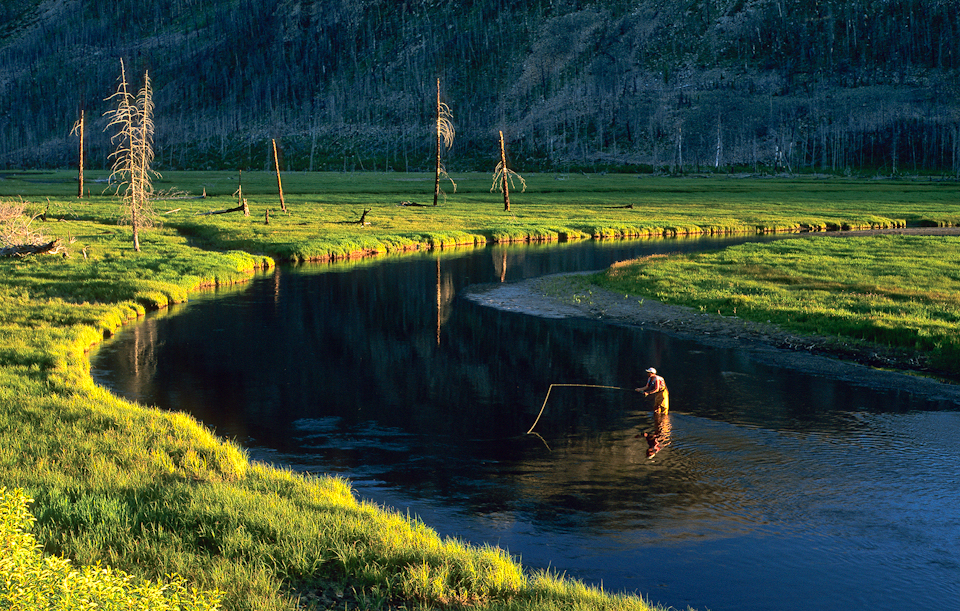
We cruse eastward along the banks of the Madison River. The river, which is a fly-fishing mecca, was named in 1805 by Meriwether Lewis of Lewis-and-Clark fame. He named the river after then-Secretary of State James Madison, who four years later succeeded Thomas Jefferson as President.
Madison River, YNP, gl-3-Edit
Fly fishing in the Madison River.

The Madison River has great fishing for rainbow and brown trout. Within Yellowstone National Park, the river is fly fishing only. All fishing in the park is catch-and-release. Fishing is a hugely popular activity within the park. More than 50,000 park fishing permits are issued annually. Yellowstone has hundreds of miles of fishable creeks, streams, rivers and lakes. The cutthroat trout is Wyoming’s state fish.

Soon we pass Mount Haynes, 8,218 feet up in the Gallatin Mountain Range. Mount Haynes is named in honor of Frank Haynes, the first official park photographer.

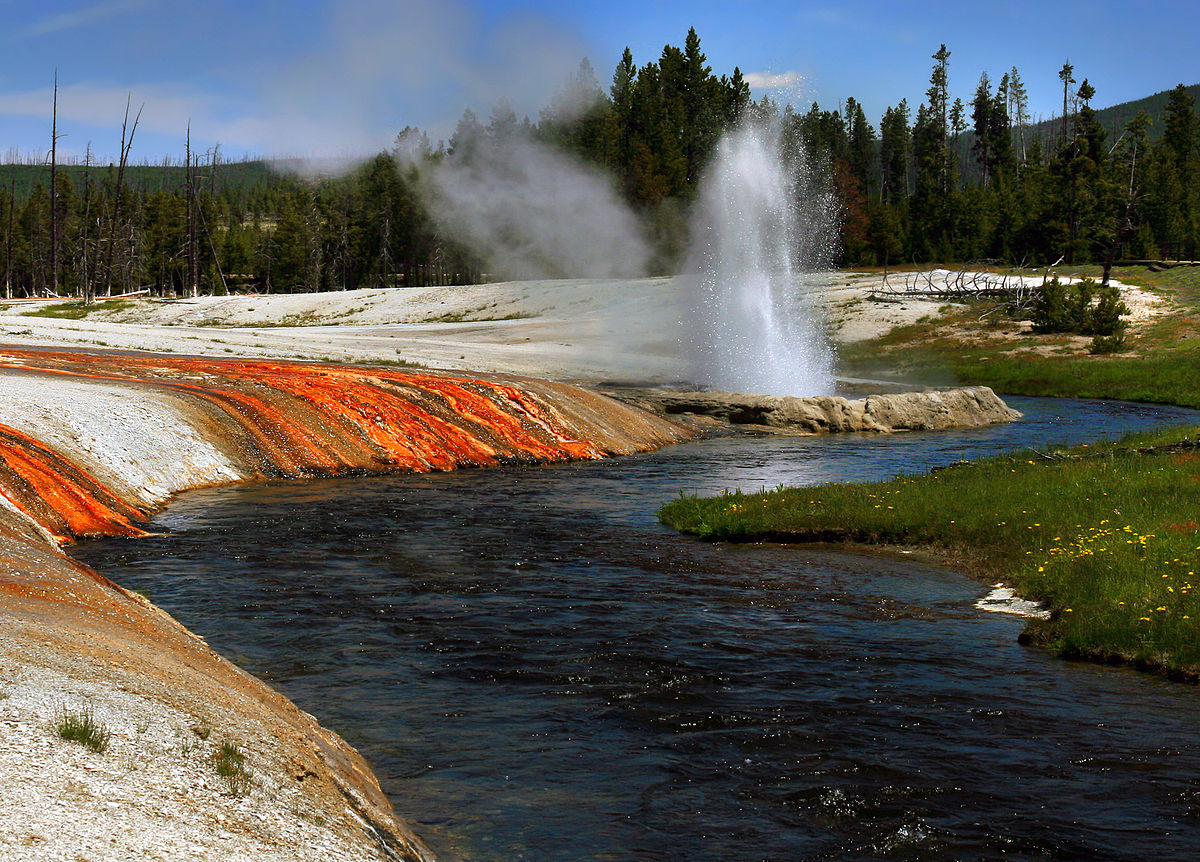
The next mountain of note is 7,549-foot National Park Mountain, at the confluence of the Madison River and the Firehole River. National Park Mountain is just west of Madison Junction, where we turn south and follow the Firehole River for the next 15 minutes. Temperatures in the river have been measured as high as 86 degrees F, with elevated levels of boron and arsenic. Despite the seemingly hostile environment, brown and rainbow trout live and spawn in the Firehole River.
1200px-Firehole_river_at_Upper_Geyser_Basin-2008-june
Firehole River: it’s smokin’ hot!

Early trappers named it the Firehole for the steam that makes it appear to be smoking, as if on fire. The steam, of course, is a result of the river flowing through several significant geyser basins in the park.
IMG_7609
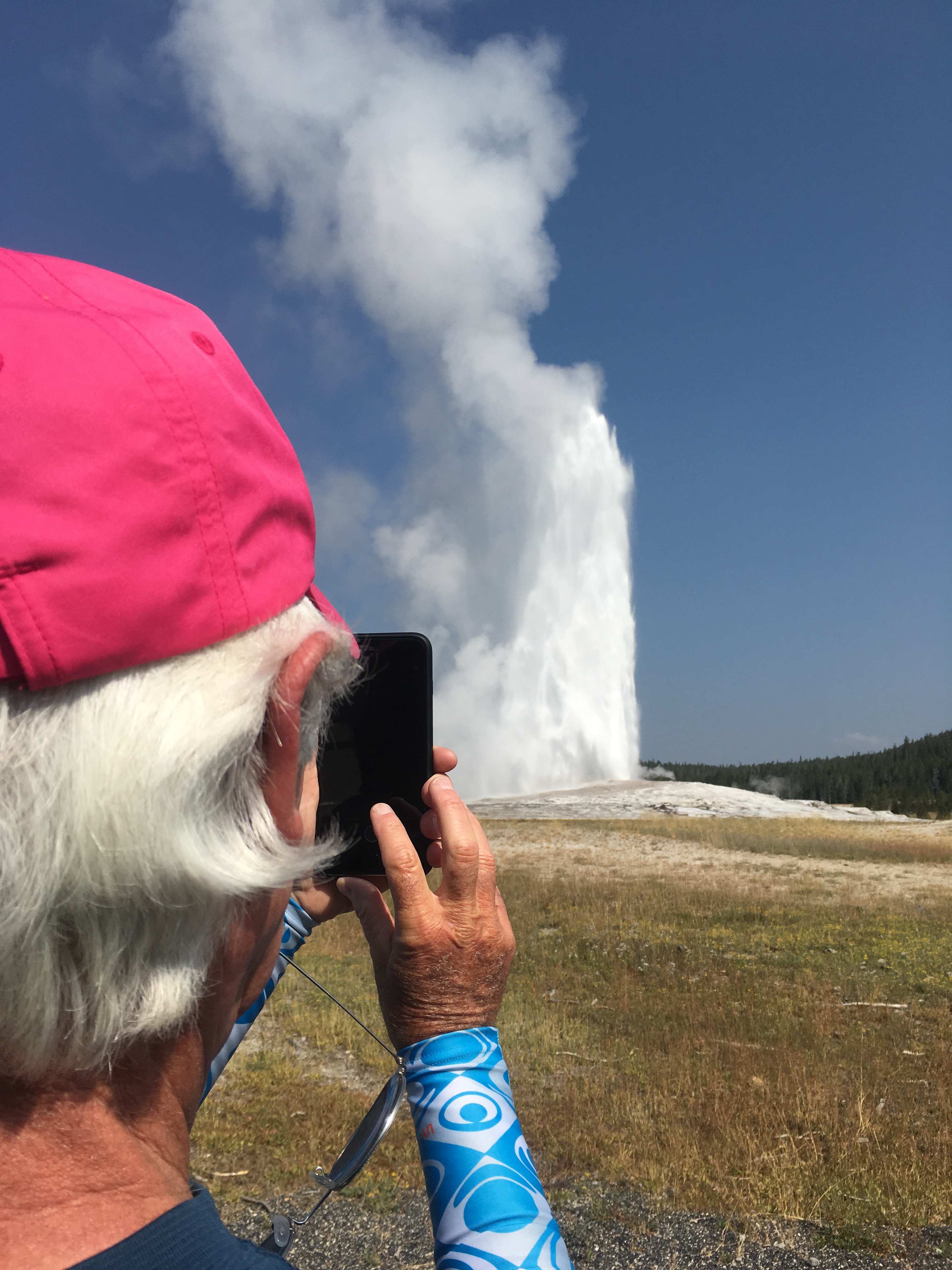
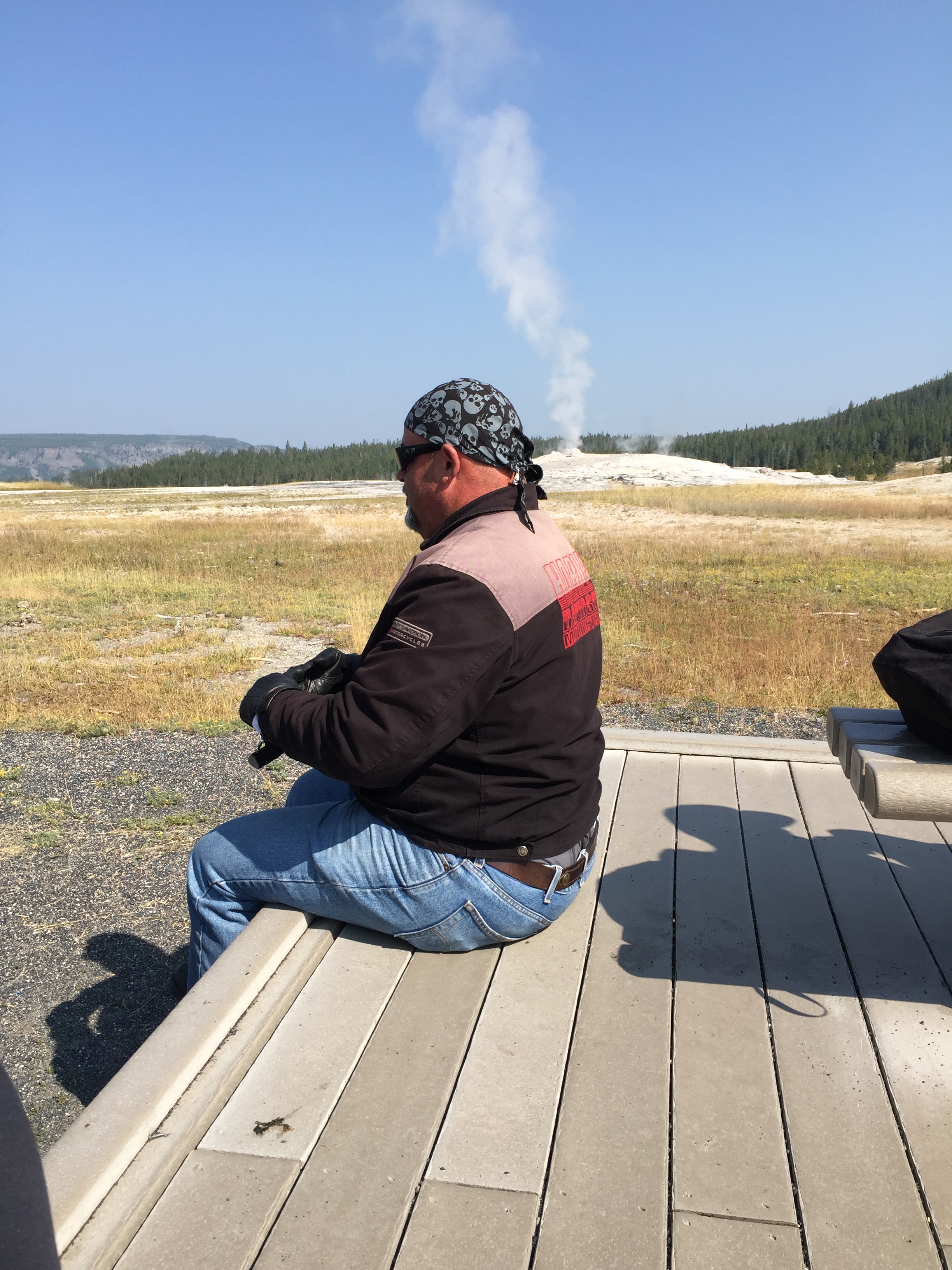
Scott waits patiently for Old Faithful to erupt.
IMG_7613
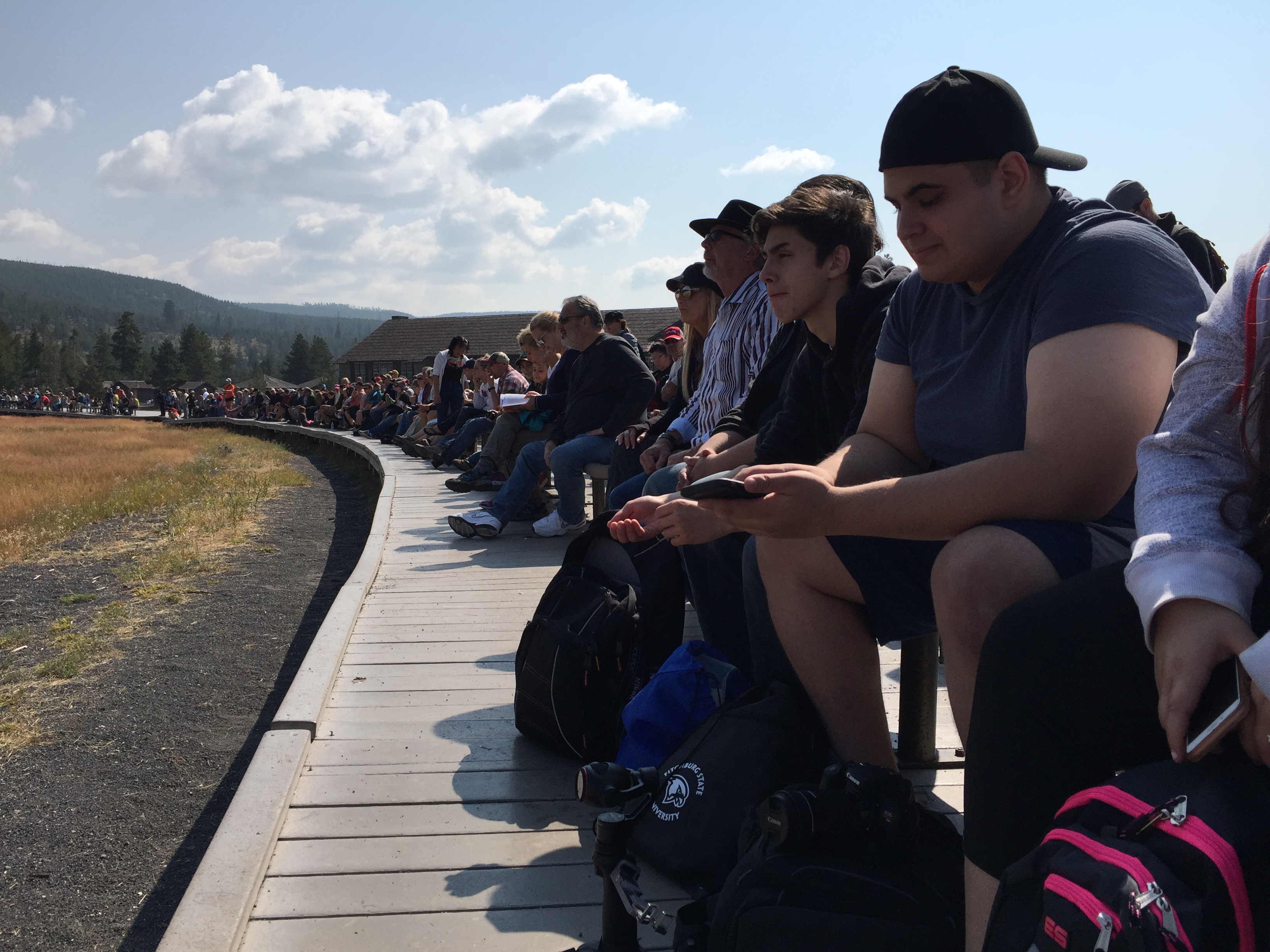
He’s not the only one waiting for the show to begin.

One of those geyser basins is the Upper Geyser Basin, which contains the world-famous Old Faithful – the first geyser in the park to receive a name. It’s faithful, for sure, erupting every 44 to 125 minutes, 365 days a year. The reliability of Old Faithful can be attributed to the fact that it’s not connected to any other thermal features of the Upper Geyser Basin.

Each eruption shoots up to 8,400 gallons of boiling water to a height of up to 185 feet. The eruptions generally last from a minute and a-half to five minutes.
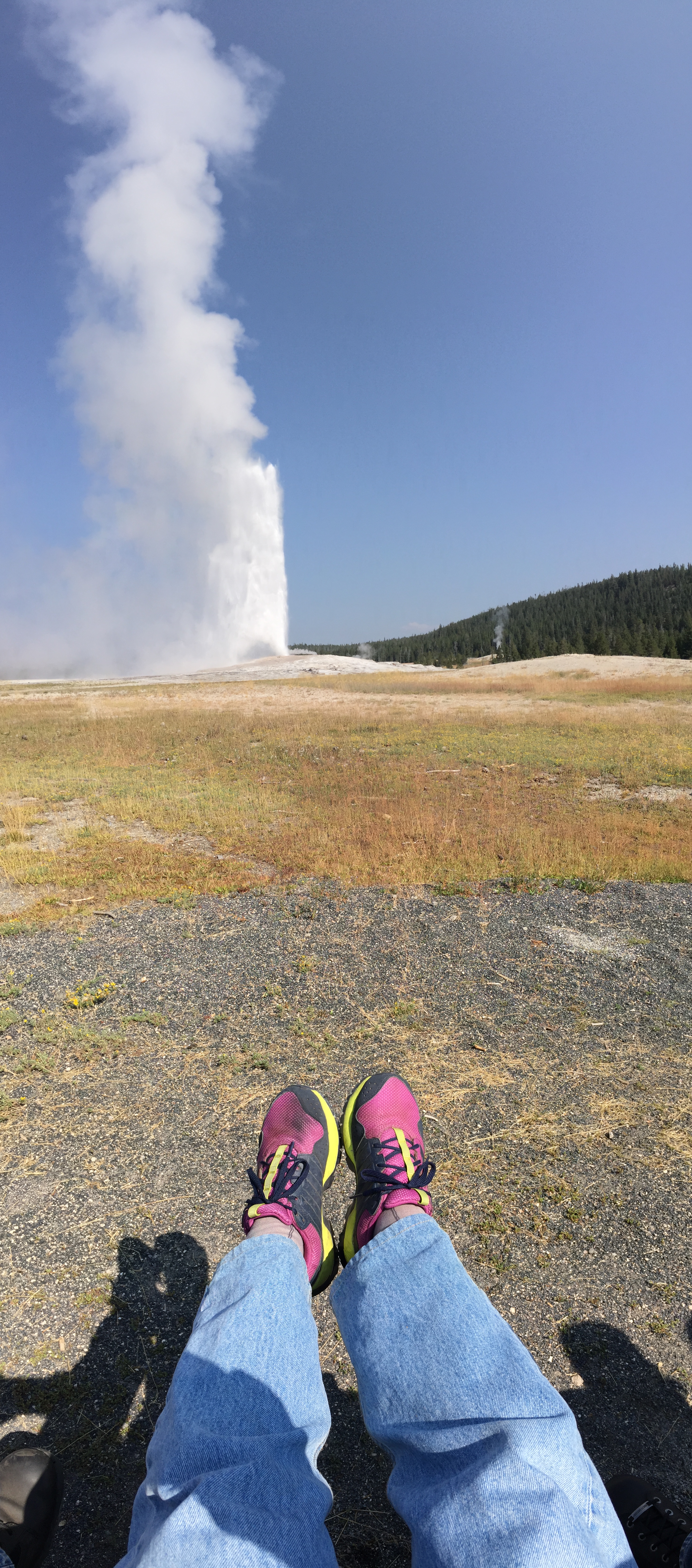
IMG_7618
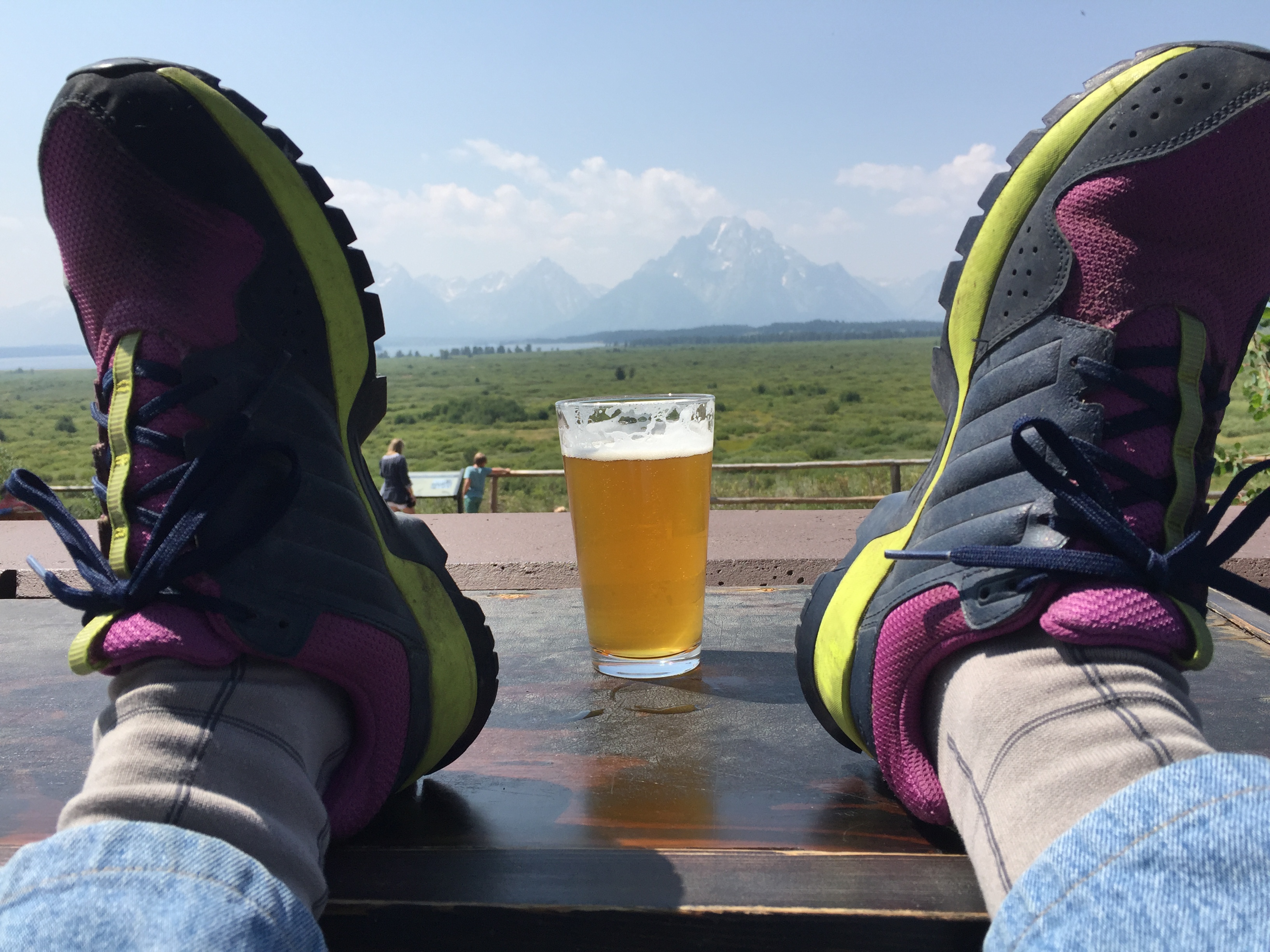
Finally, the eruption begins. Those are the author’s shoes at bottom.
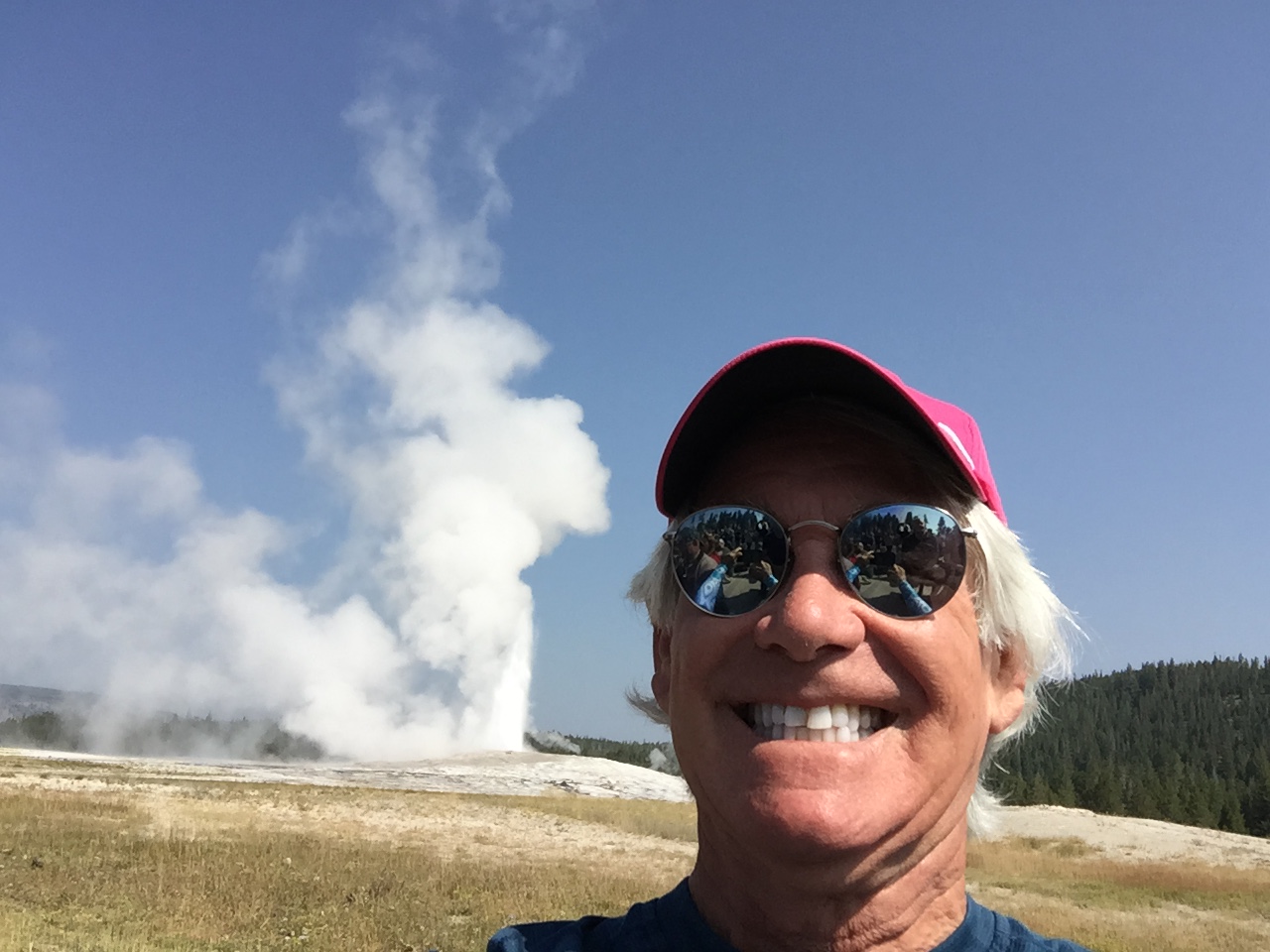
IMG_7619
Yours truly, as the eruption is underway.
IMG_0293
Ka-boom!

Before leaving West Yellowstone this morning, we checked a geyser timetable to reduce the chances of disappointment. We get to Old Faithful, and sure enough, it erupts, almost on cue.

Since you can’t be with us, the next best thing is to check the Old Faithful live webcam. You’re welcome.

People from all over the world come to Yellowstone to watch Old Faithful erupt. The park’s wildlife and scenery are well known today, but it was the unique thermal features that inspired Yellowstone to become the world’s first national park in 1872.

Old Faithful is one of nearly 500 geysers in Yellowstone – the greatest concentration of geysers in the world. Old Faithful is one of six geysers that park rangers can predict; its eruption pattern is so reliable that early developers built special viewing areas, lodging and concessions for visitors to watch eruptions.

Here, you can learn more about geysers at the Old Faithful Visitor Education Center, you can stay at the Old Faithful Inn, shop at the Old Faithful General Store, eat at the Old Faithful Lodge Cafeteria, or gas up at the Old Faithful Service Station.

***

We leave Old Faithful and continue east on Grand Loop Road, one of the park’s main thoroughfares. The road takes us over the Continental Divide, past Duck Lake, and to West Thumb, an arm of Yellowstone Lake. West Thumb is home to the West Thumb Geyser Basin, formed by a large volcanic explosion about 150,000 years ago.

The resulting collapsed volcano, called a caldera (“boiling pot” or cauldron), later filled with water, forming an extension of Yellowstone Lake. That extension is known as the West Thumb, which is about the same size as another famous volcanic caldera, Crater Lake in Oregon.

At West Thumb, the road turns south, and we soon pass Lewis Lake, named for Meriweather Lewis, commander of the Lewis and Clark Expedition. The Lewis River and the Snake River meet just north of the park’s South Entrance.
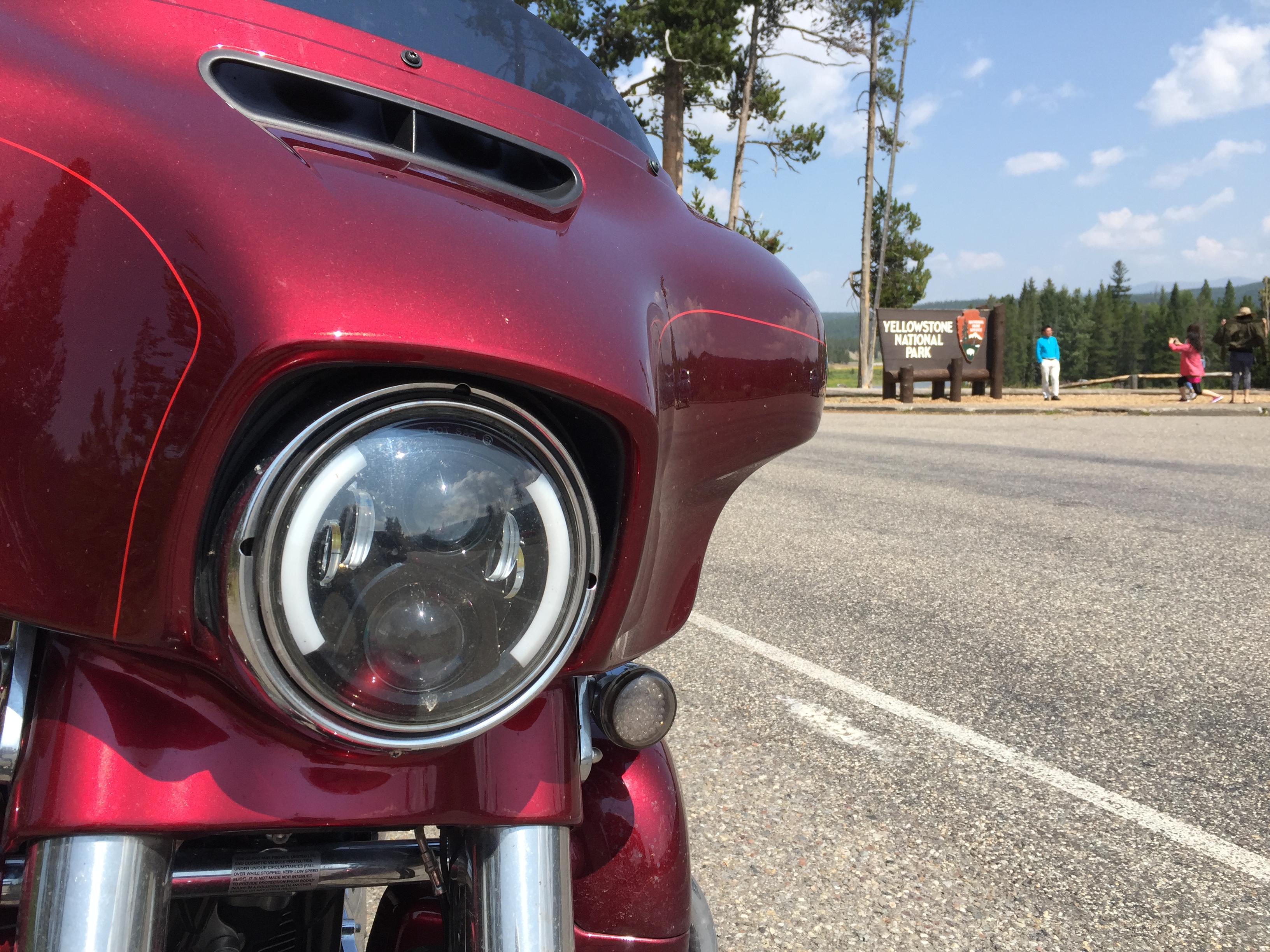
IMG_7634
At Yellowstone National Park’s South Entrance.
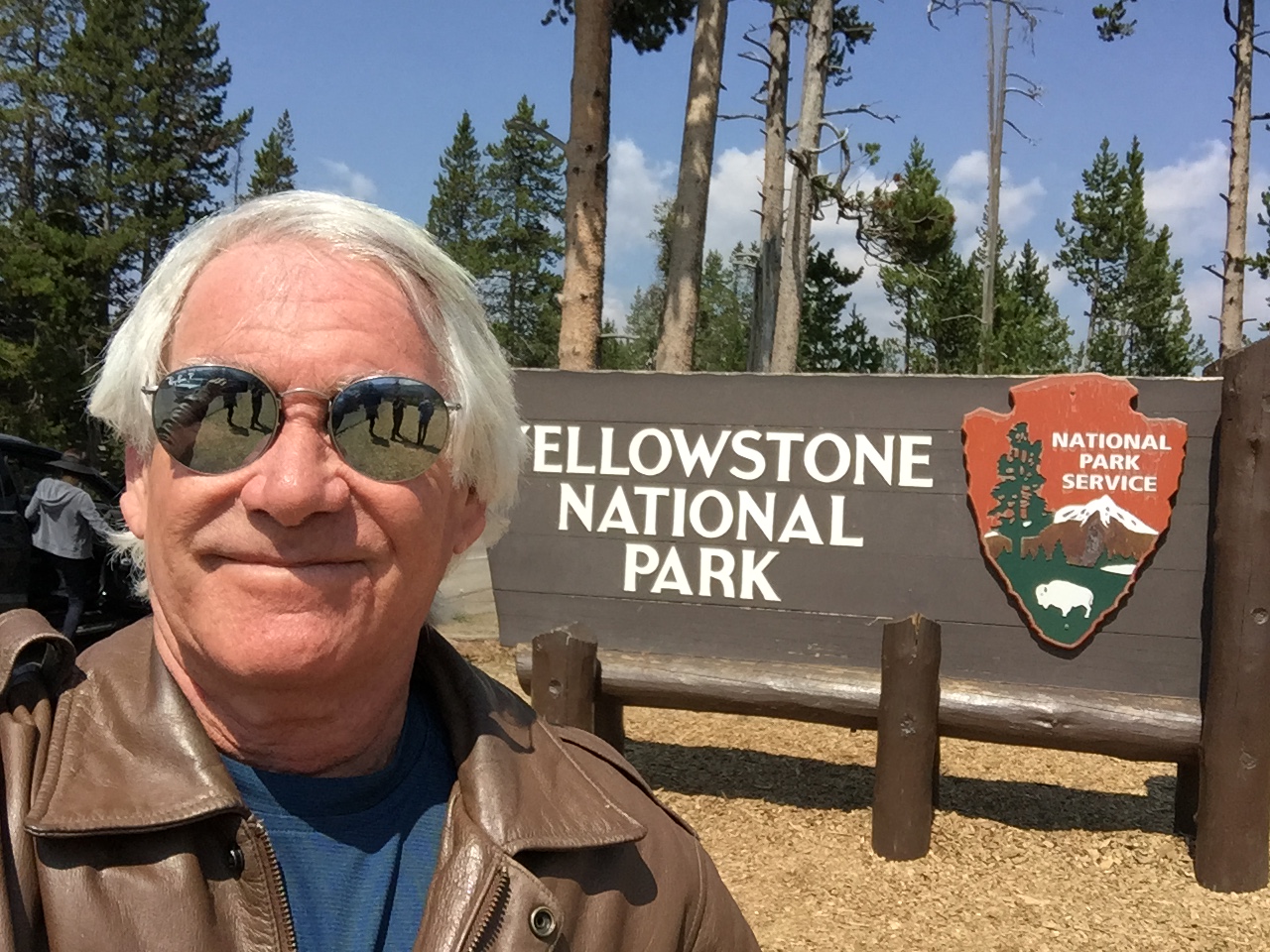
IMG_7631
Park entrance signs are popular photo spots.
IMG_7639
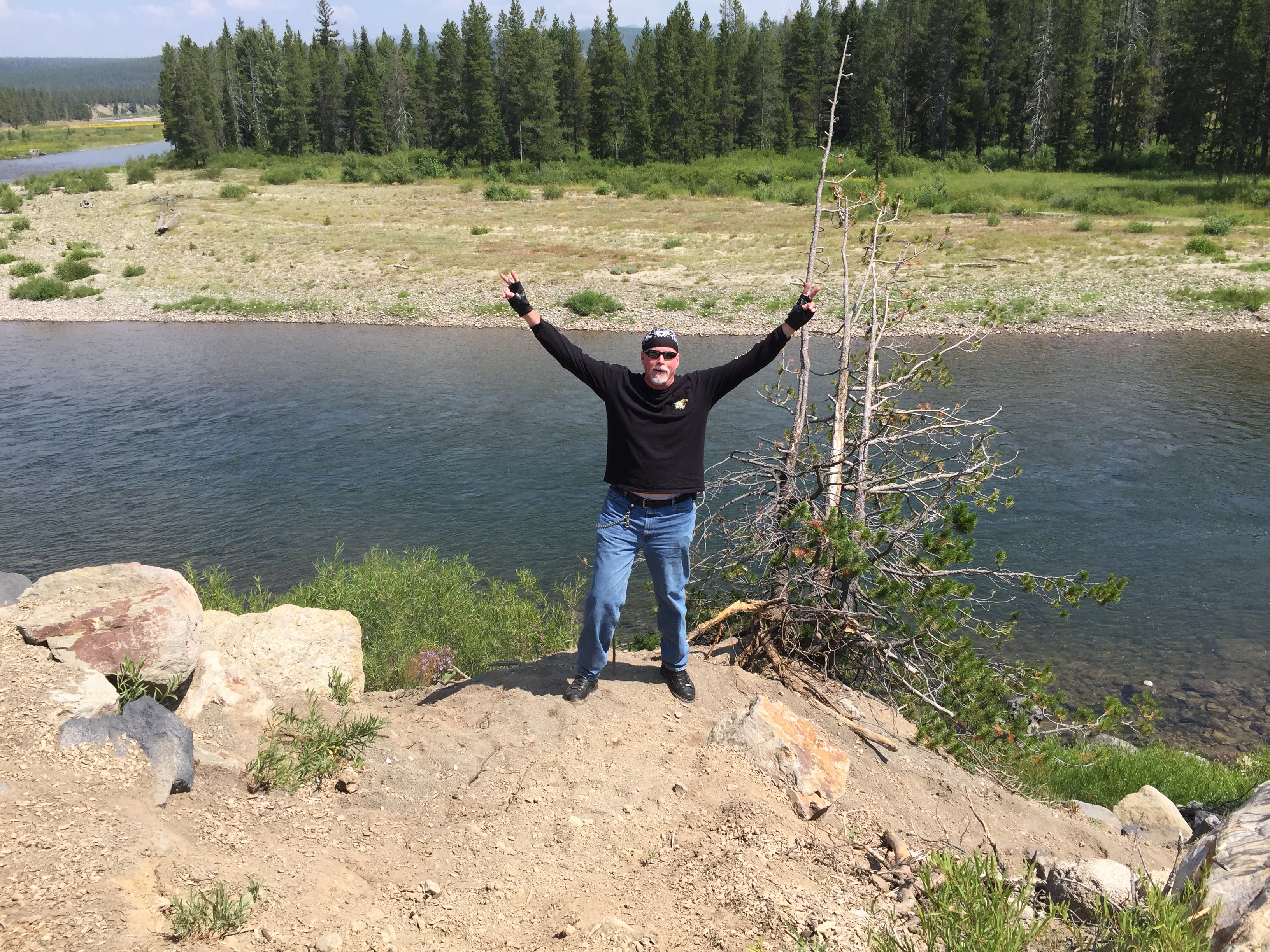
Dave poses by the park entrance along the Snake River.

We leave Yellowstone National Park and follow the Snake River, soon crossing it as we head toward yet another National Park – Grand Teton.

The scenic road that connects Yellowstone to Grand Teton National Park is called John D. Rockefeller Memorial Parkway.
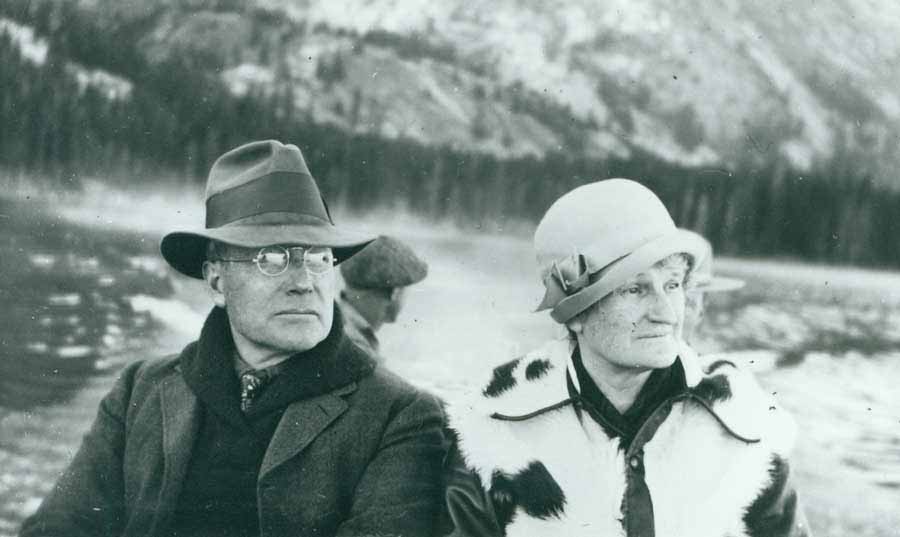
rockefellers
John D. Rockefeller and his wife, Abbey, on a boat in Jenny Lake in Grand Teton National Park — in 1931.

The 24,000-acre Rockefeller Memorial parkway was originally part of Teton National Forest, but was transferred to the National Park Service in the 1970s to create an unbroken connection between the two national parks.

Rockefeller was a conservationist and fabulously wealthy philanthropist who was instrumental in the creation and enlargement of a number of national parks, including Grand Teton. By the time Rockefeller died in 1937, his assets equaled 1.5 percent of America’s total economic output. To control an equivalent share today would require a net worth of more than $350 billion. He’s considered the wealthiest person in modern history. Rockefeller founded Standard Oil, which at its peak, had about 90 percent of the market for refined oil (kerosene) in the US. You gotta love a monopoly!

I’ll say this for Rockefeller: despite his great wealth, or perhaps because of it, he helped make the world a better place through his philanthropy – including purchasing and donating thousands of acres of land to the US National Parks system. Rockefeller serves as a shining example that becoming astonishingly rich doesn’t automatically make you a flaming a_ _ hole.

***
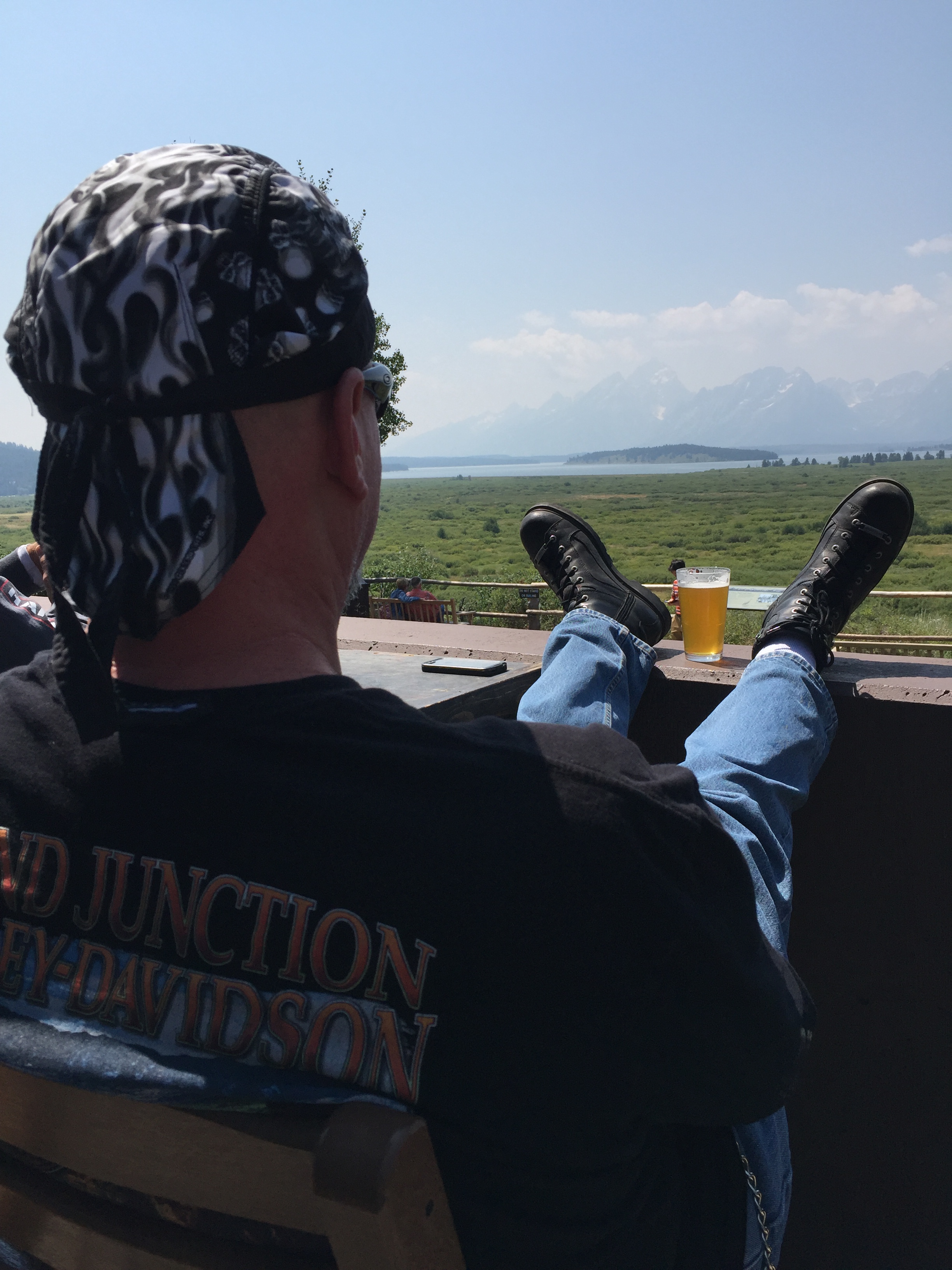
IMG_7644
We take a break at the beautiful Jackson Lake Lodge, an awesome view of the Tetons in the distance.
IMG_7647
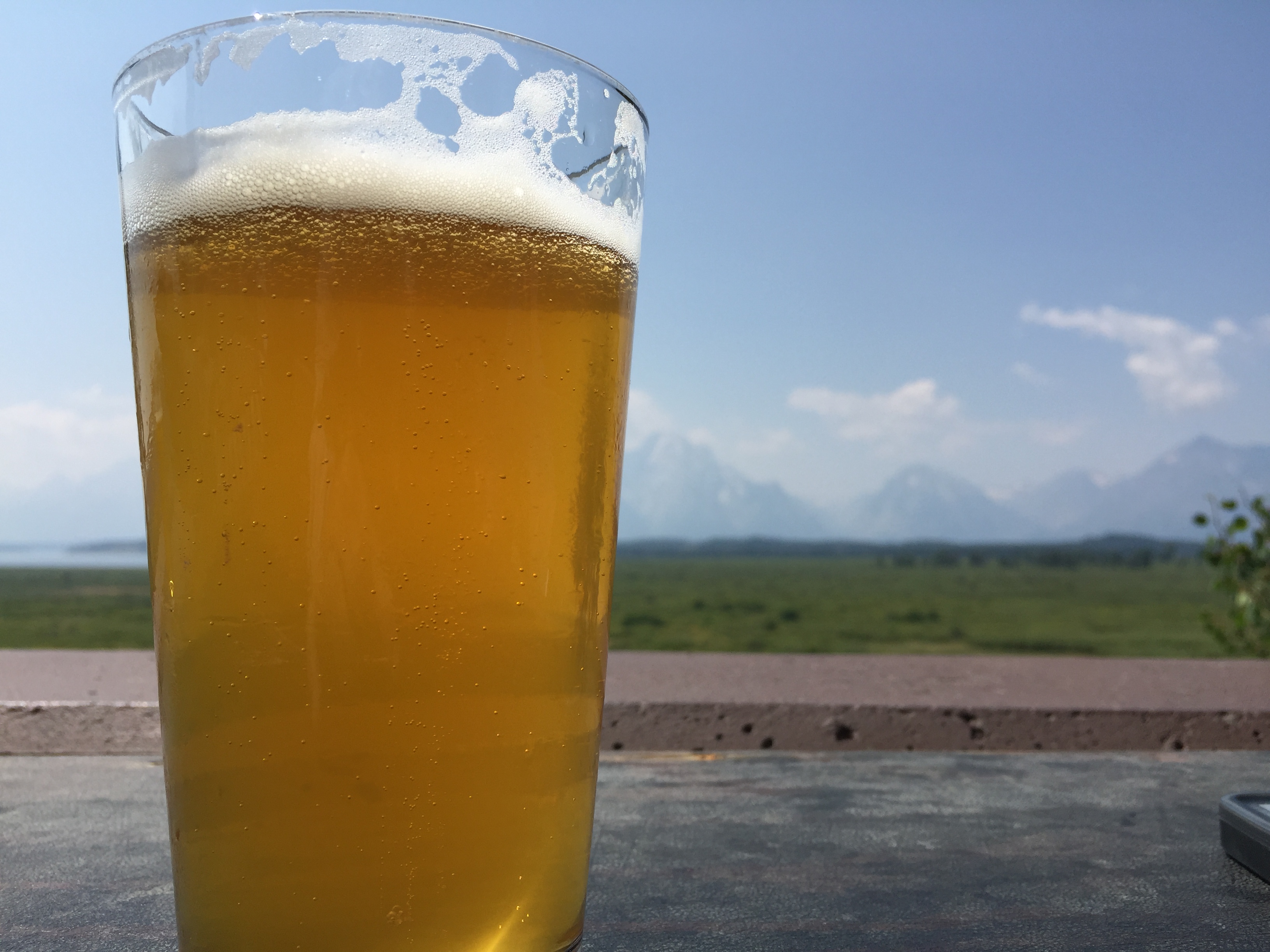
My beverage had a nice view, too.
IMG_7646
Even the beer had a nice view.

It’s not long before we find ourselves riding along the eastern shore of Jackson Lake, at 6,772 feet, one of the largest high-altitude lakes in the US. The lake is named after the Jackson Five, early mountain pioneers who later in life perfected their Motown sound. That’s a much better story than the truth, which is that it was named after David Edward “Davey” Jackson, a beaver trapper in the area in the late 1820s.

Seems everything around here is named after Davey – including the towns of Jackson and Jackson Hole, and Jackson Lake Lodge, which we pass, then turn east on Teton Park Road to take the extraordinarily scenic route to Jackson Hole.

Near the unincorporated town of Moose, we turn onto Moose Wilson Road, another breathtaking detour, and continue toward Jackson Hole. The road is lined with chokecherry and hawthorn bushes.
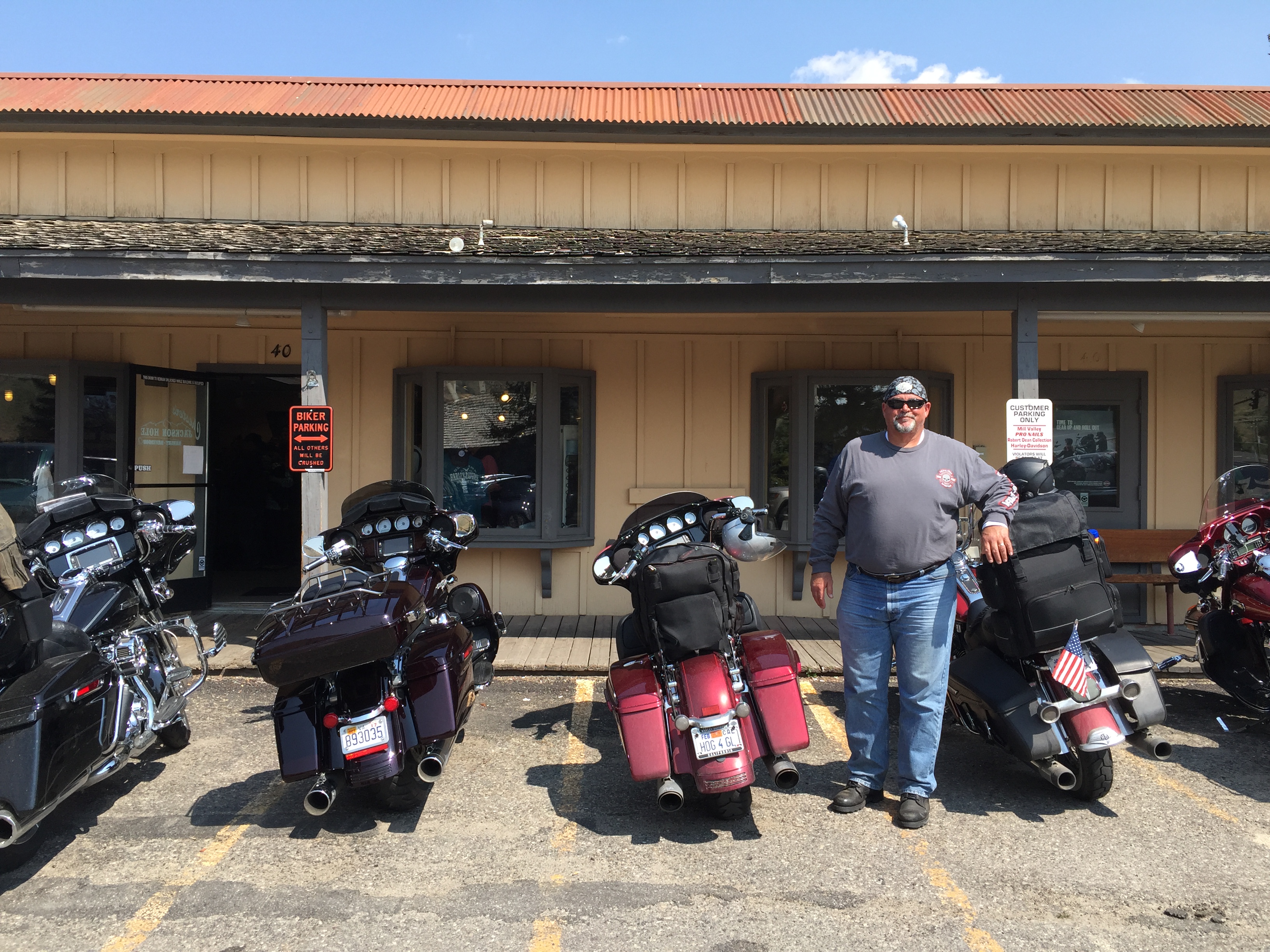
IMG_7648
Scott, in front of the Harley store in Jackson.

Just outside of the town of Jackson Hole, we arrive at Teton Village, home to the Jackson Hole Mountain Resort.

Jackson Hole, with a peak elevation of 10,450 feet, is known for its steep terrain and a vertical drop of 4,139 feet. With the Teton Range’s uniquely shaped peaks, it’s a spectacular setting for a ski area.
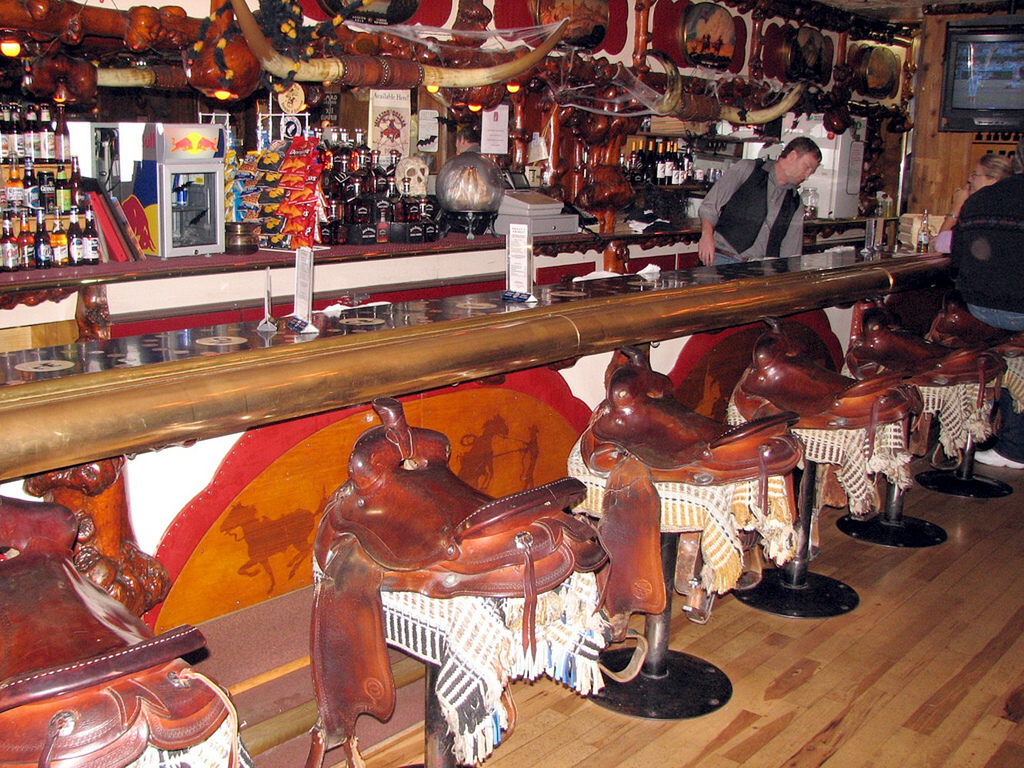
6842686629_1bd0766de4_b
The Million Dollar Cowboy Bar in Jackson, Wyoming. Saddle up!

If you’ve ever been to Jackson Hole, you probably stopped at the Million Dollar Cowboy Bar, which has been around for more than 125 years. Over the years, its stage has hosted – among others – Waylon Jennings, Glen Campbell, Tanya Tucker and Willie Nelson. The Million Dollar Cowboy Bar’s saddle barstools have been a signature item since 1973, the year I first visited the place. It’s a good place to grab a cold one on a hot day.

From Jackson Hole, it’s 70 miles to today’s destination: Afton, Wyoming.

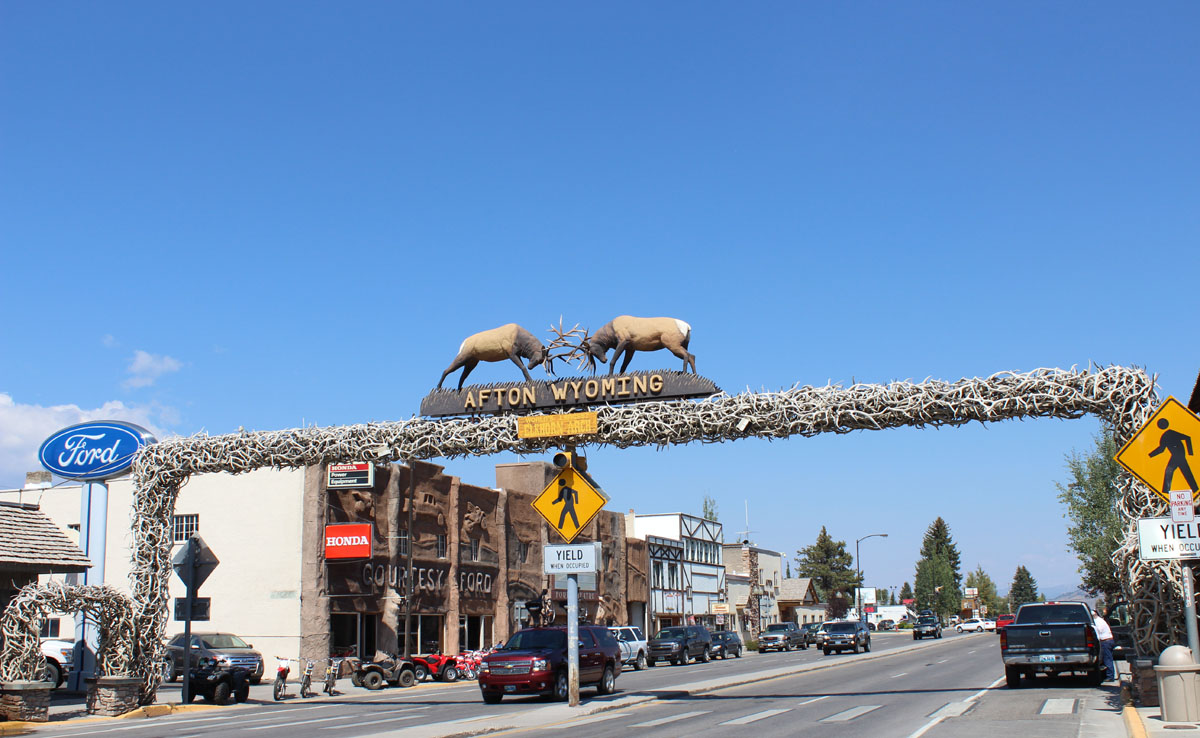
We follow the Snake River south to Alpine Junction, and continue until we see the world’s largest arch made of elk antlers. The arch is made up of 3,011 elk antlers, spanning 75 feet across Afton’s Main Street.
afton-wy-antler-arch
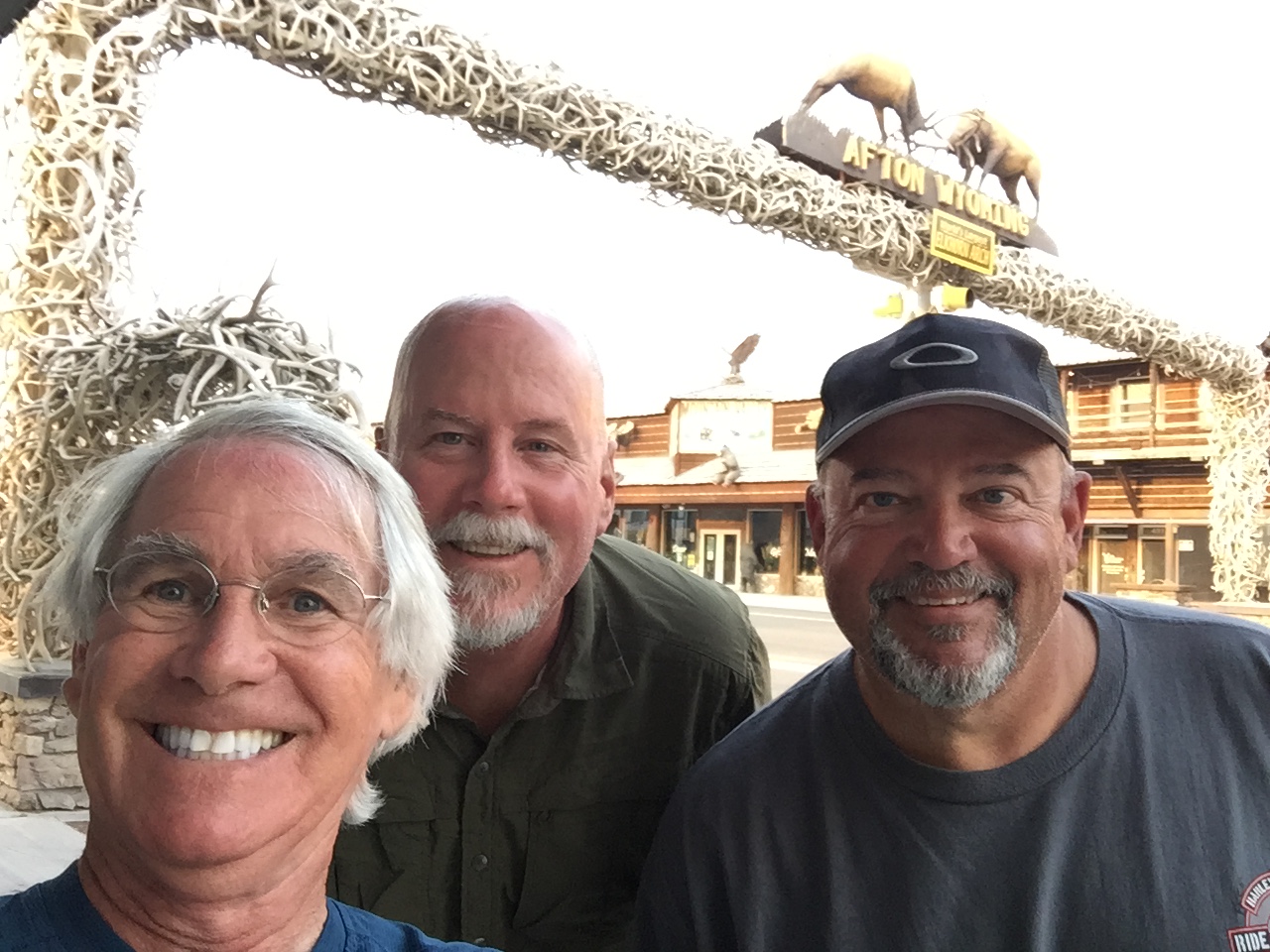
Fifteen tons of elk antlers. Woo-hoo!
IMG_7654
Elk antlers everywhere.

Good place to call it a day. How can you possibly improve on 15 tons of antlers?

***

Day Fourteen Summary: Two National Parks in one day, the predictability of Old Faithful, using your wealth to do good for the neighborhood.

Click here to see today’s complete route from West Yellowstone to Afton.

We’re on our way home.

Vroom, vroom.
IMG_7652
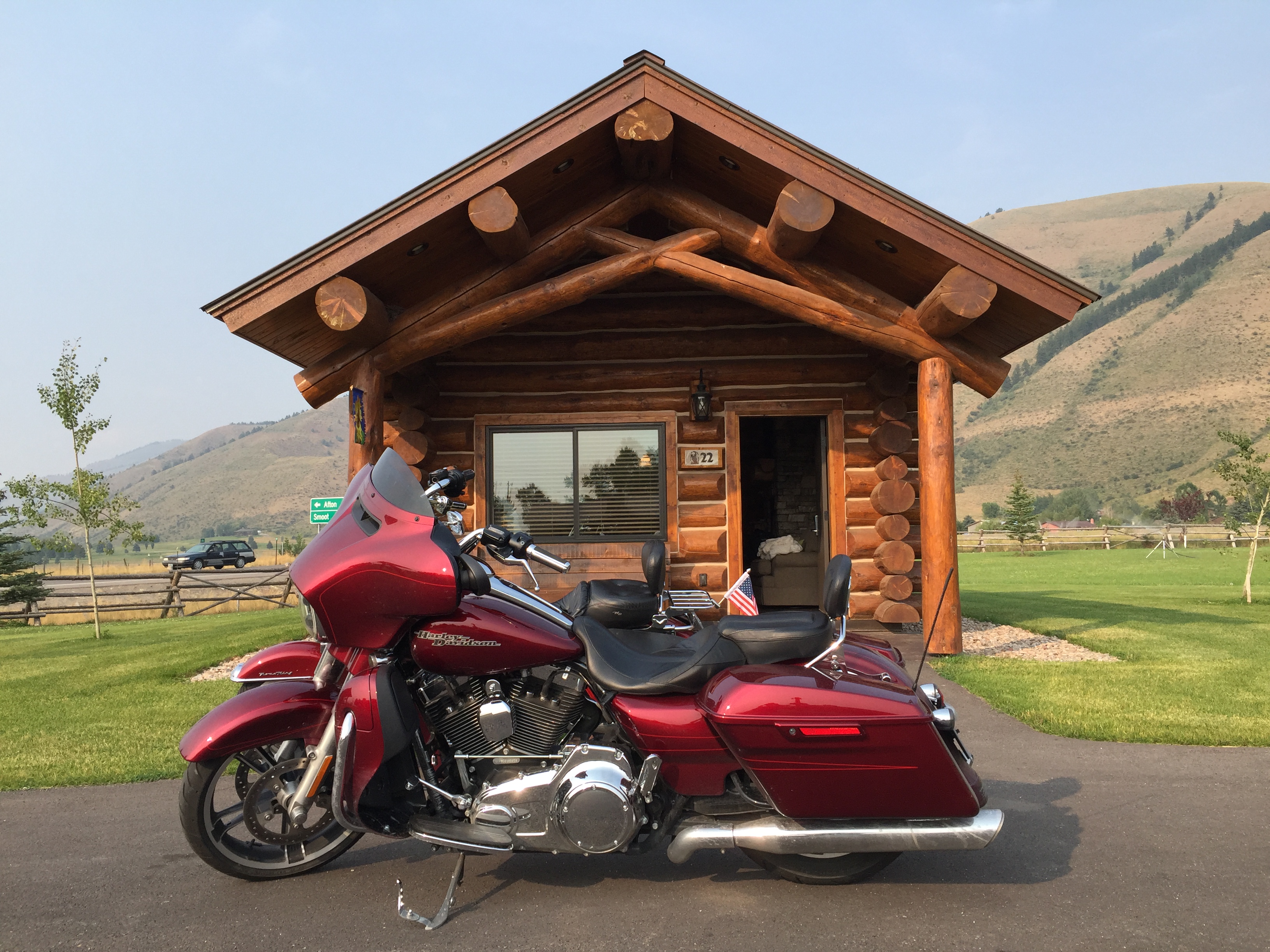
We stayed at the Kodak Mountain Resort, Cabins 22 and 23, in Afton. Awesome accommodations … best kept lodging secret ever.
IMG_7656
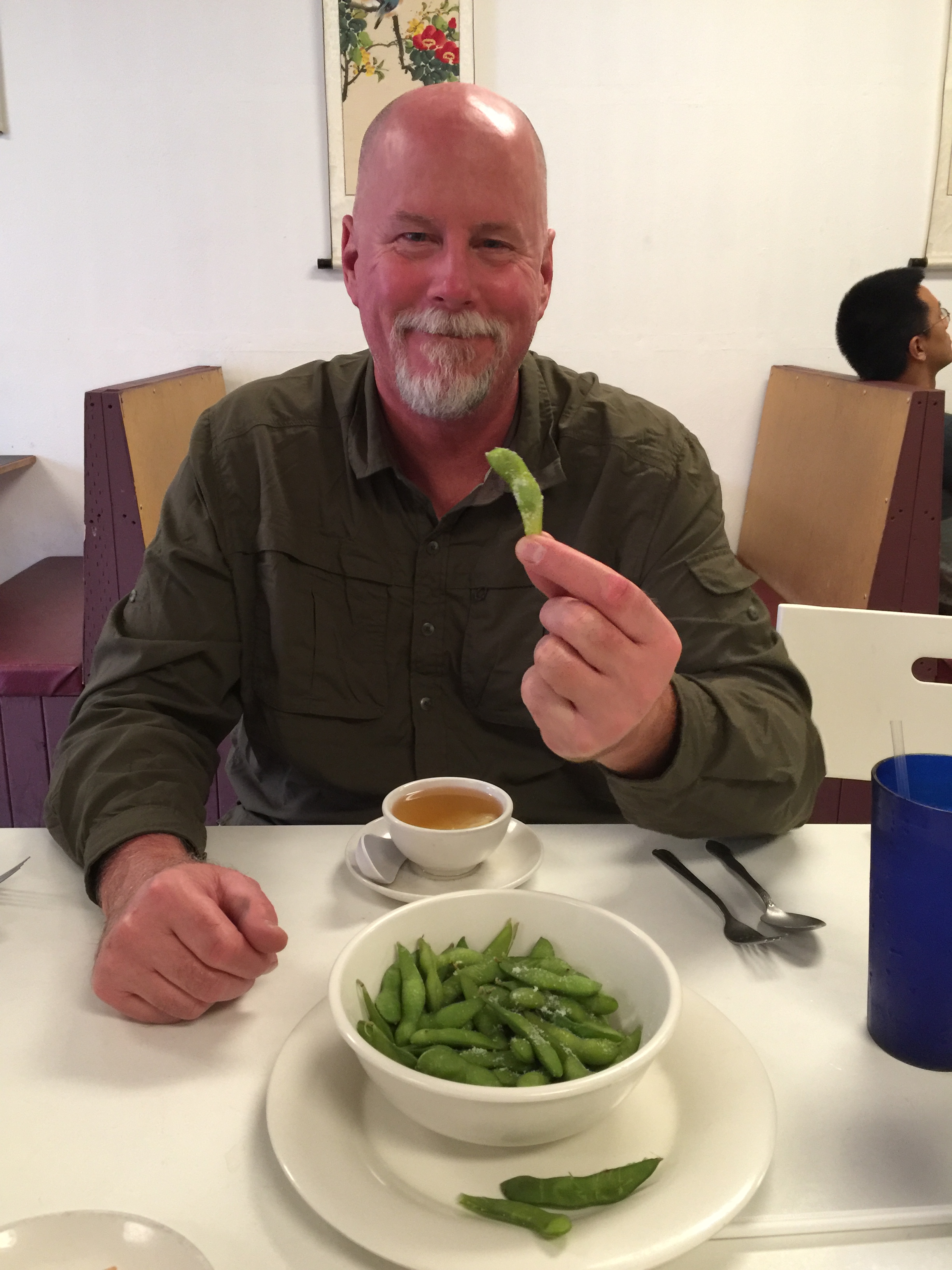
Chinese food tonight in Afton. Here, Dave eats healthy with a bowl of edamame.
IMG_7657
Scott had the dinner special. Also a healthy treat.

***

Today in Bucket List History:

Bucket List Goal: “Rename Your Company So Nobody Knows Who You Are or What You Do.”

Goal Achieved: On August 10, 2015, Google restructures itself, placing its search business and its research ventures into a holding company called “Alphabet.” Want to learn more about that? Just Google it.

ct-google-new-logo-alphabet-20150901
With all due respect, what the Hell is Alphabet?

What’s on your bucket list?

***

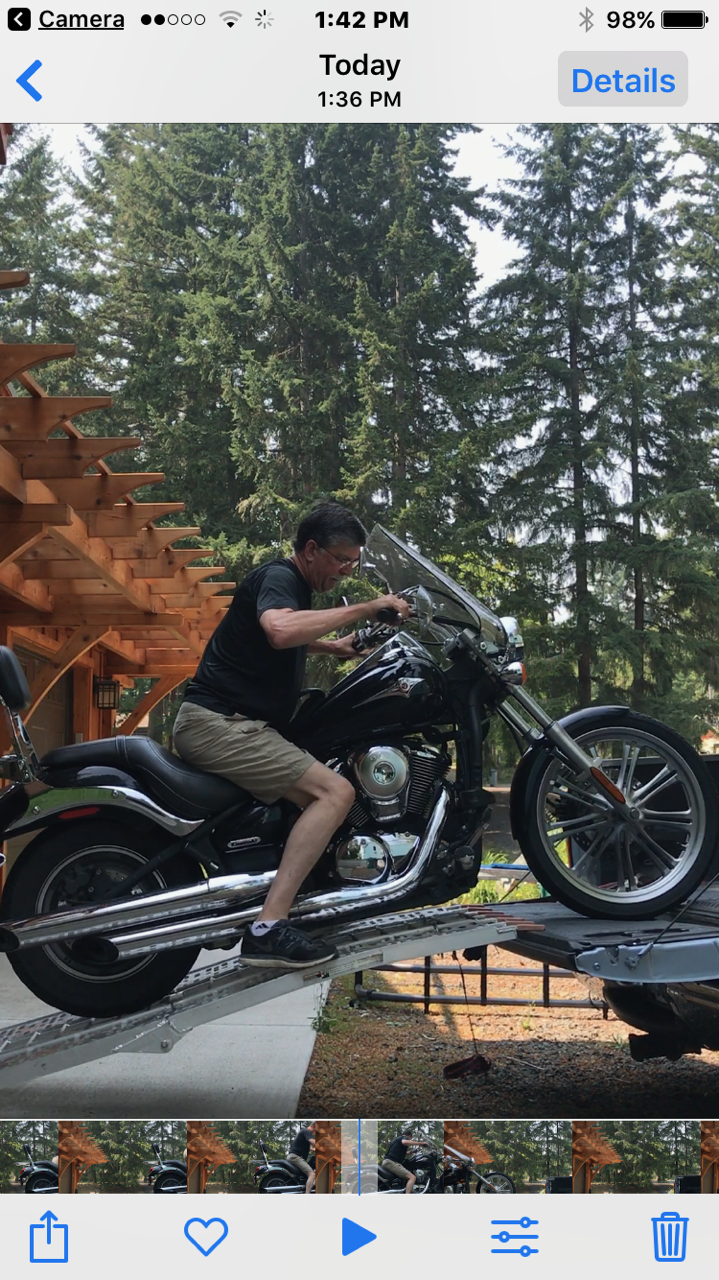
As a postscript, Randy and his Kawasaki arrived at the bike’s parking spot in Poulsbo. Here in the photo below, he unloads it from his F-150. Don’t try this at home.

IMG_7658
Clearly a feat of derring. (photo by Jo)

Meadowlark Lemon, Buffalo Bill and Yellowstone

IMG_7601
Photo of the day. Guess where?

Still trying to figure out why Buffalo is called Buffalo.

So we leave, full of breakfast and confusion, and head west on US Highway 16, through Bighorn National Forest, riding the Cloud Peak Skyway.

We roll past beautiful Meadowlark Lake – population 8 and elevation 8,199. The lake is named for former Harlem Globetrotter Meadowlark Lemon, who’s in the Naismith Memorial Basketball Hall of Fame.

Half of that preceding sentence is true – the HOF part. Wyoming’s state bird is the Western Meadowlark. Seriously. Somewhere it is written that all states must have a city or town named after their state bird.

IMG_7566
Scott and Dave relax in Ten Sleep, after a spectacular ride over the Cloud Peak Skyway between Buffalo and Ten Sleep.

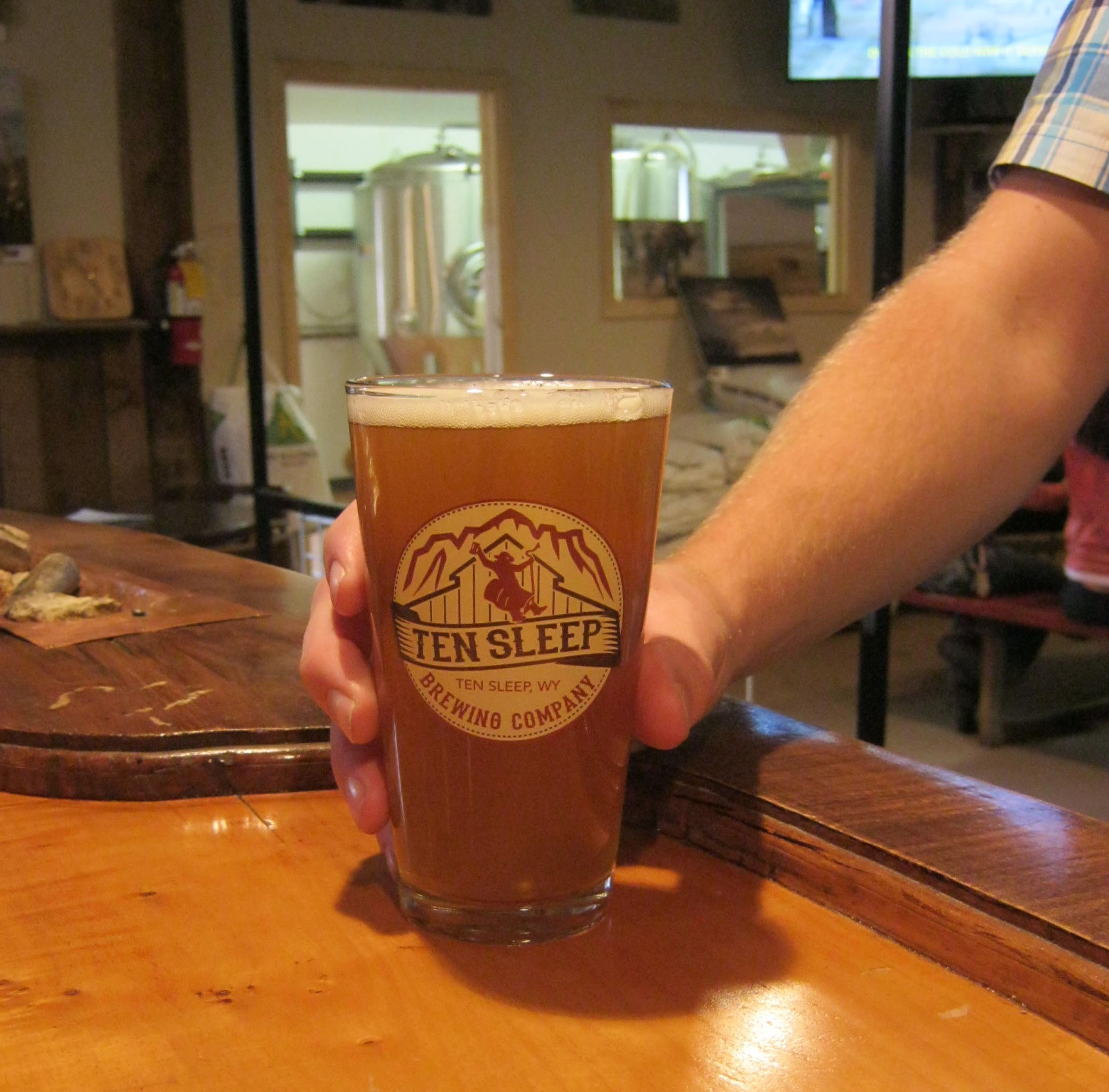
As we descend out of the mountains, we arrive in the town of Ten Sleep, population 260. We’ve ridden about 60 miles since leaving Buffalo. Ten Sleep was an American Indian rest stop that got its name because it was ten days travel, or “Ten Sleeps,” from Fort Laramie, from Yellowstone National Park, and from the Stillwater River. Ten Sleep is home to Ten Sleep Brewing Company, a microbrewery whose tagline is “Good Beer for Good People.”

store-shot
Ten Sleep Brewing Company: good beer for good people.

It’s a bit early in the day for beer, no matter how good it is for us, so we press on toward Worland, where we turn north on US Highway 20 toward Manderson. That’s where you’ll find the Hi Way Bar & Café.

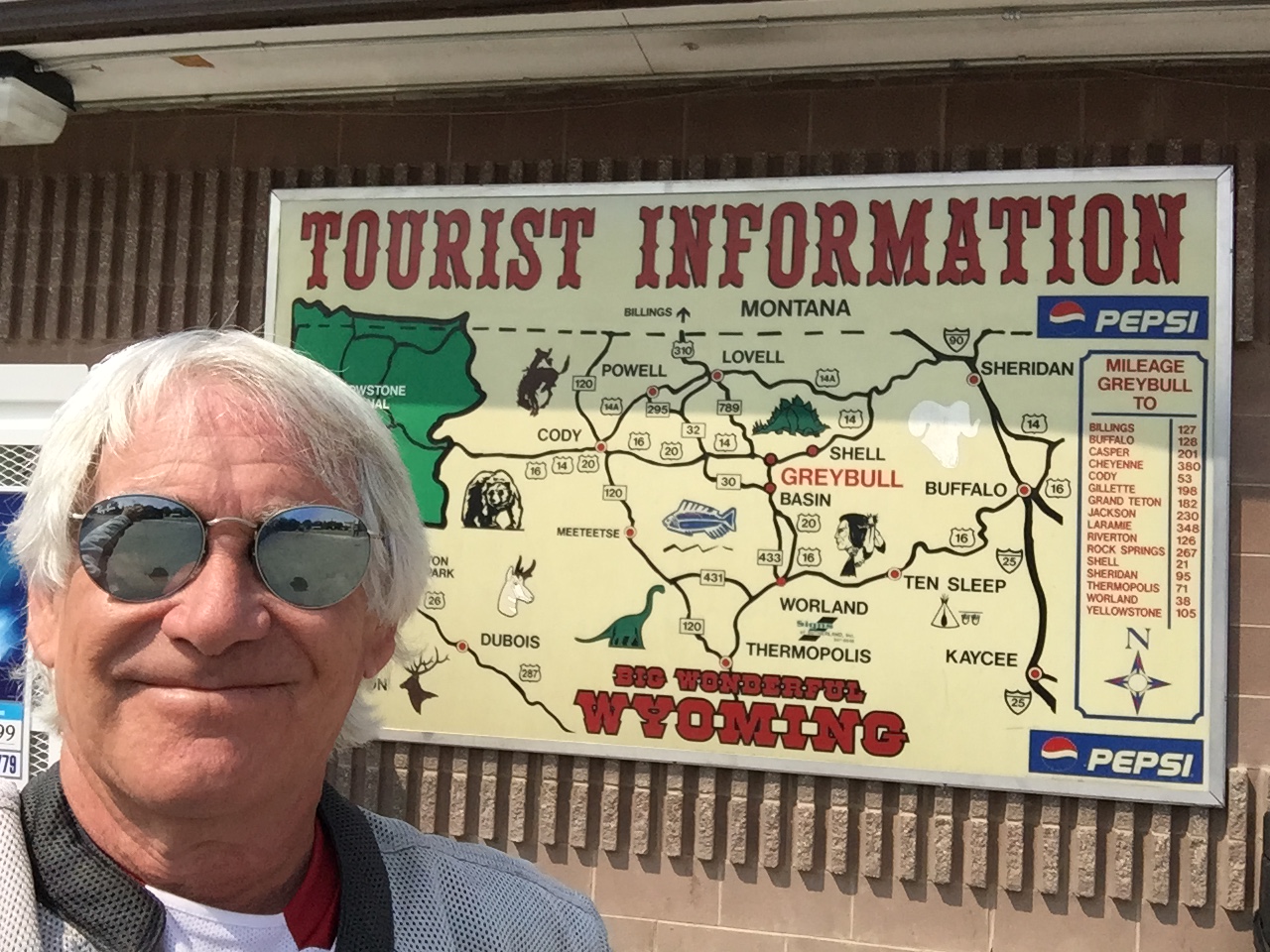
IMG_7569
Checking out tourist info in Greybull.
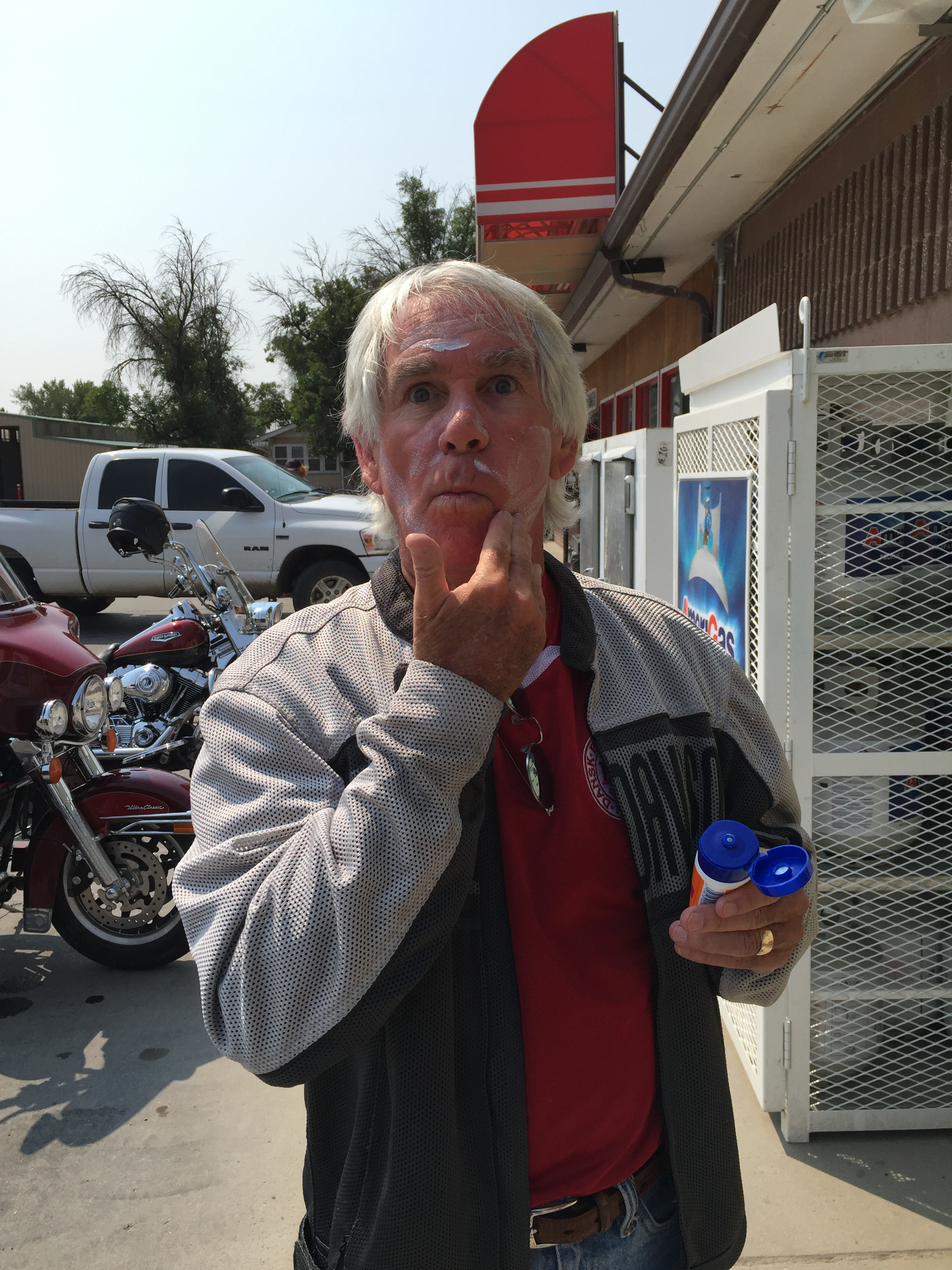
IMG_7571
This one’s for you, Sarah! The author puts on SPF 50 sunscreen in Greybull. (photo by Scott)

In the town of Greybull, home to actor Wilford Brimley, we head west on US Highway 14.

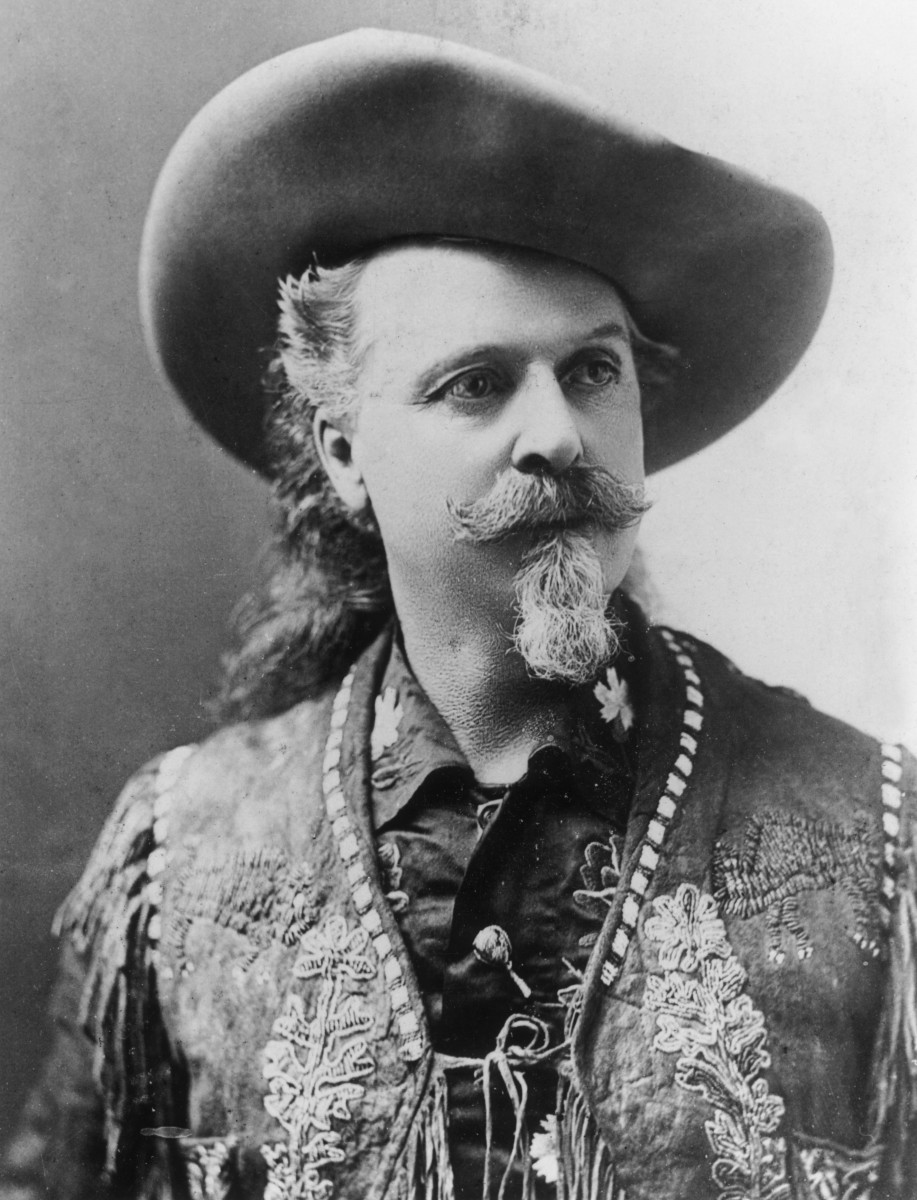
Fifty miles later, we arrive in Cody, on the banks of the Shoshone River at the western edge of the Bighorn Basin. The city is named after William Frederick Cody – better known as Buffalo Bill – a scout, bison hunter and showman – and one of the most colorful figures of the American Old West.

At one time a rider for the Pony Express at age 14, he got the nickname “Buffalo Bill” when he had a contract to supply Kansas Pacific Railroad workers with buffalo meat. He’s purported to have killed 4,282 American bison (commonly known as buffalo) in an 18-month period in the late 1860s.

buffalo-bill-cody-9252268-2-raw
Buffalo Bill Cody. A legend in Cody, Wyoming.

The city of Cody’s primary industry is tourism, and the big deal in town is the Buffalo Bill Center of the West, a celebration of Buffalo Bill’s influence on western culture. The Buffalo Bill Center has five museums, including the Cody Firearms Museum, the Whitney Western Art Museum, the Draper Natural History Museum, the Plains Indian Museum, and the Buffalo Bill Museum, which chronicles the life of William F. Cody, for whom it’s named.

IMG_7573
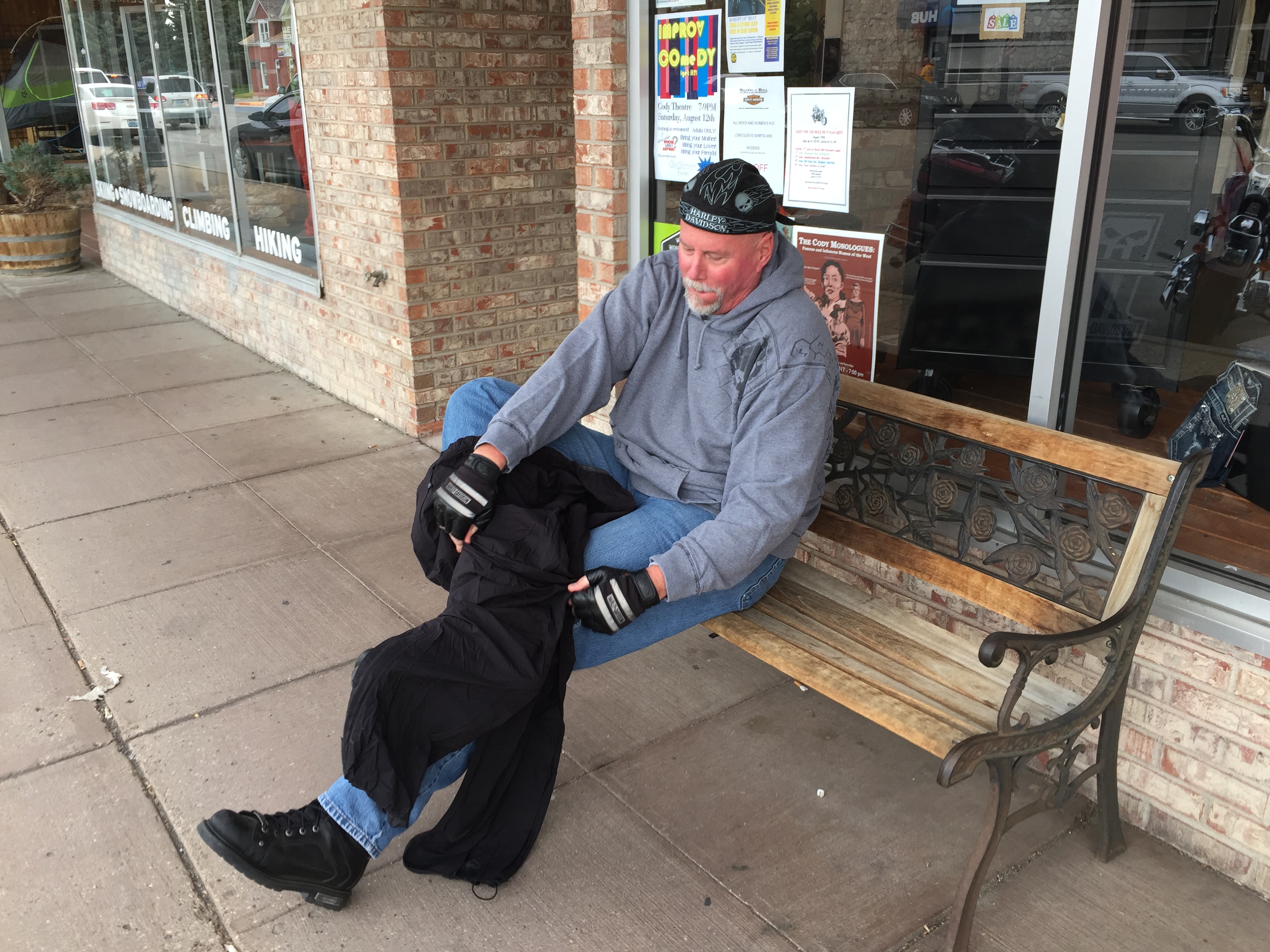
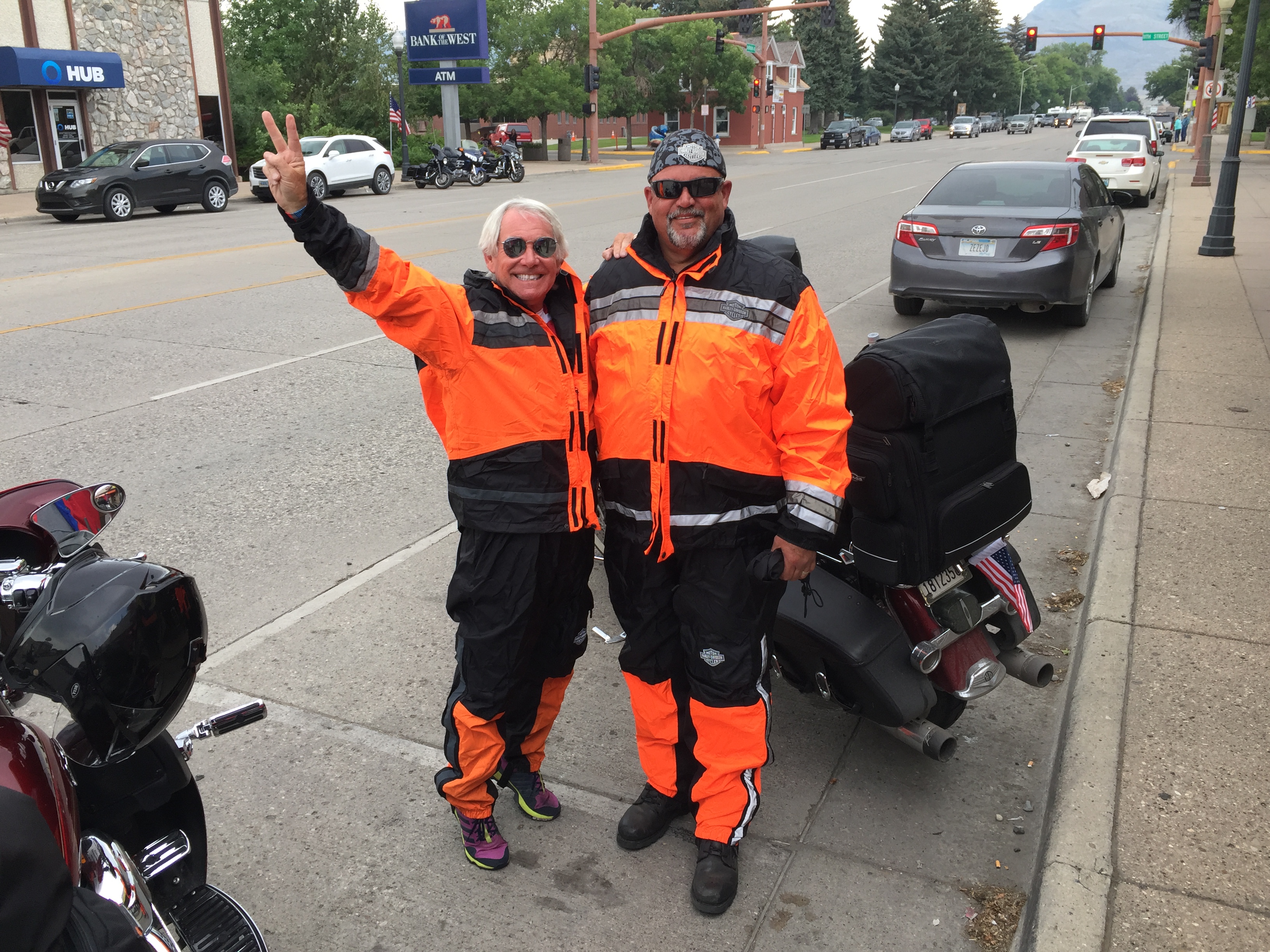
In Cody, the forecast is for rain for the next hour or two, so we put on our rain gear.
IMG_7579
In Cody, ready for rain. We rode in the rain continuously from Cody to Yellowstone National Park. (photo by Dave)

***

Leaving Cody, we continue west on US Highway 14, passing Cedar Mountain, Buffalo Bill Reservoir and State Park, before rolling into Wapiti, 20 miles past Cody. Wapiti is named for the Cree Indian word for elk.

Thirty-two miles later, we arrive at the East Entrance to Yellowstone National Park.

Yellowstone was the world’s first national park, established by Congress and signed into law by President Ulysses S Grant in 1872. The park is known for its wildlife and geothermal features, especially the Old Faithful Geyser, which we will visit tomorrow.

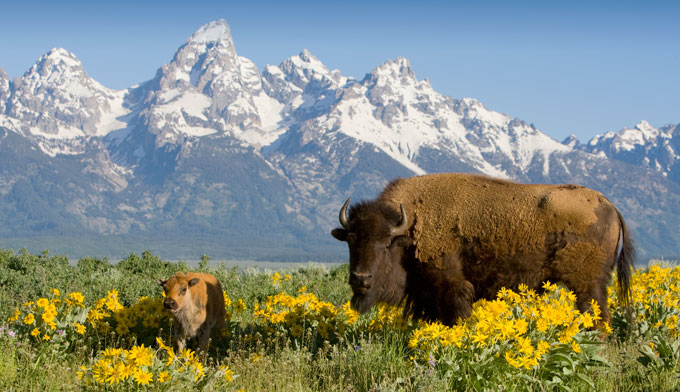
Grizzly bears, wolves and free-ranging herds of bison and elk live in the park. The Yellowstone Park bison herd is the oldest and largest public bison herd in the US. More than 6,000 bison roam inside the park’s boundaries.

Yellowstone-Wildlife-Buffalo-79
Bison in Yellowstone National Park: largest public bison herd in the US.

The bison’s resurgence in the park is a success story for nature lovers. After a mass slaughter of tens of millions of bison on the Great Plains in the late 1800s, conservationists brought about the nation’s first efforts to successfully recover a species teetering on the brink of extinction. While only 23 bison were left in Yellowstone in 1916, the herd today is thriving. In May 2016, the bison became America’s official national mammal, so named because of its historic, ecological, economical and cultural value.

With 4.5 million visitors in 2016, Yellowstone is the fourth-most visited National Park. Only Great Smoky Mountains, Grand Canyon, and Yosemite have more visitors. Yellowstone is huge – more than 2.2 million acres. You could spend weeks here exploring its natural beauty.

We have today and tomorrow. We’ll do a drive-by and hope for the best.

IMG_7581.JPG
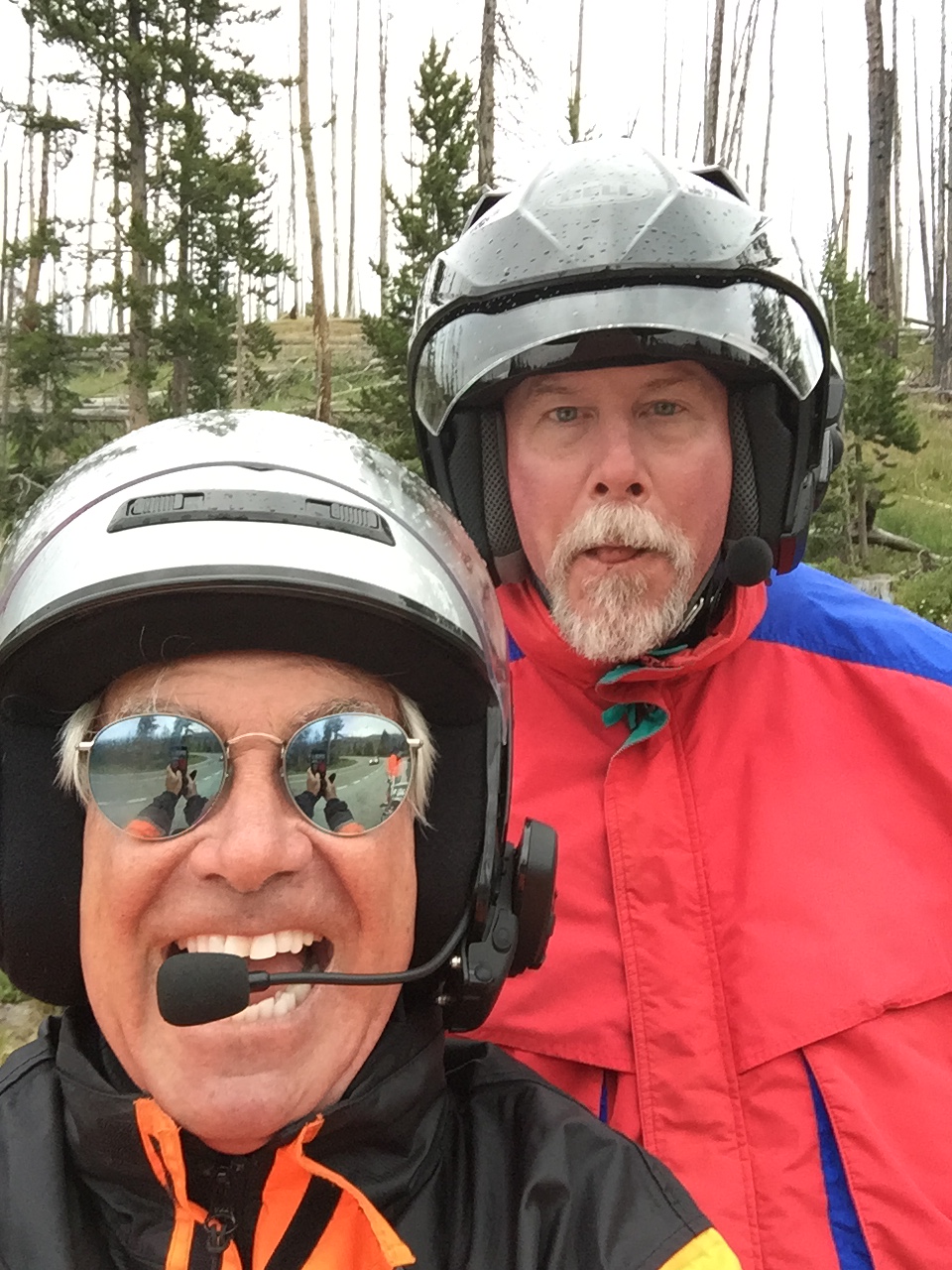
It’s cold and raining, and we’re still having a great time.
IMG_7585
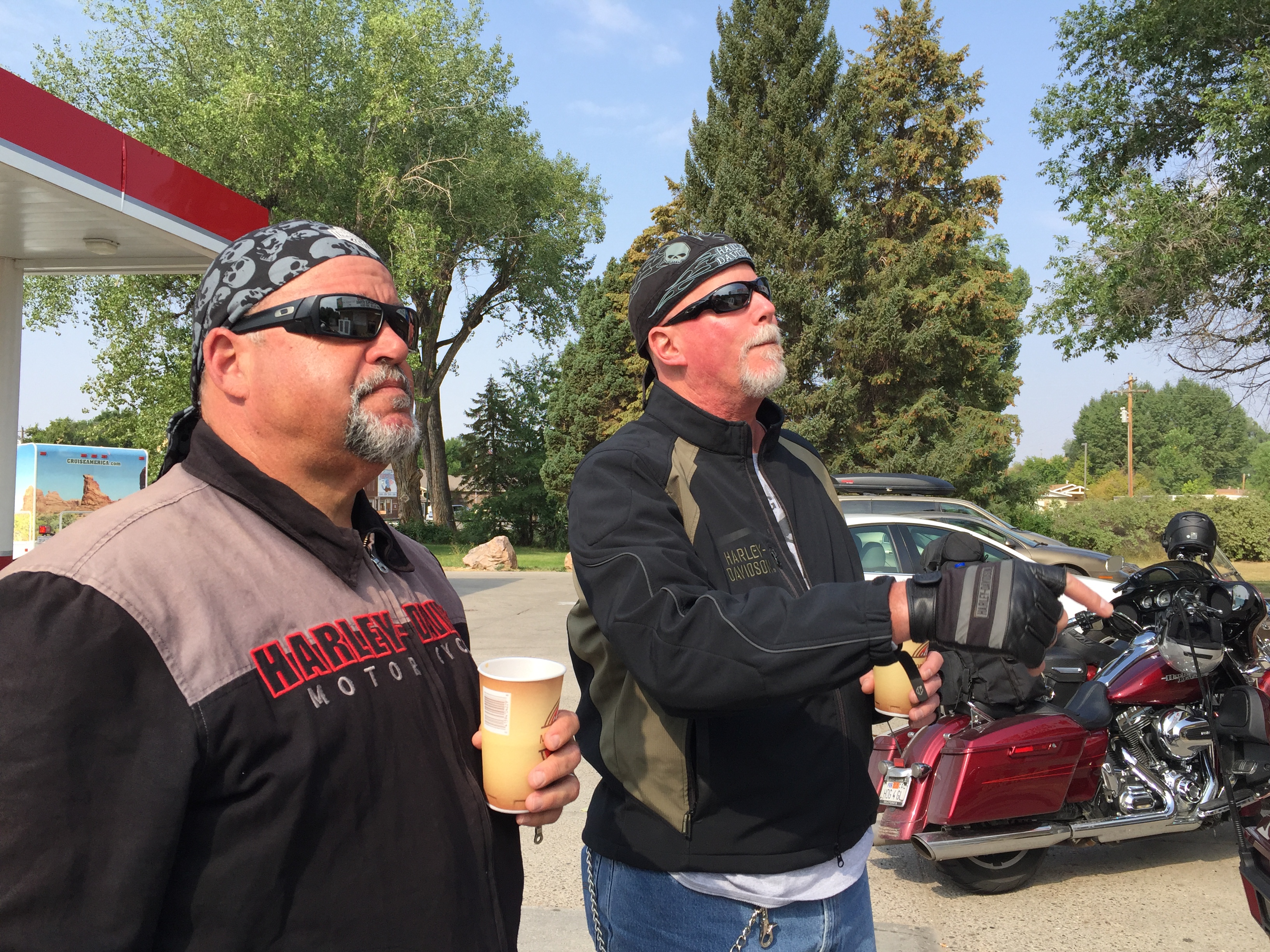
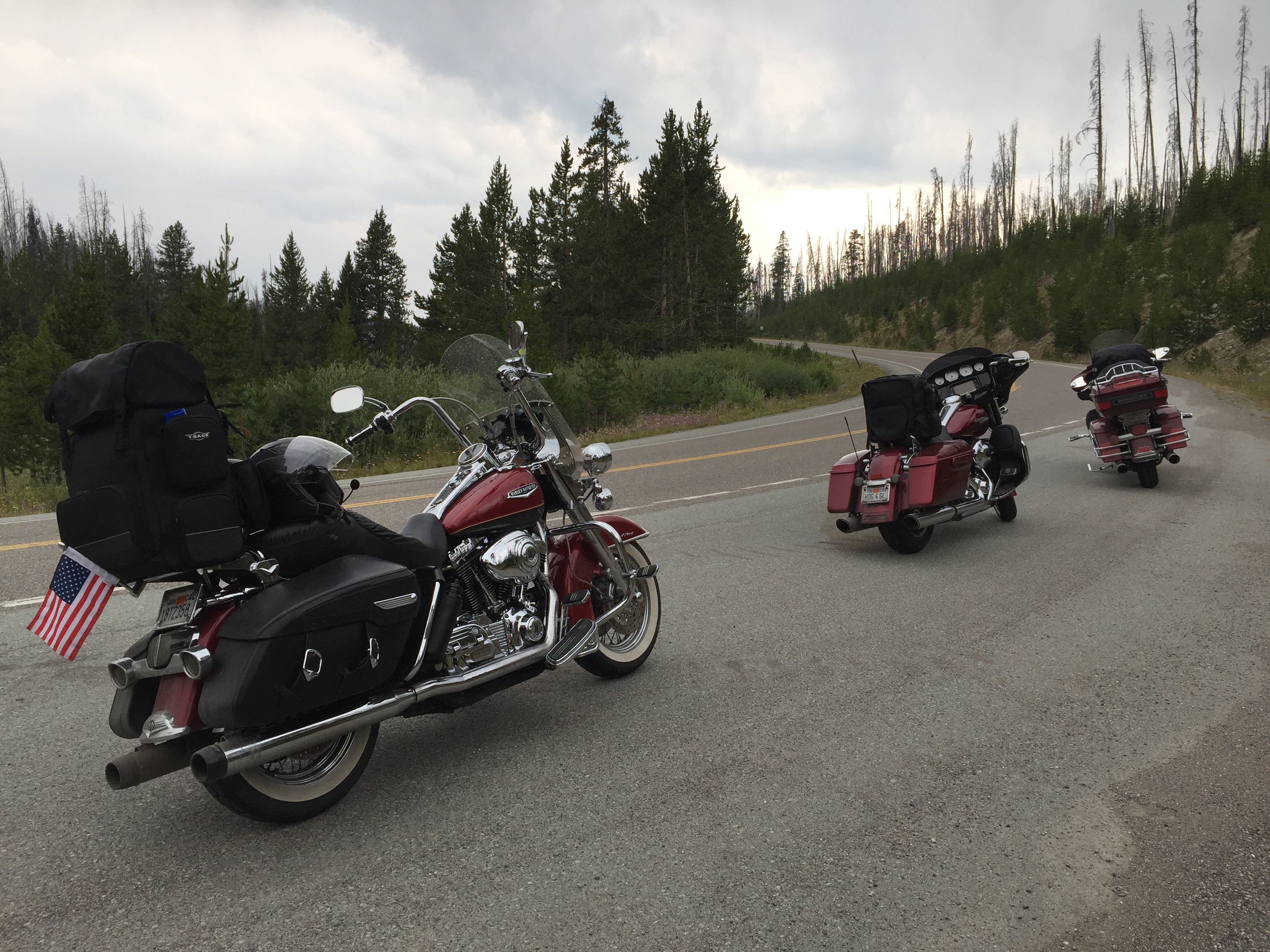
The Red Brigade pauses in Yellowstone.

From the park’s entrance, we continue west for 25 miles, riding along the shoreline of Yellowstone Lake. We turn north, hugging the Yellowstone River, at 678 miles, the longest undammed river in the continental US. Fifteen miles later, we arrive in Canyon Village, the civilized hub of the Park.

IMG_7590
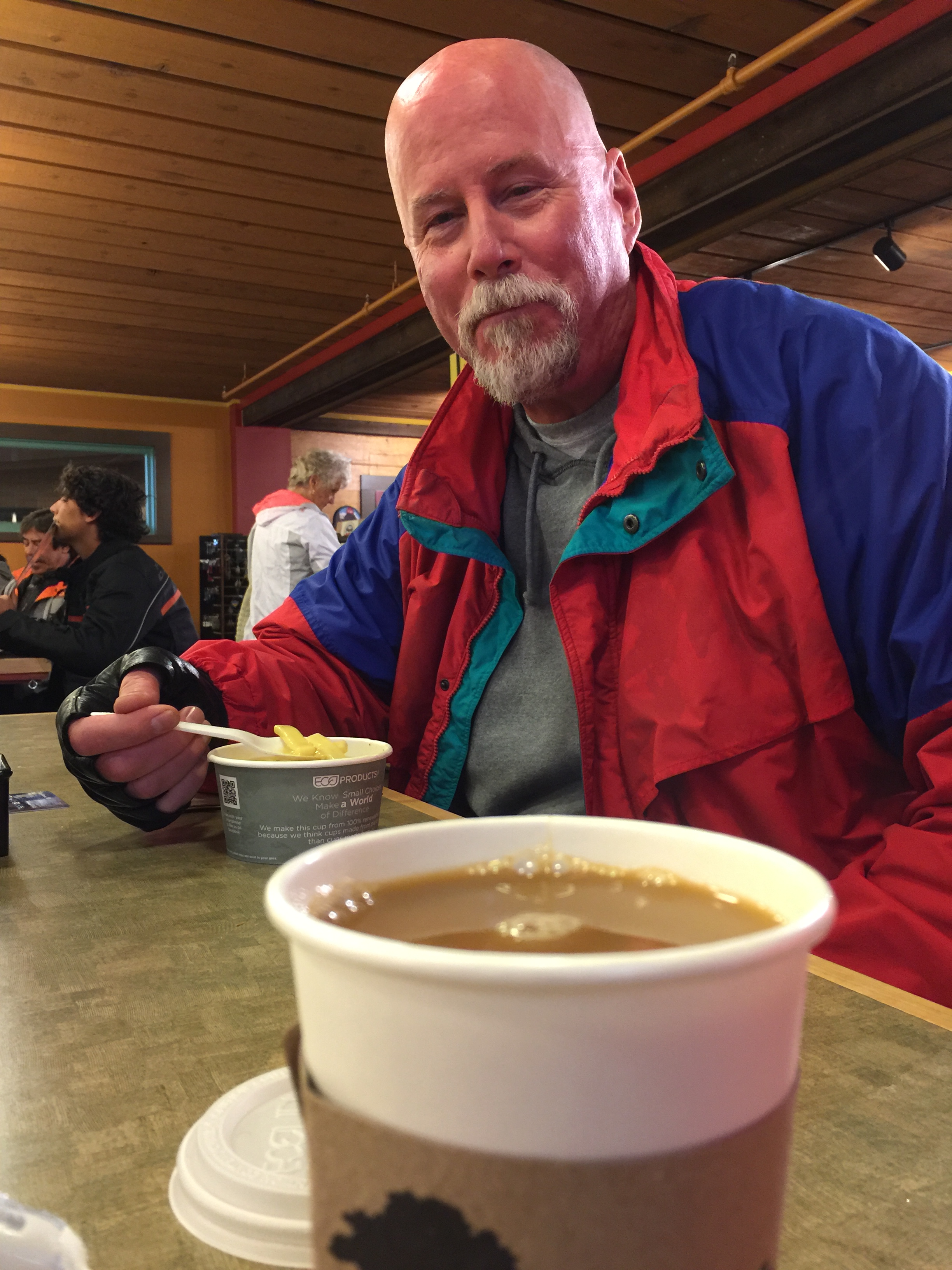
Warming up with chicken noodle soup at the Fishing Bridge General Store. It was a relief getting out of the rain — and the cold.
IMG_0277
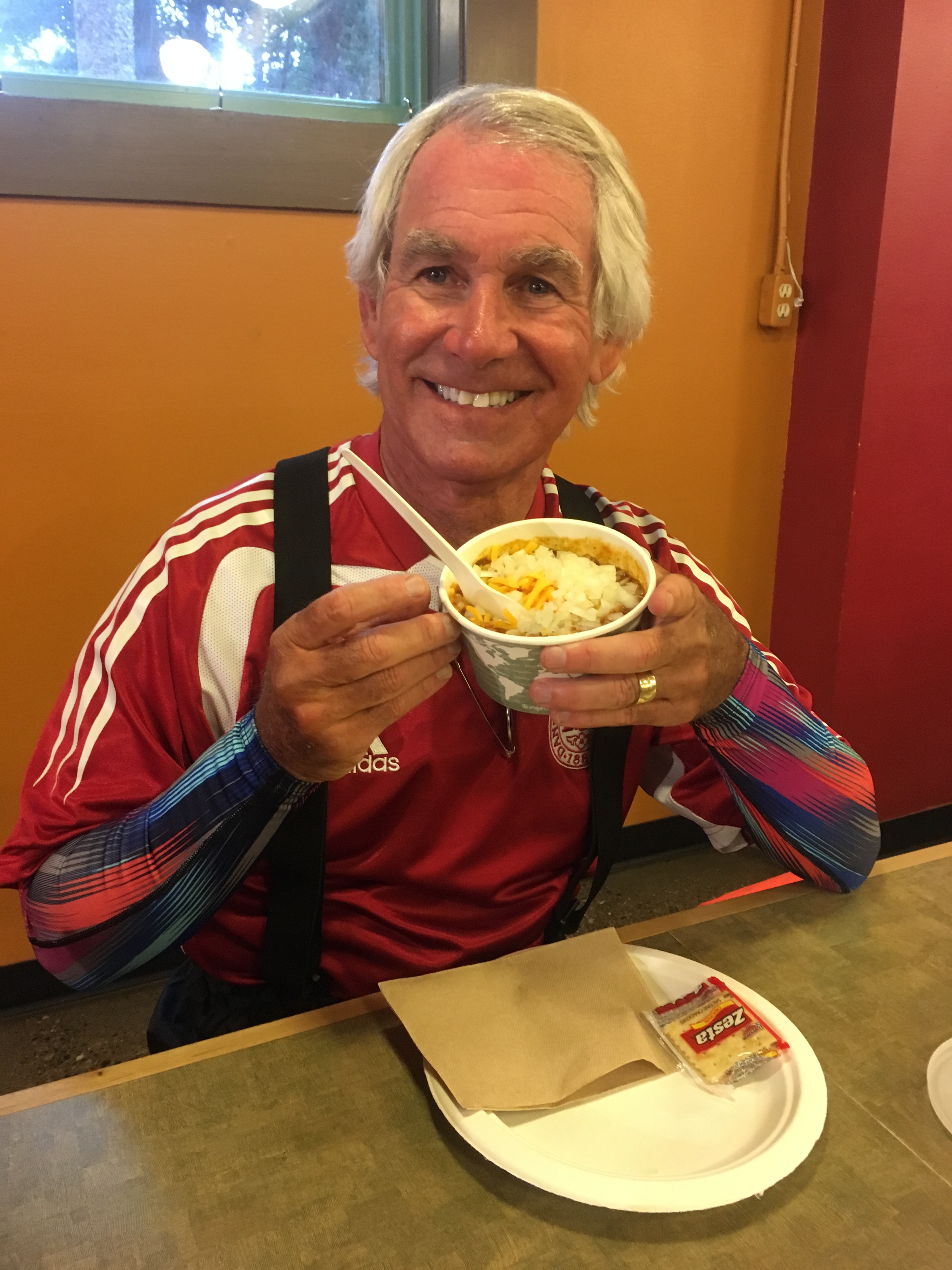
No ribs, no fries, no ice cream. Just a nice cup of chili🌶 . (photo by Dave)

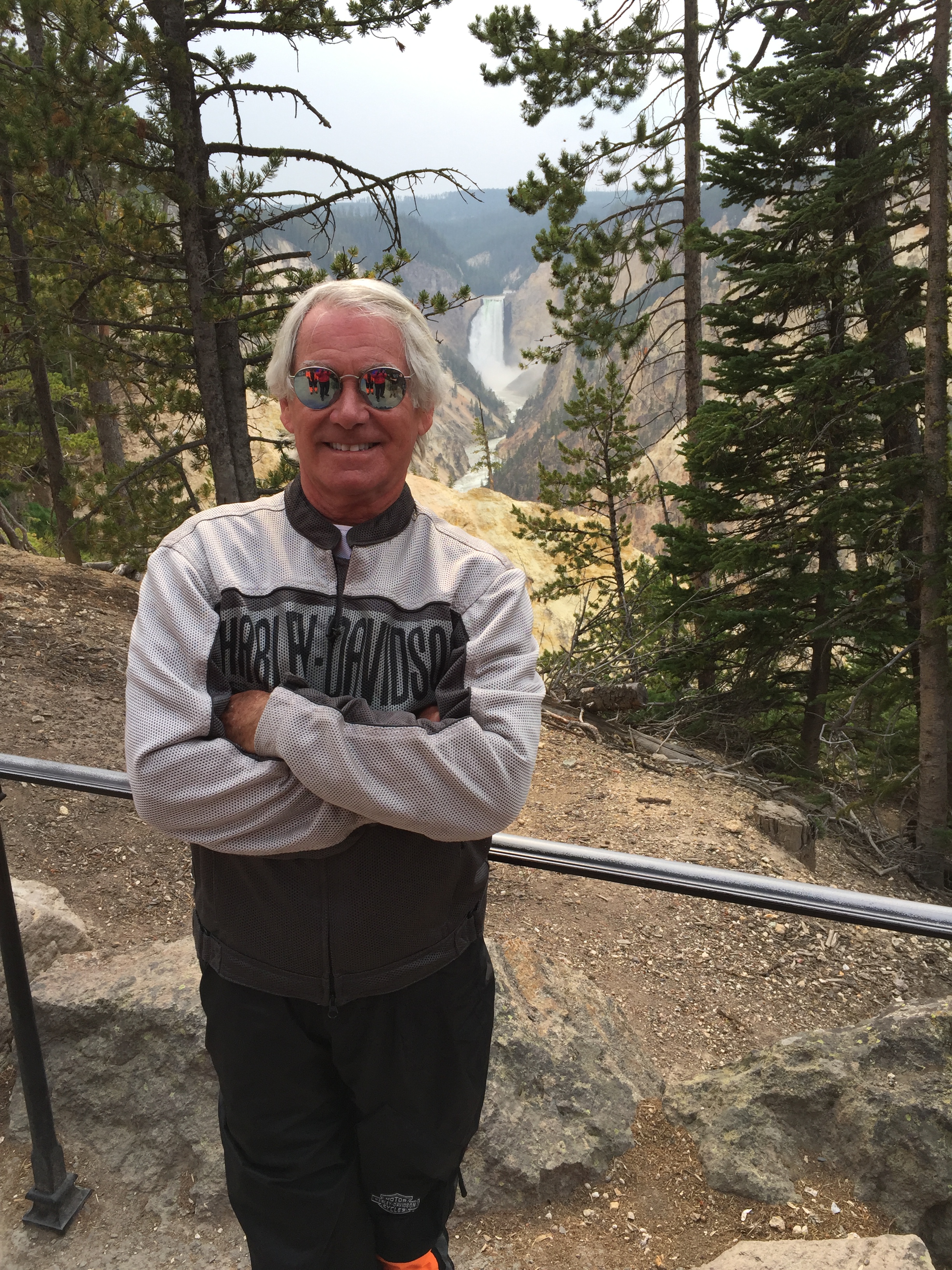
Canyon Village gets its name from the nearby Grand Canyon of the Yellowstone, which is about 20 miles long, 4,000 feet wide, and up to 1,200 feet deep. Artist Point, Lookout Point, Grand View, and Inspiration Point all provide breathtaking views of the canyon.

IMG_7597.JPG
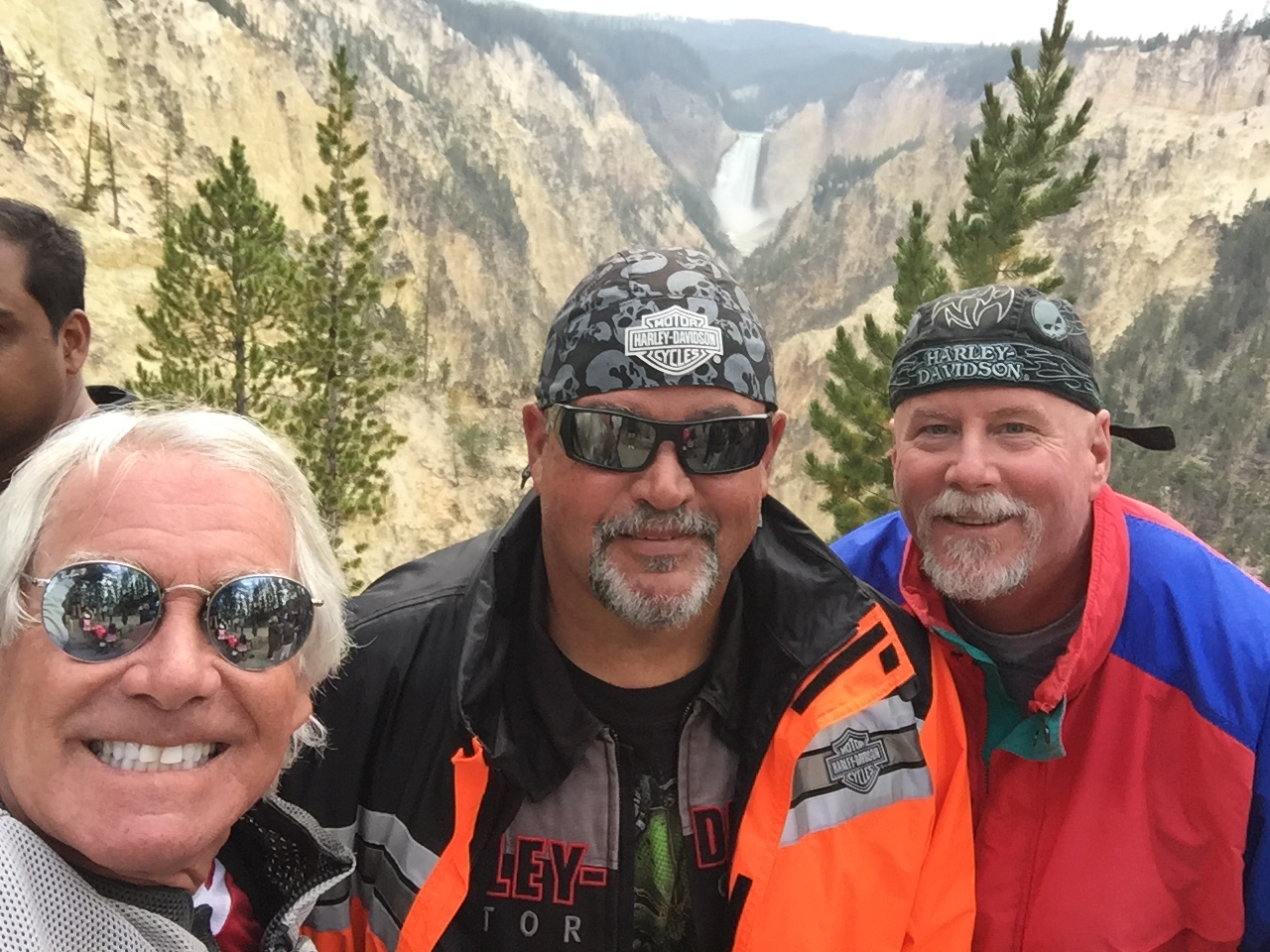
At the Grand Canyon of the Yellowstone. (photo by Dave)
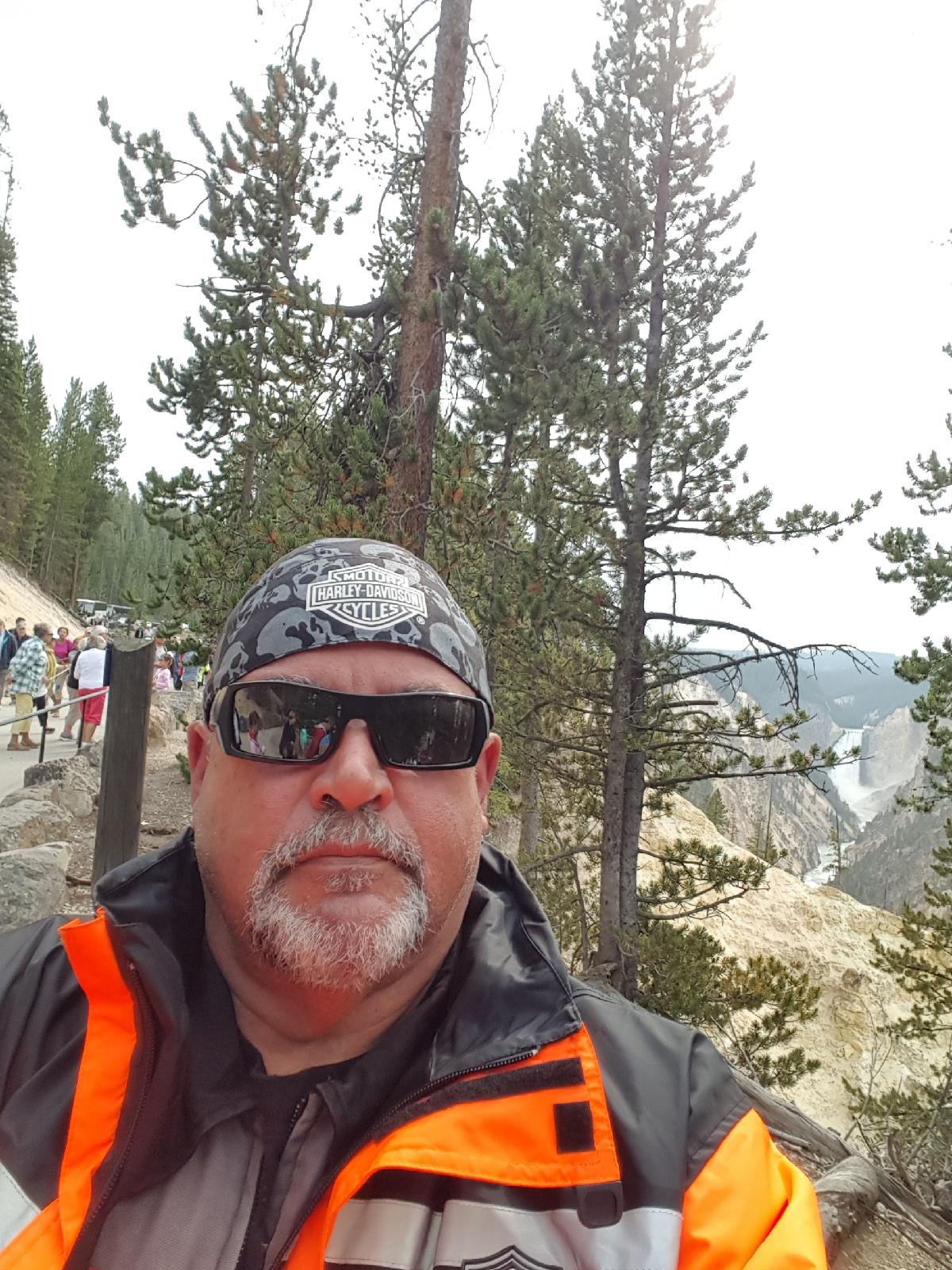
IMG_7603
Scott at the Grand Canyon of the Yellowstone.

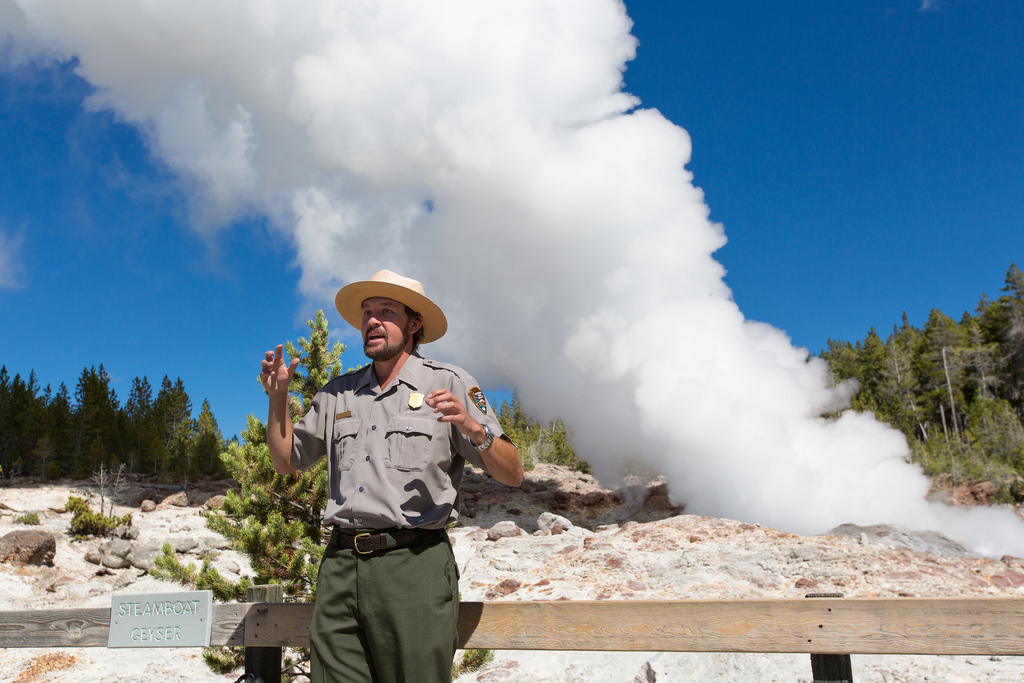
After snapping photos and selfies galore, we turn west onto Norris Canyon Road, which takes us to the Norris Geyser Basin, the hottest and most changeable geyser basin in the park. The tallest active geyser in the world, reaching more than 300 feet, is Steamboat Geyser, located here in Norris Basin.

22323583532_82fa4a1f2f_b
The Steamboat Geyser, in its “steam” phase.

Unlike the slightly smaller but much more famous Old Faithful Geyser, which we’ll visit tomorrow, Steamboat has an erratic and lengthy timetable between major eruptions. Sometimes, Steamboat Geyser goes more than a year between major eruptions. Since you couldn’t be here with us, the next best thing may be an online tour offered by the National Park Service.

The online tour is much quieter and less stinky than actually being here. The Norris Geyser Basin is one of the most thermally extreme environments on the planet, with temperatures measured as high as 459 F, 1,000 feet below the surface.

Throughout Yellowstone National Park, there are more than 10,000 hot springs and geysers. Tomorrow, we’ll visit the most famous – and predictable – of them all. Old Faithful.

But first, we’re tired and hungry, so we jump on US Highway 89 (sometimes called Grand Loop Road), then US Highway 191, and head for tonight’s destination, West Yellowstone, Montana – just outside the Park’s western entrance. Montana is the eighth of nine states we’ll visit on this trip.

West Yellowstone is home to the Grizzly & Wolf Discovery Center, a non-profit wildlife park that provides a safe way to observe these creatures up close and personal. Wanna see what the bears are up to? Check out a live view, known as the Bear Habitat Webcam.

There are no panda bears here, but that would be an interesting tourist draw. Turns out more than half the tourists coming through West Yellowstone are from China. The tourism surge is being fueled by looser visa rules, rising middle class salaries, and a growing desire among the younger generation to explore the world.

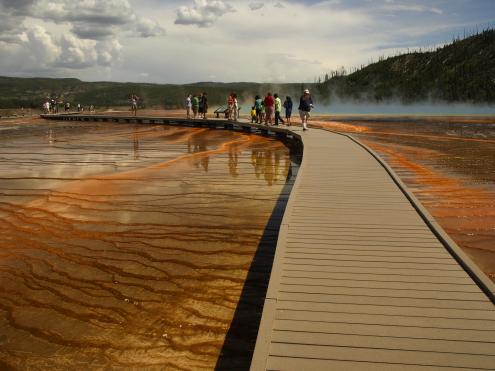
Chinese visitors to Yellowstone have increased so dramatically in recent years that the park has hired three Mandarin-speaking interpretive rangers to help with communication. This trio of rangers tries to help with language and cultural barriers. In the 2016 summer season, a tourist from China was fined $1,000 for walking off a boardwalk in the park and collecting thermal water, apparently for medicinal purposes.

188_1
Stay on the boardwalk, to avoid hefty fines!

For many Chinese, the attraction to Yellowstone has to do with it being a natural place, without the severe pollution and big crowds found in larger Chinese cities. And, they get to see old American guys on Harleys pursuing their bucket list dreams.

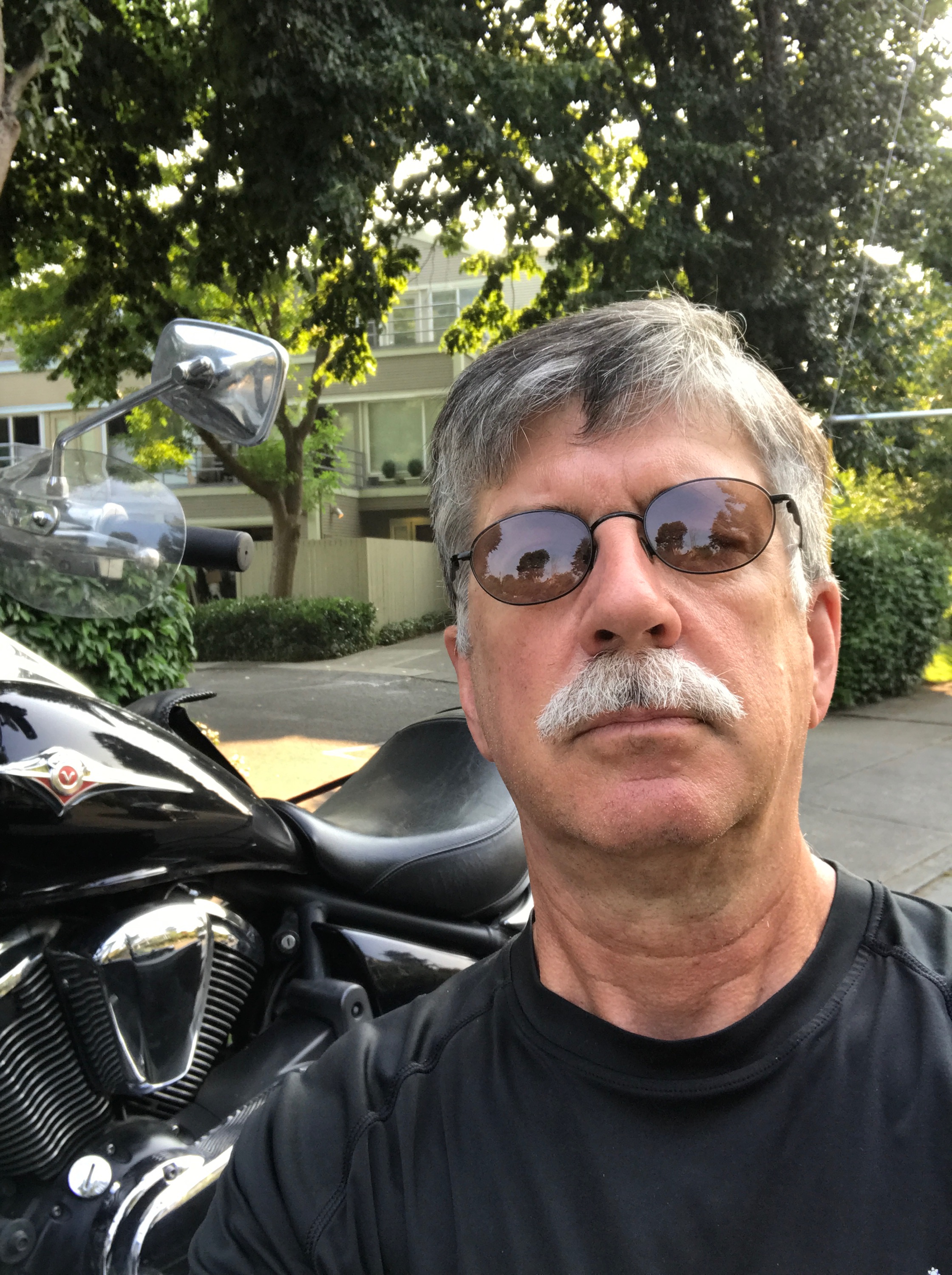
IMG_7602
Like a bad penny, Randy’s back.  Here, he arrives home in Seattle after a two-day drive from a Rapid City, South Dakota. Randy made it home about the same time as Dave, Scott and Gary arrived in West Yellowstone.

***

Day Thirteen Summary: Channeling Meadowlark Lemon, honoring Buffalo Bill, seeing Yellowstone’s Grand Canyon, smelling the Park’s odiferous geothermal features.

Click here to see today’s complete route from Buffalo to West Yellowstone.

We’re on our way home.

Vroom, vroom.
***

Today in Bucket List History:

Bucket List item: “Do Something To Restore Faith in the Country.”

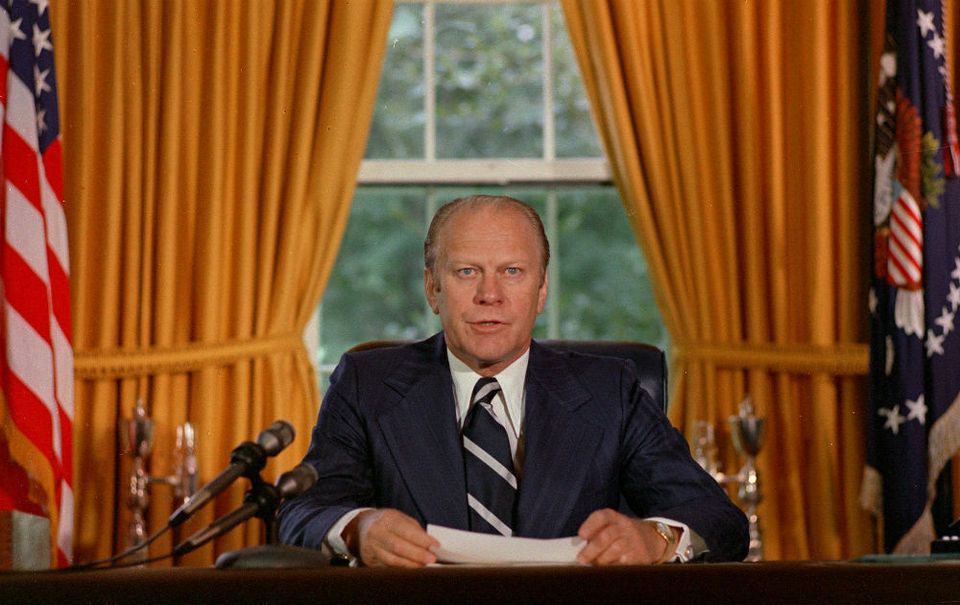
Goal Achieved: On August 9, 1974, Richard Nixon resigns the presidency, and Vice President Gerald Ford becomes the 38th president. Nixon’s final words to the White House staff: “You are here to say goodbye to us, and we don’t have a good word for it in English – the best is au revoir.  We’ll see you again.”

Ford
It wasn’t easy, but Gerald Ford restored faith in the presidency after Richard Nixon’s self-destruction.

What’s on your bucket list?