***
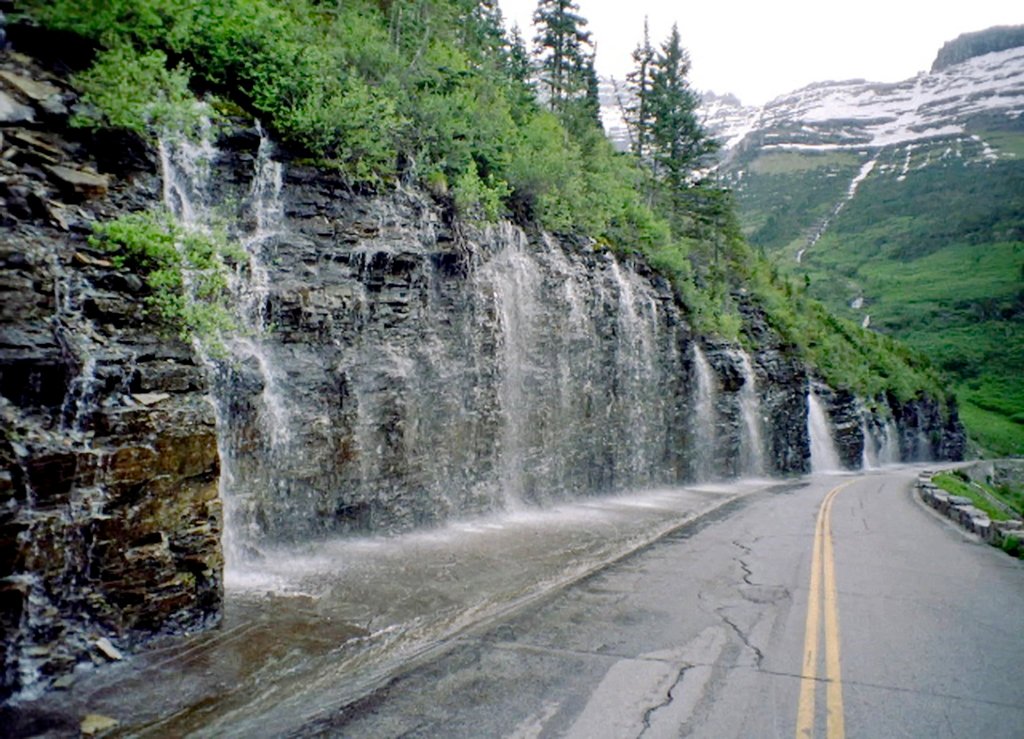
If you’re of a certain age, get out your lifetime National Parks pass (mine cost $10). You’ll use it to ride the world-famous Going-to-the-Sun Road, which takes you through Glacier National Park.
The 48-mile ride begins in West Glacier, Montana, and ends in St. Mary, Montana.
In West Glacier, you’ll turn off of US Highway 2, onto Glacier Route 1 Road, more commonly known as the Going-to-the-Sun Road.
I rode this route in 2021, West to East. In 2024, it was an East to West journey. Either way you do it, you’re gonna be blown away.
My description below of the road is from a West-to-East perspective.
West Glacier sits at the west entrance to Glacier National Park. You’ll enter the park here and head for the visitor center in Apgar, two miles away, on the southern end of Lake McDonald.
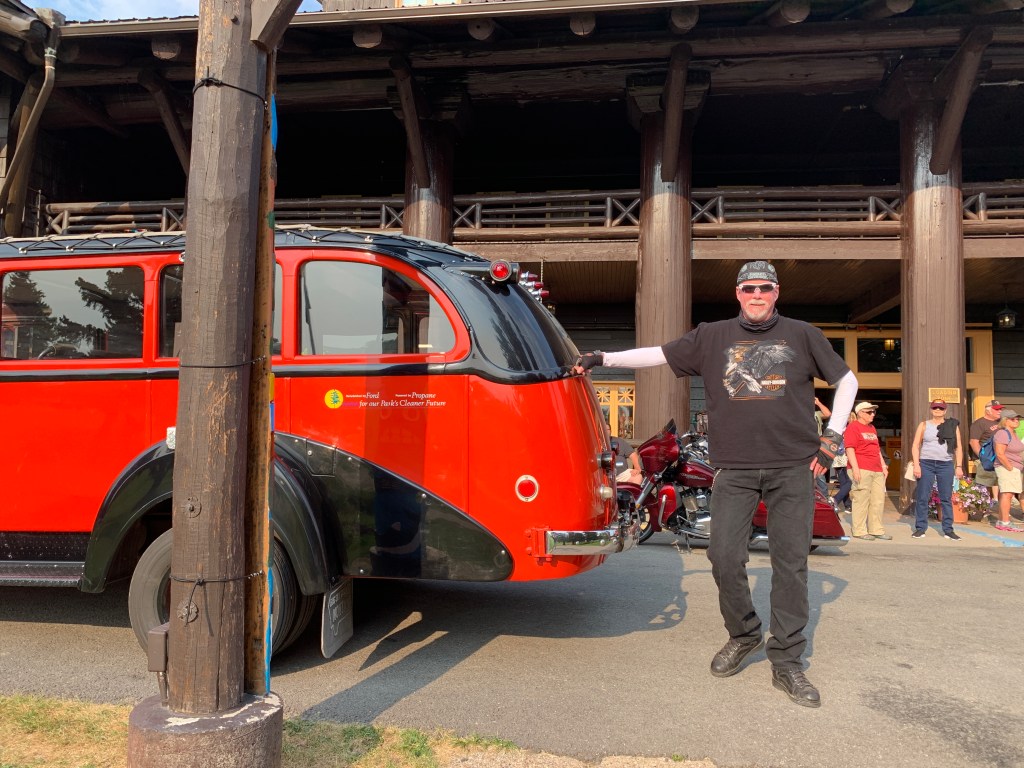
Apgar is one of the main villages in the park. In addition to the visitor center, it has a restaurant, gift shops, boat rentals, and the largest campground in Glacier National Park. Apgar also has a reservation center for Red Bus Tours.
Apgar Village is the starting point for almost all Red Bus Tours. These buses are better known as Red Jammers. The fleet of 33 Red Jammers in Glacier National Park is widely considered to be the oldest touring fleet of vehicles anywhere in the world.
When the park opened in 1910, it had just a few miles of rough wagon roads, and the primary mode of transportation was the railway, which took affluent guests to luxurious chalets. Officials convinced local businesses and Congress to support a trans-mountain road through the park.
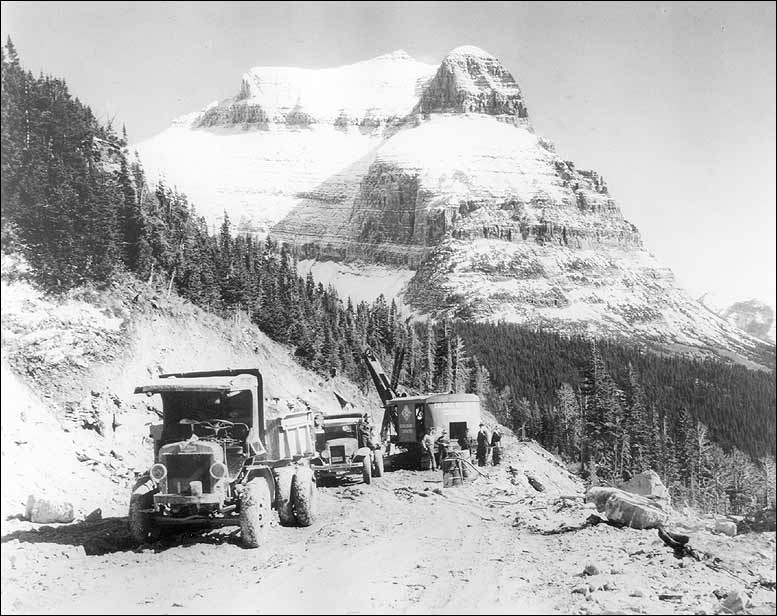
Construction of the road, now known as the Going-to-the-Sun Road, began in the 1920s and was completed in 1933. While a modern marvel at the time, park officials quickly realized many motorists were terrified of driving on it. They contracted White Motor Company of Cleveland, Ohio to produce a fleet of buses to be piloted by expert drivers.
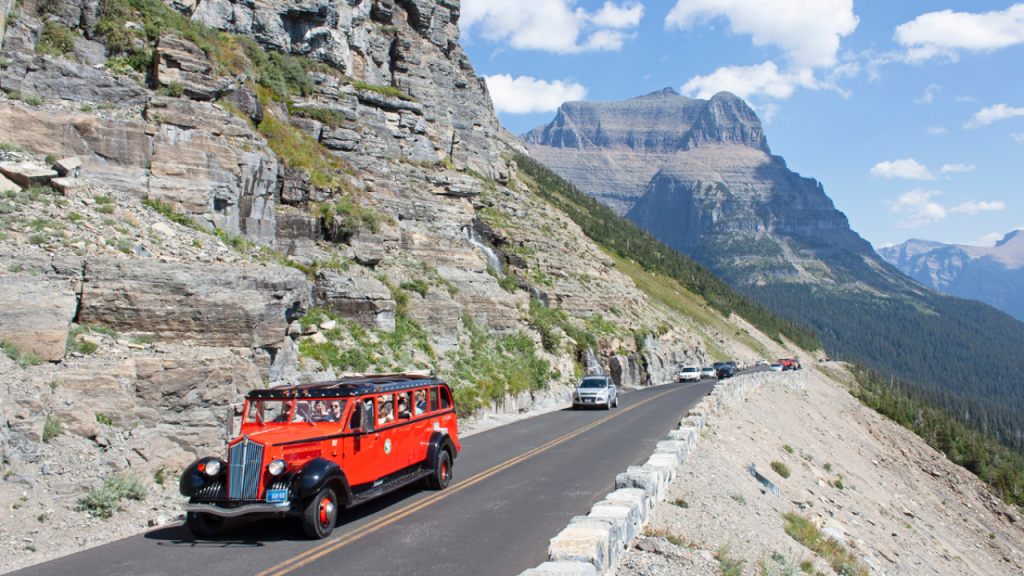
The buses, with their roll-back convertible tops, leave Apgar and head for the Going-to-the-Sun Road. The Red Jammers are the vintage White Motor Company/Bender Body Company Model 706 buses that have transported park visitors since 1936. They’re called “Reds” for their distinctive livery, painted to match the color of ripe mountain ash berries.
The bus drivers are called “jammers” because of the sound the gears made, back in the day, when the driver shifted on the park’s steep roads. The “jamming” sound came from the unsynchronized transmissions, where double clutching was required to shift gears prior to a 1989 fleet retrofit that added automatic transmissions.
For you Millennials and others too young to remember unsynchronized transmissions (or shifting at all), double clutching involves manually matching the engine speed with the speed of the driveshaft. It’s harder than it looks and sounds, but unless you’re driving Grandpa’s vintage Model T, this is a skill you don’t need these days.
Double clutching is a lost art.
Nearly all transmissions today are automatic, and of those that do call for shifting, nearly all have synchronized gearboxes. Amazing that Millennials look so puzzlingly at that pedal to the left of the brake. Yes, the clutch.
Beginning in 2019, Legacy Classic Trucks, based in Driggs, Idaho, started restoring and updating each bus with a new Ford chassis and Ford 6.2 liter V-8 engine, including a hybrid electrical system — to increase fuel economy and lower emissions.
Vroom!

Leaving Apgar, you begin your journey east on the Going-to-the-Sun Road.
It’s a spectacular ride along the eastern shoreline of Lake McDonald, the largest lake in the park. The high alpine lake is 10 miles long and nearly 500 feet deep. It was once occupied by massive glaciers that carved this area thousands of years ago.
Just as the Red Jammers take tourists through the park on the Going-to-the-Sun Road, a fleet of classic wooden boats is available to explore the park’s major lakes. The boats are part of the Glacier Park Boat Company.
A 57-foot boat, DeSmet, has been cruising Lake McDonald since the 1930s. The DeSmet, a carvel-planked vessel with cedar on an oak frame, can carry up to 70 passengers. The boat, named after Father Pierre DeSmet, a prominent Jesuit missionary in the area, has never left Lake McDonald since being launched here almost a century ago.
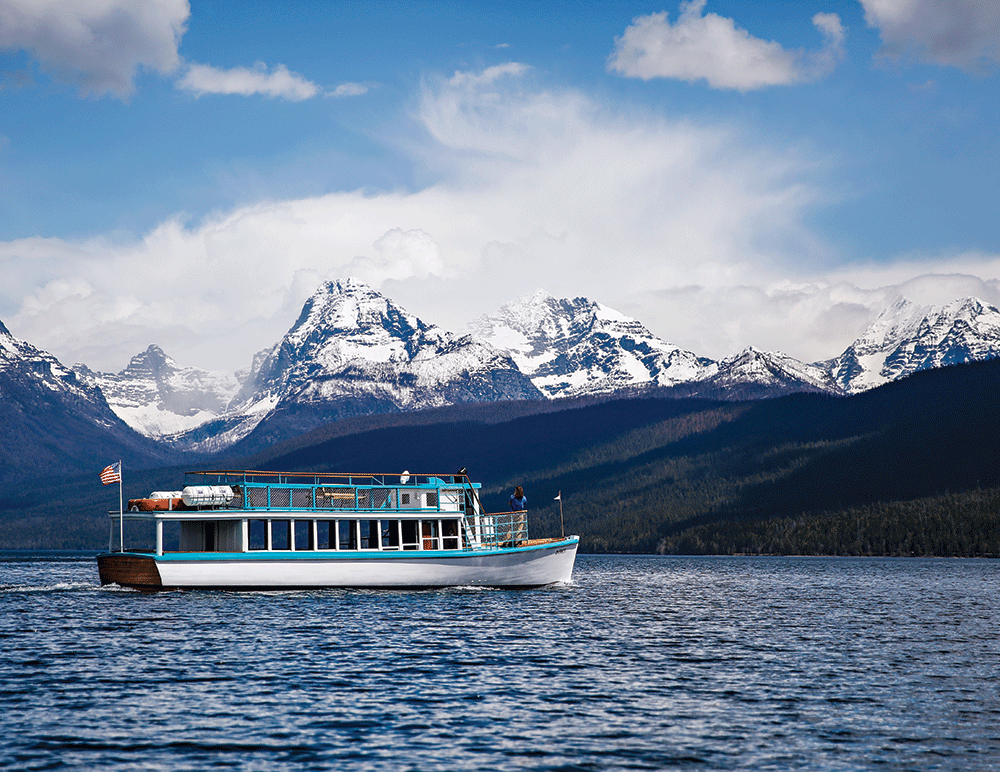
Similar boats ply the waters of the other major lakes in Glacier National Park: The Sinopah on Two Medicine Lake, Little Chief, and Joy II on Saint Mary Lake, the Morning Eagle on Lake Josephine, and Chief Two Gunson Swiftcurrent Lake.
Each fall, the boats are lifted on a cradle-and-track system, and moved into custom boathouses built specifically for each boat. The vessels are closed up, protected against the brutal Glacier Park winters, and then re-launched every spring for the summer tourist season.
The DeSmet begins its tours of Lake McDonald at historic Lake McDonald Lodge. The lodge, built in 1913, sits on the southeast shore of the lake. It’s a National Historic Landmark. Artist Charles Russell was a frequent at the hotel in the 1920s, and is believed to have etched pictographs in the dining room’s original fireplace hearth.
Six miles past the Lake McDonald Lodge is the Trail of the Cedars, a short, easy trail mostly on boardwalks and flat ground. The trail is named after the towering trees you’ll hike beneath. This cedar forest, resembling the ecosystems of the Pacific Northwest, is the only one of its kind in in the park.
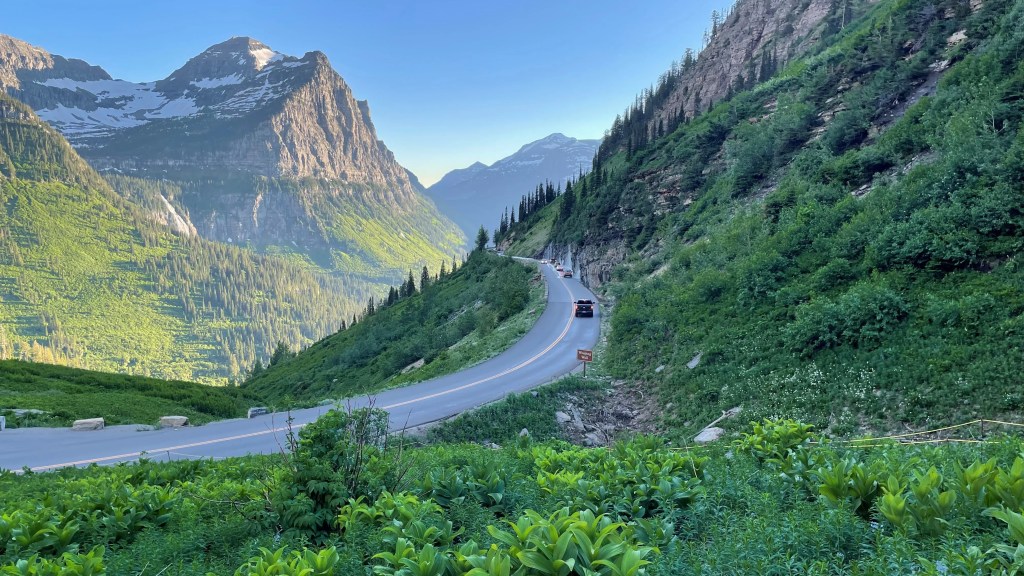
All national parks are distinguished by their unique natural beauty. How do you even begin to compare Grand Canyon, Yosemite, Yellowstone, Zion and Grand Teton? Naturalist John Muir, known as the “Father of the National Parks,” summed up his view of Glacier National Park in a simple thought.
“It is the best care-killing scenery on the continent.”
Care-killing scenery.
Glacier National Park encompasses more than one million acres, and it borders Waterton Lakes National Park in Canada. The two parks are known as the Waterton-Glacier International Peace Park and were designated as the world’s first International Peace Park in 1932.
Glacier is the eighth-most visited of the national parks, with about three million visitors a year. It’s so popular, that you now need a $2 “timed-entry” ticket, an advance reservation you book through recreation.gov, to ride the Going-to-the-Sun Road. At least you need one going West to East. If you ride East to West, no timed pass required; it’s the park service’s way of encouraging you to enter the park at St. Mary, rather than West Glacier.
In the mid-19th century, about 150 glaciers still existed in the area that is now Glacier National Park. By 1910, only 25 active glaciers remained. Scientists studying the glaciers in the park believe all the active glaciers in the park may disappear over the next ten years. Global warming is real. Glacier National Park’s name will outlive its glaciers.
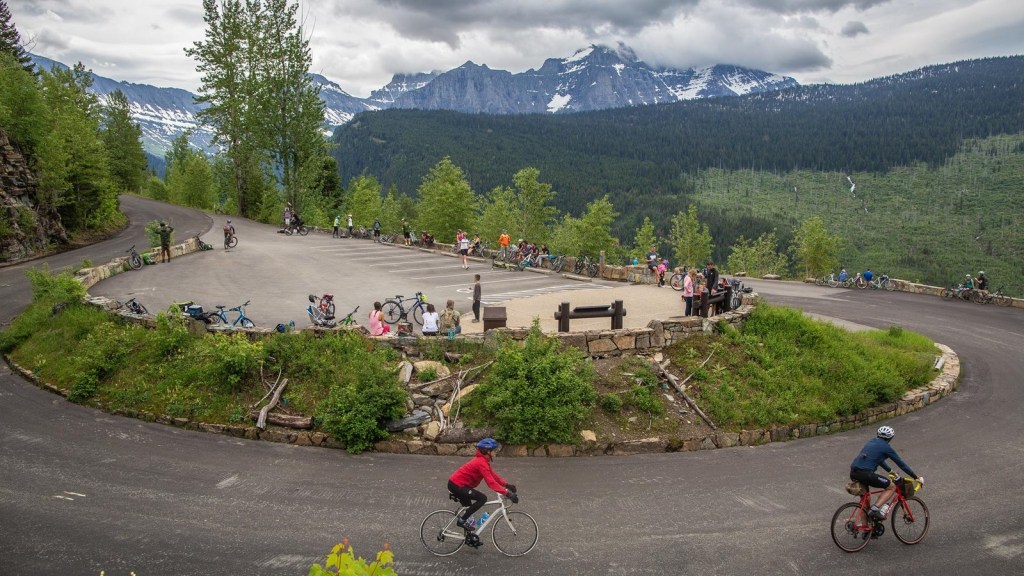
The first major vista on the 51-mile long Going-to-the-Sun Road is Red Rock Point, a popular pullout on the north side of the road. Eight miles beyond Red Rock Point is The Loop, where the road makes a tight hairpin turn. It’s the lone switchback on the Going-to-the-Sun Road, marking the beginning of the narrow, carved-into-the-mountainside portion of the road.
At first, the road’s surface was crushed gravel. It wasn’t until 1952, 20 years after opening the Going-to-the-Sun Road, that the entire road was paved.
Building the road was a feat of engineering because the many obstacles faced by engineers and laborers during its construction road. Sheer cliffs, short construction seasons, 60-foot snowdrifts and tons of solid rock made road building across the Continental Divide a unique challenge.
The road is narrow and winding. As a result, vehicles going over the highest portions of the roadway are limited to 21 feet in length and 10 feet in height, due to overhanging rocks. For comparison purposes, 12,095-foot Independence Pass, east of Aspen, restricts vehicles to no more than 35 feet in length.
Because of the intense winters and heavy snowfall, the Going-to-the-Sun Road generally opens in late June or early July, and closes the third Monday of October. It’s a short season, but well worth the wait.
The Going-to-the-Sun Road has been fittingly recognized for its epic nature.
It’s on the National Register of Historic Places. And, it’s a National Historic Civil Engineering Landmark — joining such structures and accomplishments as the Brooklyn Bridge, Cape Hatteras Lighthouse, Grand Central Terminal and Captain George Vancouver’s Mapping of the West Coast of North America.
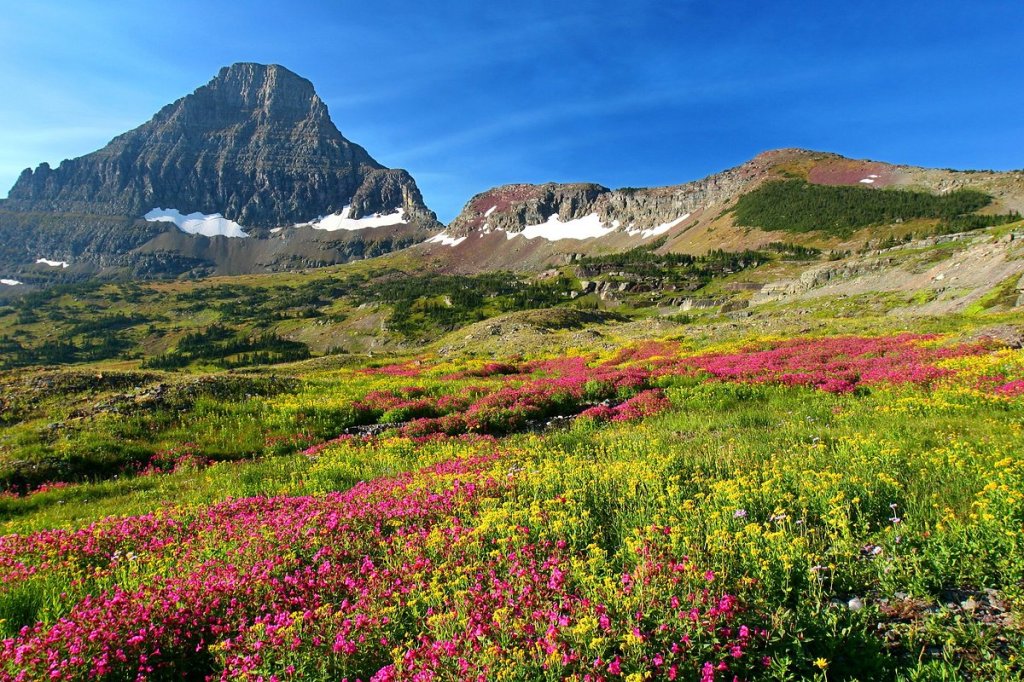
A few miles east of The Loop is Logan Pass. At 6,646 feet, it’s the highest point on Going-to-the-Sun Road. The pass is named after William R. Logan, the first superintendent of the park.
Logan Pass offers breathtaking scenery amid what’s called “the backbone of America,” the Continental Divide. As you work our way toward the east end of the park, you’ll approach 9,647-foot Going-to-the-Sun Mountain. It’s just a mile or so from the Logan Pass Visitor Center.
Your descent from Logan Pass takes you toward St. Mary Lake, the second-largest in the park, after Lake McDonald. The Going-to-the-Sun Road runs along the lake’s north shore.
The lake is nearly 10 miles long, and when you reach the eastern end of it, you arrive at the town of St. Mary, home to the St. Mary Visitor Center. Saint Mary marks the end of the Going-to-the-Sun Road.
Remember Father DeSmet, the Jesuit missionary, and the inspiration for naming the Lake McDonald boat, DeSmet. Well, he also had a hand in providing the name for St. Mary.
Once upon a time, Father DeSmet was caught in a heavy fog coming off of Divide Mountain, When the fog cleared, the first thing he saw was the face of Saint Mary. He was able to use this as a landmark to help guide himself down to St. Mary Lake. Divine inspiration? It’s a good story, anyway.

From St. Mary, you can turn south on US Highway 89 and ride 30 miles to East Glacier Village, home to historic Glacier Park Lodge. It’s a good place to park the bikes, find your room, grab a cold beer, and call it a day.
To explore this route, click here.
 Riding With Gary