Today will have a bit of a déjà vu feel to it.
We’re leaving Estes Park, riding a counter-clockwise loop, and returning this afternoon.
Going in the opposite direction always makes the ride seem like a new road. Half of our 192-mile ride today will be like that.
The Trail Ridge Road Scenic Byway (and All-American Road!) was so much fun yesterday that we’re gonna do it again, but today’s route – on Father’s Day – will be East-to-West.
Oh, yeah. To all you dads, Happy Father’s Day!
Step one on today’s journey is to enter Rocky Mountain National Park at the Bever Meadows Entrance Station. It’s the eastern entrance to the park. We use our Timed Entry passes, a system that began several years ago in an effort to better manage crowding in national parks that needed it.
The timed entry reservation system has been put into place in a few national parks, where the visitors were on the brink of overwhelming the parks – on heavily-traveled roads. Last year, the timed entry reservations were required at Arches National Park, Glacier National Park, Yosemite National Park, Acadia National Park, Haleakala National Park, Rocky Mountain National Park, Shenandoah National Park, and Zion National Park. The timed entry passes cost $2 per vehicle, and are purchased from Recreation.gov.
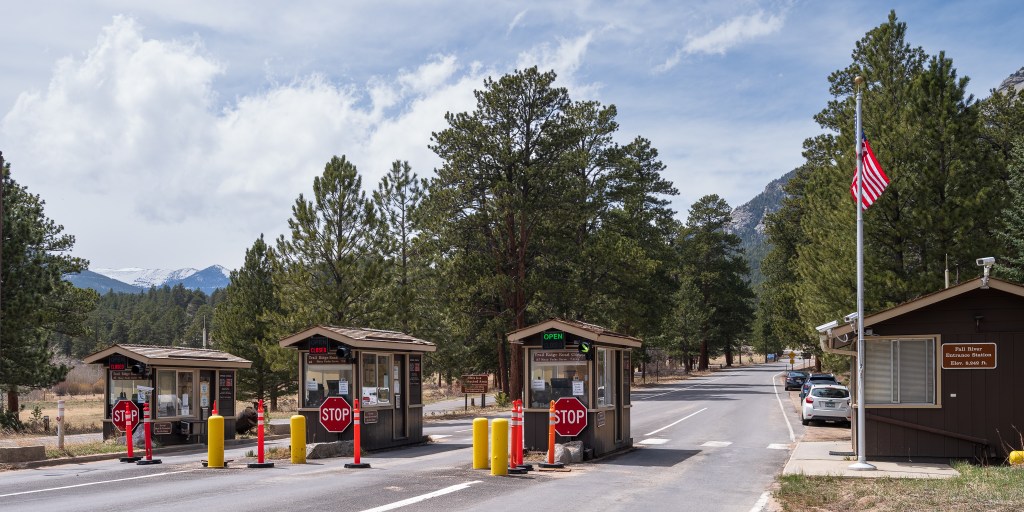
Managers at Rocky Mountain National Park decided they needed a tool to handle crowding at the park, which is the fifth-busiest in the country, after Great Smoky Mountains, Zion, Yellowstone and Grand Canyon national parks. Rocky Mountain National Park receives about 4.5 million visitors per year. This represents a 65 percent increase in visitation over 12 years.
National Park Service leaders say visitor crowding and congestion have led to increased negative impacts to visitor and staff safety, resource protection, visitor experience and operational capacity. At Rocky Mountain National Park, the goal of the timed entry program is to spread visitation out throughout the day.
So, we show up at the gate, with proof of our timed entry reservation, make the rangers happy, and press on. We’re pretty sure we made them happy.
We’ll be on Trail Ridge Road for 37 miles, until we arrive in Grand Lake, at the west end of the park. But first, we climb to 12,183 feet – well above the timberline. On our way, we cross 11,827-foot Iceberg Pass, our twenty-seventh 10,000-foot + pass of this trip. Then on our way out of the park, we cross the Continental Divide at Milner Pass, 10,729 feet.
It all seems familiar, in a beautiful and breathtaking way.
We exit the park, arrive in Grand Lake, and take ten. Our concept of take ten is generally more like 30. That’s just how we roll.
Peak-to-Peak Scenic Byway
Leaving Grand Lake, we ride south on US Highway 40, through Granby, Winter Park, and over 11,315-foot Berthoud Pass. Same as yesterday. Just opposite direction.
Soon, we’re on Interstate 70 heading east toward Denver. Many interstates are boring. This one isn’t. We’re riding at elevations between 7,500 feet and 8,500 feet. The Rockies are quite spectacular. This is nothing like Nebraska. No offense, Nebraska. Colorado sets the bar pretty high.
We exit the interstate, just past Idaho Springs, and join the Central City Parkway. This is also the beginning of the Peak-to-Peak Scenic Byway. Established in 1918, the byway is Colorado’s oldest. It stretches 55 miles, from Black Hawk – just ahead of us – to Estes Park, tonight’s destination.
As we ride north on the byway, we’re less than an hour from Denver, and right outside the college town of Boulder. As we begin the byway, Denver is due east.
Central City is our first sign of civilization on the Peak-to-Peak Scenic Byway. It was founded in 1859 by gold miners, and soon called “the richest square mile on earth.” Central City and the adjacent city of Black Hawk form the Central City/Black Hawk Historic District.
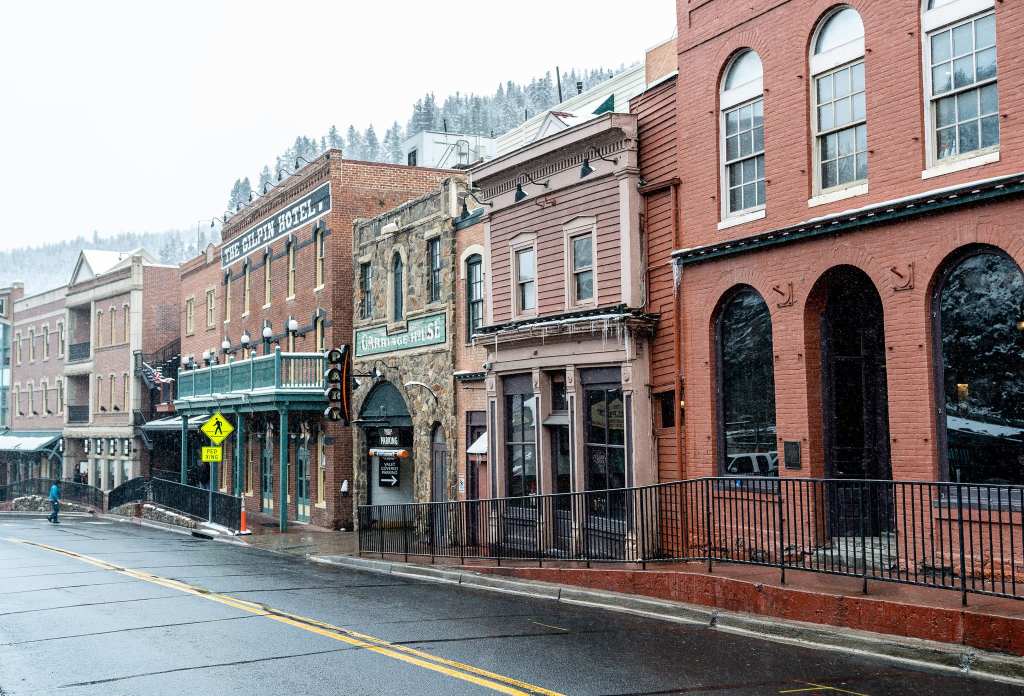
There’s a lot of history here. By 1860, as many as 10,000 prospectors had flocked to the town, then known as Mountain City. Eventually, gold mining decreased rapidly between 1900 and 1920, as the veins were exhausted. Mining revived for a time in the 1930s, as the price of gold spiked from $20 to $35 an ounce (the numbers seem kind quaint, don’t they?). Mining shut down during World War II, when gold mining was declared non-essential to the war effort. The district was enlivened in the 1950s by efforts to locate uranium deposits, but those proved unsuccessful.
Today, the economies of Central City and Black Hawk are almost entirely based on casino gambling.
Nederland, the Low Lands
Leaving Black Hawk, we join Colorado Highway 119 and continue our journey northward on the Peak-to-Peak Scenic Byway. Twenty miles of twisty road later, we arrive in the town of Nederland.
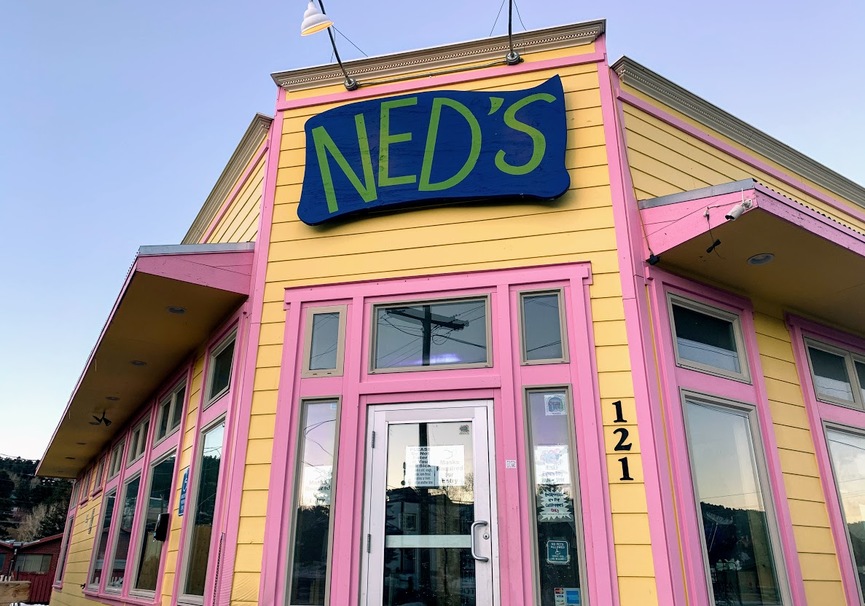
The town, with a population today of 1,500, began as a trading post between Ute Indians and European settlers during the 1850s. Nederland’s first economic boom came when minerals such as tungsten, silver and gold were discovered east of town in the late 1850s.
A man named Abel Breed owned the silver-rich Caribou Mine, not far from here. The mine was at roughly 10,000 feet. The high elevation meant fierce winds and deep winter, so when the Mining Company Nederland bought the mine in 1873, it moved the milling to a lower elevation, near where Nederland is today.
The Mining Company Nederland was based in Holland. In the Dutch language, Nederland means “low land,” and based on casual usage by the Dutch miners, the area was soon called “Nederland.” In 1874, when the town was incorporated, the people chose Nederland as its name. The name stuck, and it remains today. Ironically, Nederland sits at 8,236 feet; it’s a stretch to call it low land.
By 1890 there was little ore remaining to be milled, and Nederland became another mountain ghost town. By 1920, its population dwindled to about 200 people. The final boom in Nederlands happened in the 1940s, when demand for tungsten picked up during World War II. But that didn’t last, either.
Today, Nederland has had a bit of a revival, and is the hub of the Peak-to-Peak Scenic Byway. It’s an easy place to visit from nearby Boulder, just 17 miles away. Nederland is known as a gateway to outdoor recreation in the nearby Indian Peaks Wilderness, Rocky Mountain National Park, Roosevelt National Forest and the James Peak Wilderness.
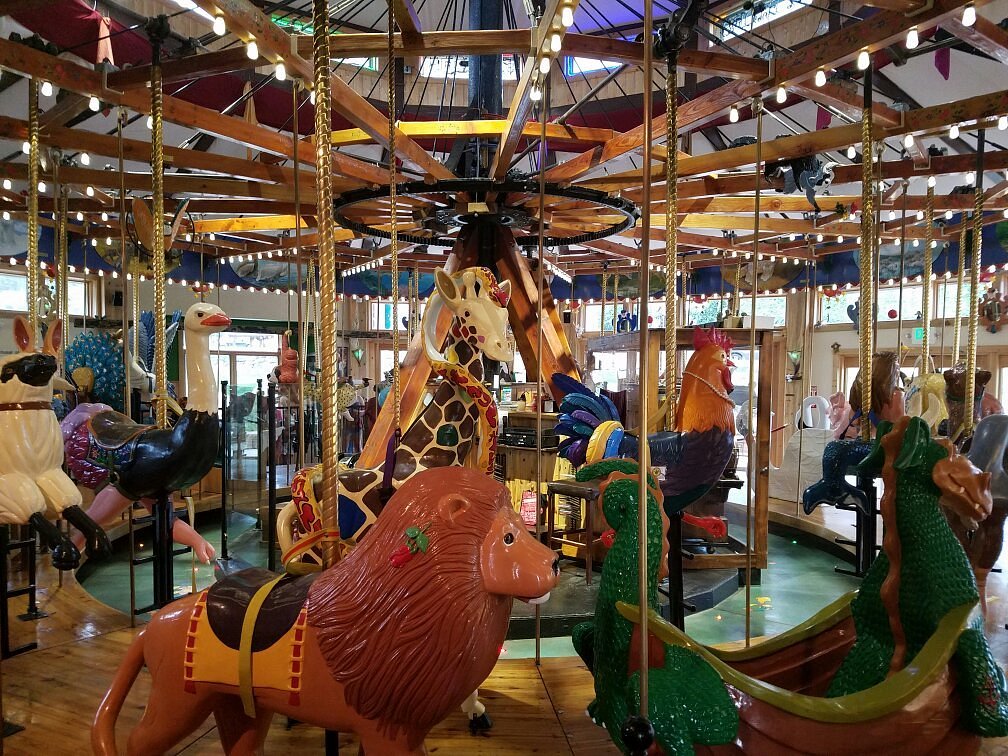
The number one attraction in Nederland is the Carousel of Happiness. It’s one of the last carousels in the US with hand-carved wooden animals. Last summer, the carousel welcomed its one millionth rider since opening in 2010. It has 56 different animals, 35 of which can be ridden. All the colorful creatures are carved by one man, Scott Harrison, who calls himself the Creative Custodian of the Carousel of Happiness. The carousel turns to the music of a restored 1913 Wurlitzer Band Organ. A ride is $3. A small price to pay for a few minutes of happiness.
Returning to Estes Park
Our ride on the Peak-to-Peak Scenic Byway is not quite over. We still have 40 miles to Estes Park.
We pass a number of old mining towns, including Ward, once one of the state’s richest during the Colorado gold rush. The town was named for Calvin Ward, who prospected a claim in 1860 on the site that had been known as Miser’s Dream. Today, Ward has about 150 hearty residents, who brave winters here at its 9,450-foot elevation.
Just 12 miles from Estes Park, we roll through Allenspark, a town of 500. Originally named Allen’s Park, after its founder, Alonzo Nelson Allen, it’s now simply Allenspark. Allen was a miner who built the first cabin in the area. It was called Allen’s Park because, sitting in a meadow, surrounded by towering mountains, it just felt like a park.
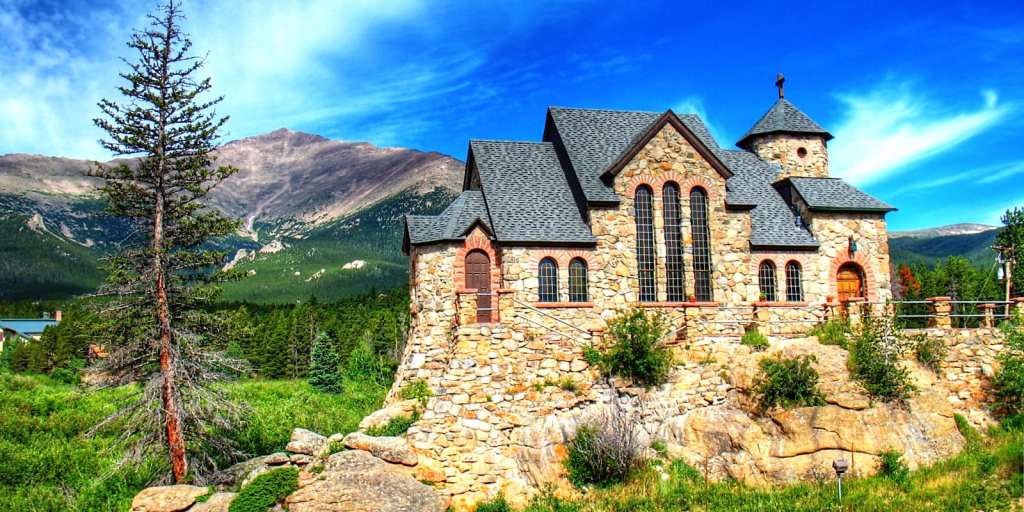
Allenspark’s most notable feature is the Chapel on the Rock at St. Malo, a 100-year-old functioning Catholic church built atop a rock formation. Its official name is St. Catherine of Siena Chapel. The Chapel was first conceived in 1916 by Monsignor Joseph Bosetti, who happened across the rocky area where the church would later be built and was inspired by Matthew 16:19, “Upon this rock I will build my church.”
In 1993, Pope John Paul II visited the Chapel while touring Denver. He prayed inside the church and blessed it afterwards before hiking in the surrounding forest.
We arrive in Estes Park shortly after 4 pm, having completed our 192-mile loop, half of it a déjà vu-like repeat from the day before.
Tomorrow, we’ll try something completely different.
***
The Day in Review:
Click here to see today’s complete route from Estes Park, Colorado and back to Estes Park – via the Peak-to-Peak Scenic Byway, and the Trail Ridge Road Scenic Byway – an All-American Road.
Today’s Takeaways:
- Peak-to-Peak Scenic Byway for peak pleasure.
- A low land in Nederland, elevation 8,236 feet.
- Allenspark is Allen’s Park.
Today’s Trivia: Black Hawk, a Colorado Gambling Mecca
When we rolled through Black Hawk and Central City today, at the start of the Peak-to-Peak Scenic Highway, it felt like we were in the middle of a tiny gambling mecca. Las Vegas without the neon. Monte Carlo without the luxury. Macau, China — without the Wynn, the MGM Grand, and the Venetian. Atlantic City, without the boardwalk.
There are 18 casinos in Black Hawk, population 128. Adjacent Central City, population 785, has six casinos.
How on earth did that happen?
In the 1980s, the three historic Colorado mining towns of Black Hawk, Central City and Cripple Creek – southwest of Colorado Springs – were facing an economic and existential crisis. Hard-rock mining no longer supported the economies of the towns, tourists were visiting other attractions across the state, and the buildings that gave the communities their historic character were deteriorating.
Like most states, Colorado did not have enough public funds to take on long-term restoration and preservation of the three towns, let alone the thousands of historic sites across the state.
So, Colorado looked to South Dakota, which had passed a state constitutional amendment legalizing gambling in the historic Black Hills town of Deadwood. The South Dakota amendment carried the stipulation that revenues from gaming activities be used to revitalize the economically stagnant community, and provide for the long-term restoration and protection of its historic resources.
Citizens of Central City began pursuing a similar amendment in Colorado, which eventually became Amendment 4 on the 1990 ballot. On November 6, 1990, 57 percent of voters approved it – and the result is what you see when passing through the tiny towns.
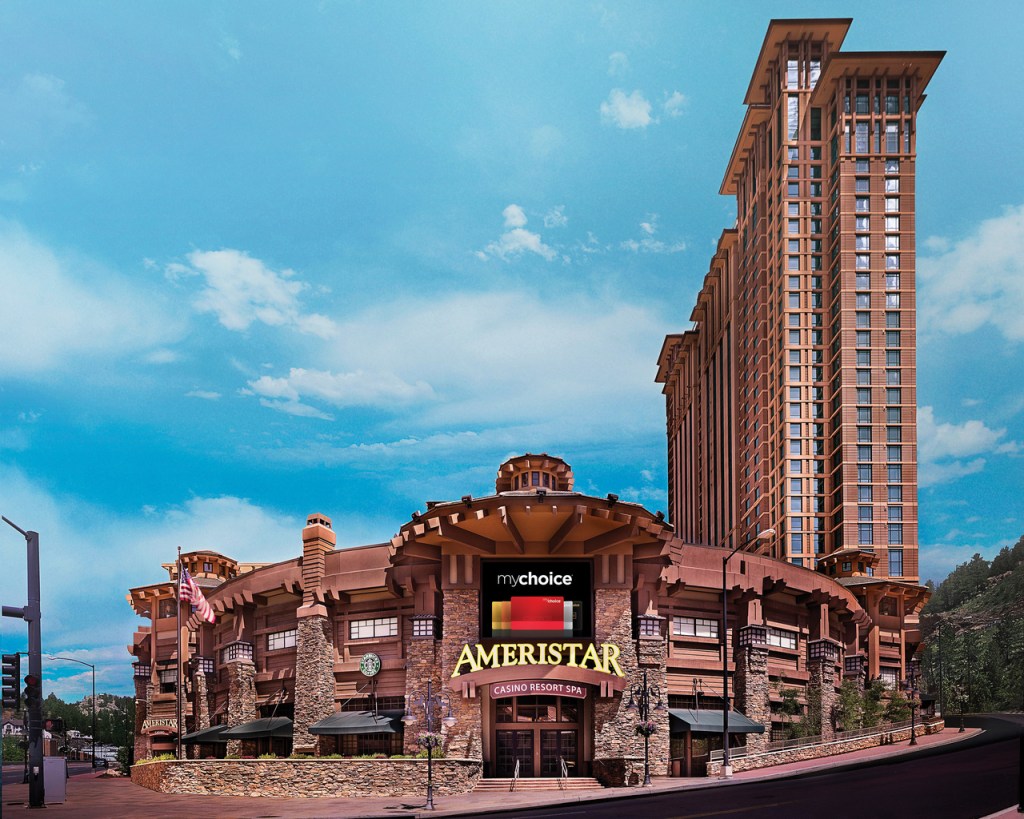
Ameristar is the largest of the casinos, with 57,000 square feet of gaming space and a 34-story, 536-room hotel. Some of the casinos in Black Hawk and Central City operate 24/7. Together, the casinos in the three cities benefitting from Amendment 4 bring in an estimated $850 million in revenue every year. Since gambling began thirty years ago, it has generated nearly $20 Billion in Colorado casino revenue.
The state constitution directs the Department of Revenue to deposit 28 percent of gambling tax revenues into a State Historical Fund, managed by the Colorado Historical Society. Since 1992, when gambling revenues were first collected, the State Historical Fund has contributed more than $330 Million in grants to all 64 Colorado counties.
With an area of less than two square miles, Black Hawk claims to hold the distinction of being the least populous city in Colorado, although at any given time, there are more guests in the hotels and casinos than residents of the city. Black Hawk’s town motto: “Preserving the Past, Preparing for the Future, Still Making History.”
When Amendment 4 was approved more than 30 years ago, it limited bets to $5, and allowed only slot machines, poker and blackjack. Since then, the Colorado state legislature approved higher limits, and sports betting became legal in 2020. Today, there’s no limit on your bets. You can lose as much money as you’re willing to risk.
And now you know.
 Riding With Gary
Happy Father’s Day from your adopted CA daughter! 🥰 Love you guys!
LikeLike