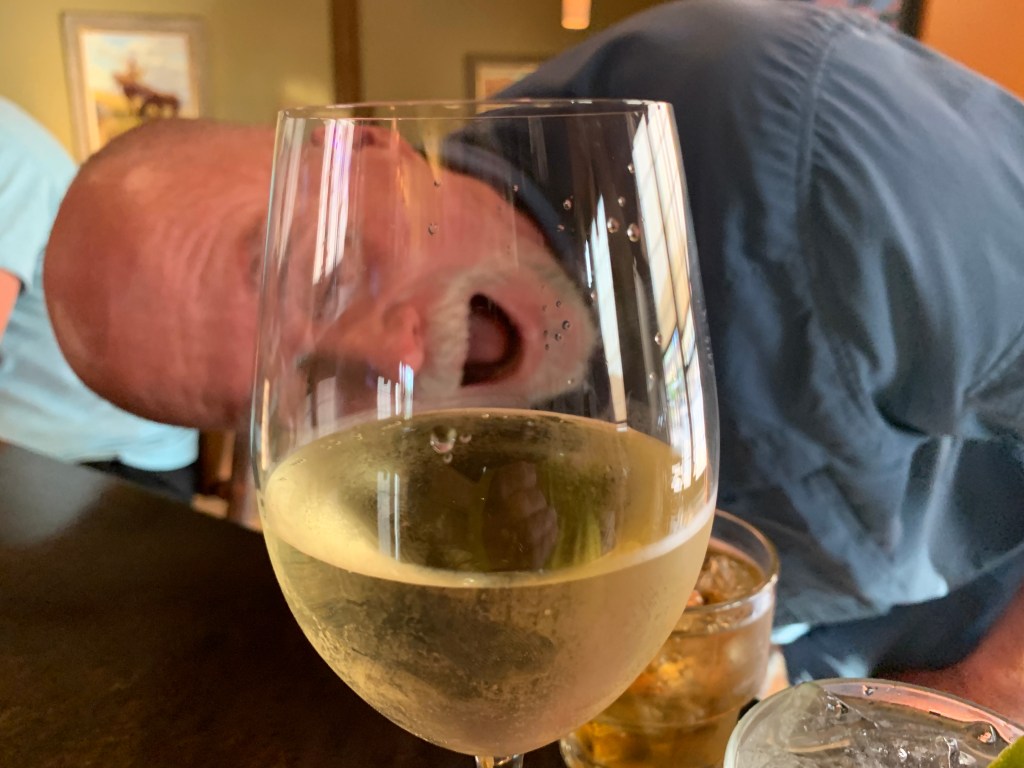
Half a million riders from all over the country are gathering for the annual Sturgis Motorcycle Rally, which officially begins tomorrow. Dave, Scott and I are among them.
Two biker babes, Sarah Murr and Gail Bowman, were supposed to be joining the posse for our four days in the Black Hills. You may know them as Mrs. Gary Lesser (which she doesn’t call herself) and Mrs. Dave Bowman. Sadly, Sarah couldn’t make her flight out of Eagle, Colorado, because of the I-70 closure through Glenwood Canyon. Damn!
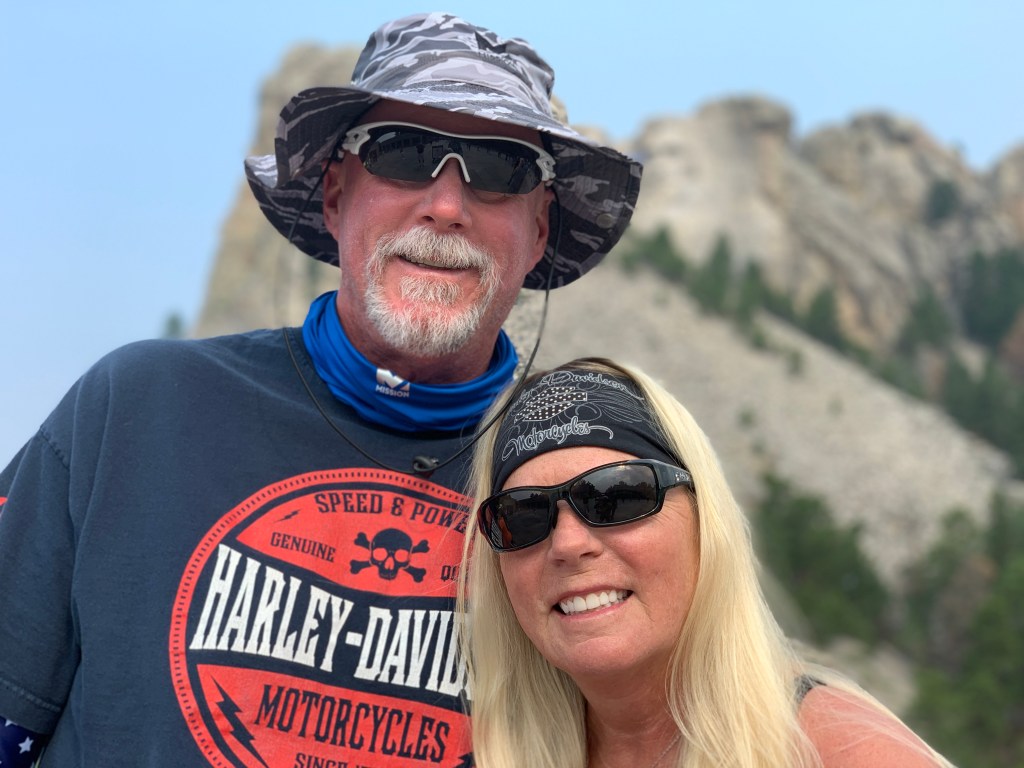
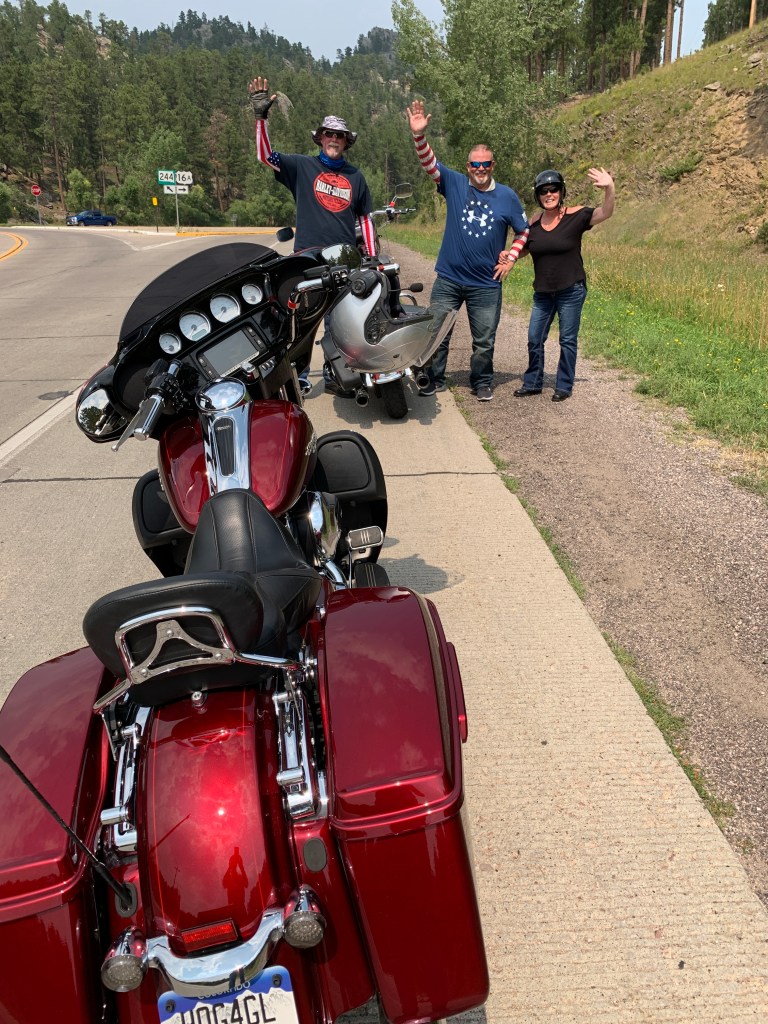
But Gail successfully flew into Rapid City yesterday from Southern Nevada to ride and party with the Harley glitterati. Welcome, Mrs. Bowman! Glad to have you aboard.
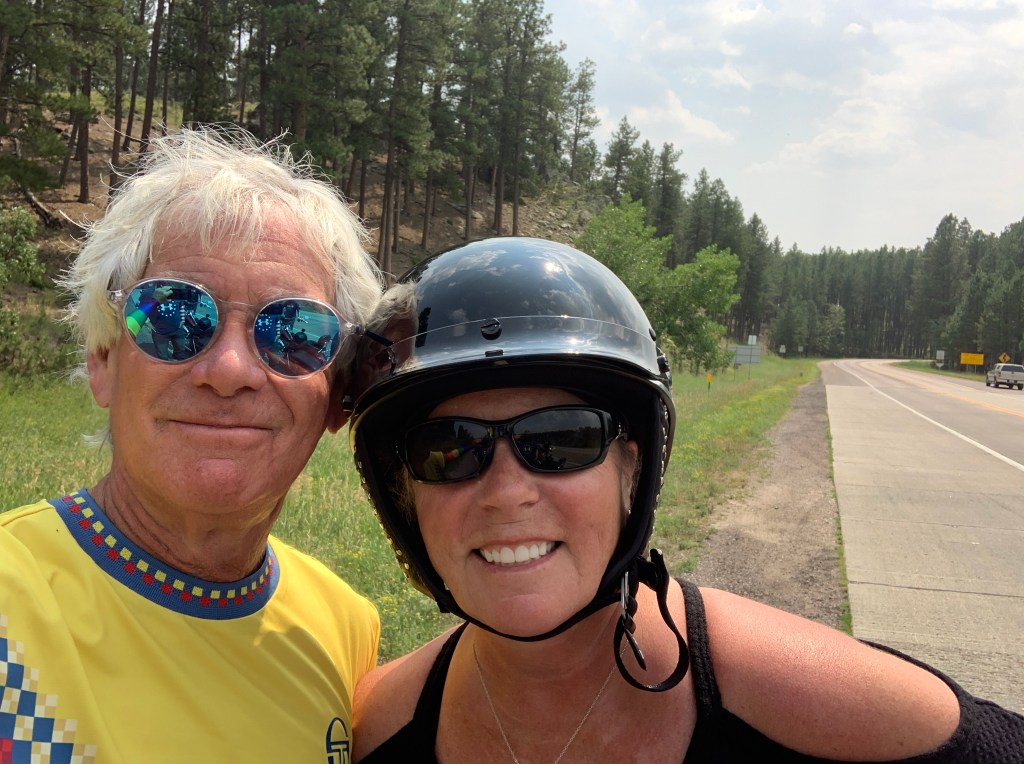
Many Harley enthusiasts come here every August. They couldn’t imagine a year without a trip to the Black Hills. So, of course, they’re particularly restless this year. Some missed the 2020 event, which was wisely cancelled due to Covid-19. Hundreds of thousands showed up, anyway.
We missed the 2020 Sturgis rally, too. Our posse had been planning a 2020 Sturgis trip, ever since we finished the three-week 2019 journey to Canada and back, nearly two years ago.
Having the Sturgis rally last year, as though we were living in normal times, would have been one of the stupidest ideas. Ever. And yet it went on as usual – 460,000 knuckleheads gathering in the Black Hills, despite South Dakota being, like the rest of the world, in the midst of a pandemic.
Because of its freedom-thinking, personal responsibility-loving population, and a governor who largely ignored Covid, South Dakota was harder hit by the pandemic than other states that took it more seriously. Masks? Social distancing? Not here.
Downtown Sturgis during unofficial rally week last year was one gigantic Petri dish – thousands upon thousands of riders, many with underlying health conditions, disdain for public health restrictions, generally dismissive of science, bringing their germs and viruses from every corner of this country.
What could possibly go wrong?
Now back to a semblance of normal, riders at this year’s rally are scattered all over the Black Hills, from Rapid City to Deadwood, from Belle Fourche to Spearfish. More than likely, there will be more than a half-million of us converging on this tiny town.
We’re all here for pretty much the same reasons: Great riding on fabulous roads, biker camaraderie, a chance to show off our beautiful bikes and Harley mamas — and of course, Sturgis.
***
Tourism is big in South Dakota, accounting for more than 55,000 jobs, and bringing in about $4 billion annually. The state estimates as many as 15 million visitors a year come to South Dakota, generating more than $300 million in tax revenue. Tourism spending supports almost nine percent of all jobs in South Dakota.
Big numbers, for sure. But the really big drivers of the state economy are agriculture, manufacturing and mining.
Agriculture, including livestock and crops, has about a $21 billion impact annually on the state’s economy. The state has an estimated five beef cattle per resident of South Dakota. That’s a lot of T-bones!
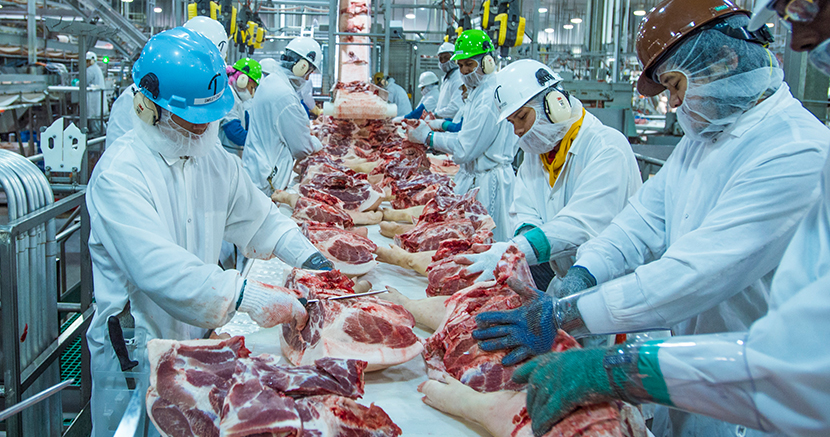
Manufacturing accounts for about 10 percent of the state’s workforce. Food processing is a big part of that, including gigantic operations like Smithfield Foods. The Sioux Falls pork producing facility, home to a large-scale Covid outbreak, is one of the largest food processing sites in the US. Its 3,700 employees supply nearly 130 million servings of food per week.
And there’s mining. Even though the gold mine in Lead closed down in 2001, other types of mining continue – including construction sand, gravel and stone. Minerals like gypsum, silver and copper are found in abundance. One of my favorite places of higher learning is South Dakota School of Mines and Technology. Best college nickname ever. Go Hardrockers!
This week, more than any other, tourism is king. Hundreds of thousands of motorcycle riders are descending on the Black Hills. They’ll spend an estimated $800 million on beer, burgers, hotel rooms and souvenirs, proving they made it to Sturgis. Each August, the rally accounts for about 95 percent of Sturgis’ annual revenue.
***
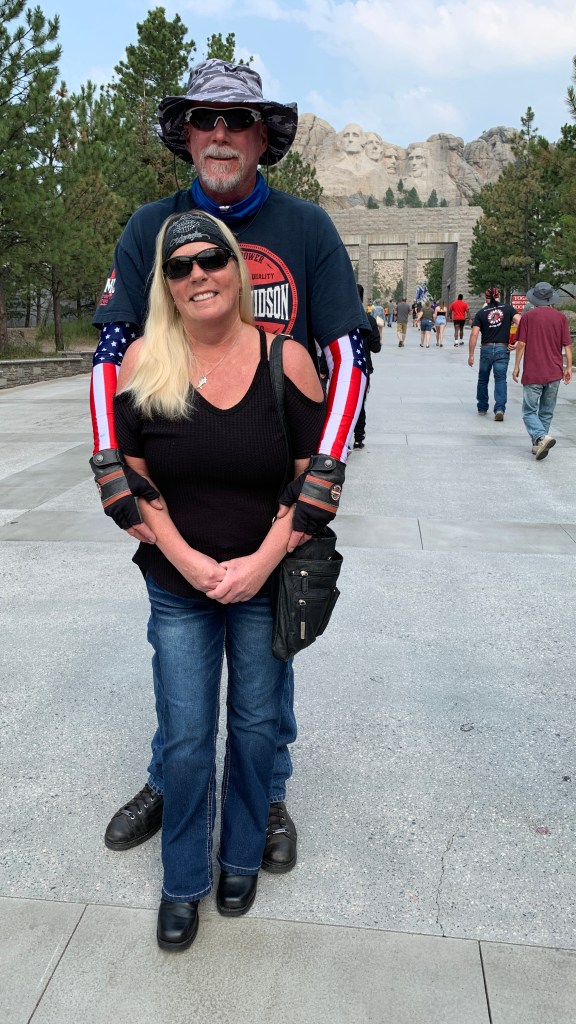
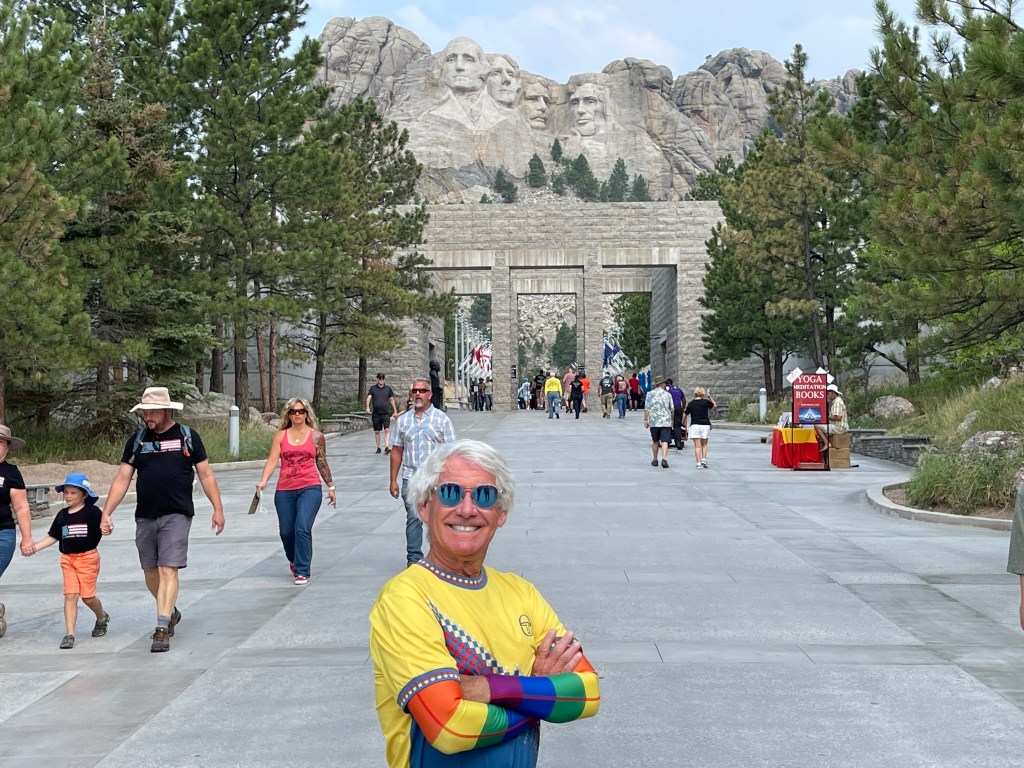
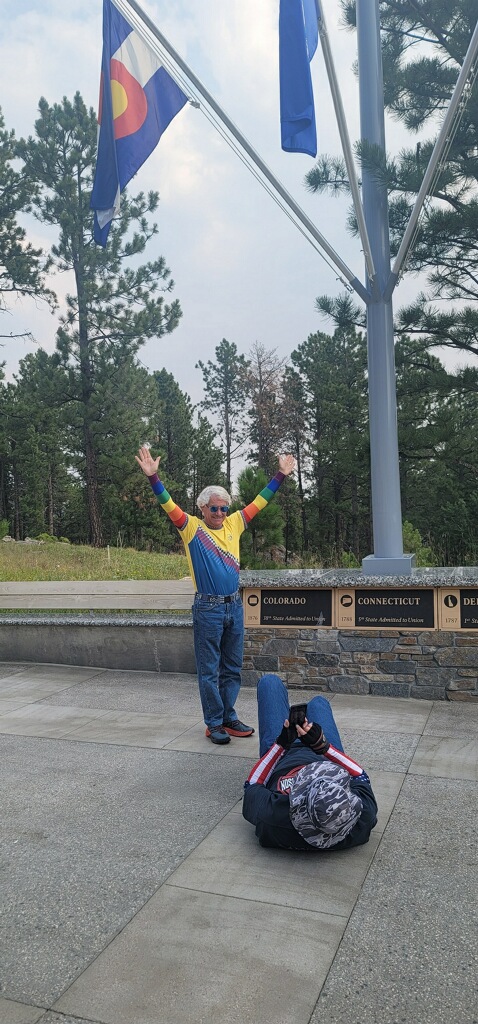
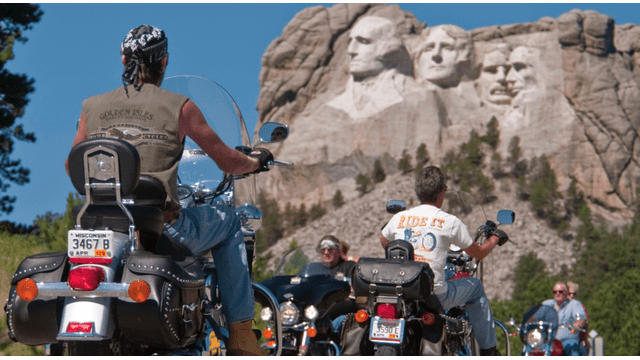
We begin our journey through the Black Hills by heading south out of Rapid City on US Highway 16, also called Mount Rushmore Road. It’s an easy, well-marked, 30-minute ride to the Mount Rushmore National Memorial – South Dakota’s biggest lure for all those millions of tourist dollars.
The Mount Rushmore Memorial, of course, is a sculpture carved into the granite face of the mountain, featuring 60-foot-high depictions of four US Presidents: George Washington, Thomas Jefferson, Theodore Roosevelt, and Abraham Lincoln.
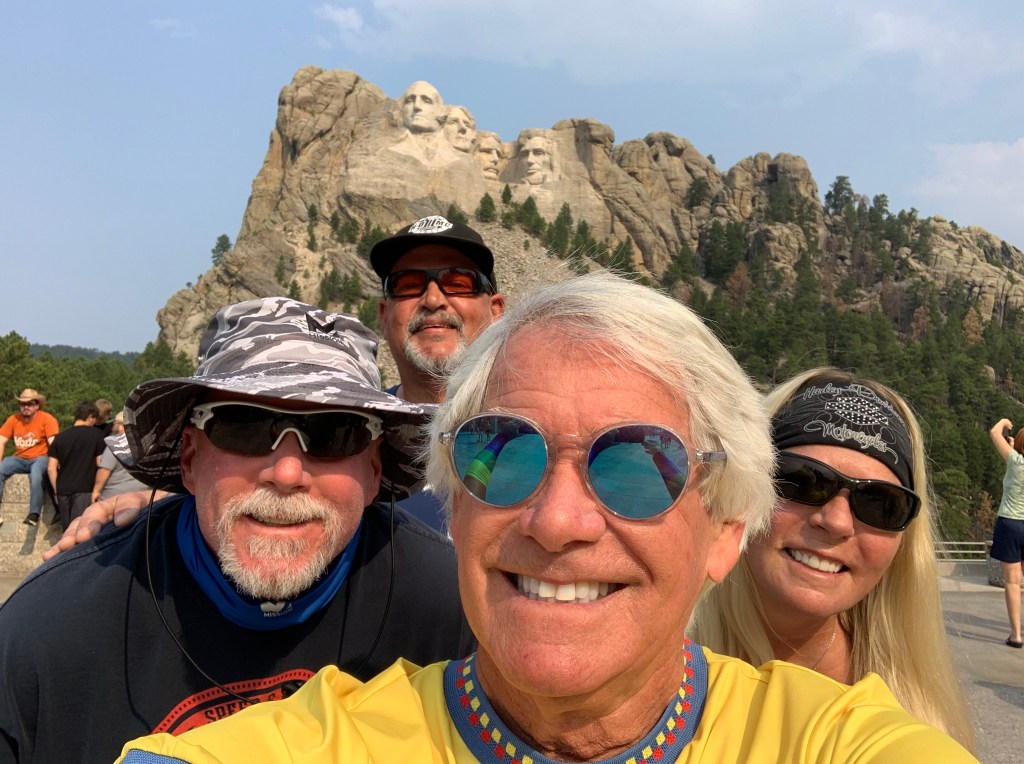
Mount Rushmore is by far the state’s top tourist attraction. Nearly two and a half million visitors come here each year. The only national monuments or memorials seen by more tourists are in Washington DC or New York City, which have a somewhat larger population base to draw from than the greater metropolitan Rapid City area.
Sturgis rally week is a particularly crazy time at the Mount Rushmore Memorial.
Work on the mountain, carving the presidential faces, took place between 1927 and 1941. It was a Depression-era feel-good project. Danish-American Gutzon Borglum and his son, Lincoln Borglum, led a team of more than 400 workers on the gigantic rock carving effort.
More than 90 percent of the memorial was sculpted using dynamite; the blasts removed about 450,000 tons of rock. Details were finished with jackhammers and hand chisels. The initial concept called for each president to be depicted from head to waist, but lack of funding forced construction to end in late October 1941, with faces only.
***
We leave Mount Rushmore, continuing west on South Dakota Highway 244. The highway takes us around 7,242-foot Black Elk Peak, the highest point in the US east of the Rockies. Atop Black Elk Peak is a stone fire tower built by the Civilian Conservation Corps in the 1930s. The tower has a panoramic view of the Black Hills.
We continue circling Black Elk Peak, turning south on South Dakota Highway 87, part of the Peter Norbeck National Scenic Byway.
When he was a US Senator in the 1920s and ‘30s, Norbeck proposed most of the roads that now make up the Peter Norbeck Scenic Byway, a route that was proclaimed one of America’s top 10 scenic drives by the Society of American Travel Writers.
The roads were built with hundreds of curves, switchbacks and other architectural features, designed to limit the speed of travelers to 35 miles an hour, so they could best enjoy the beauty of the Black Hills.
Norbeck personally explored Iron Mountain at age 63, looking for views that best showed off the Black Hills landscapes and the emerging faces being carved at Mount Rushmore. He also served two terms as South Dakota’s Governor, and is often remembered as “Mount Rushmore’s great political patron,” for promoting construction of the sculpture and securing federal funding for it.
At the highest point on the Peter Norbeck Scenic Byway, on the summit of Iron Mountain, there is a small memorial recognizing his legacy, and describing him as: “Well driller, Statesman, first native Governor of South Dakota, US Senator, founder of Custer State Park, sponsor of Mount Rushmore Memorial, road builder, art lover, poet of nature, patriot, gentleman.”
Nice way to be remembered. We should all be so well thought of.
***
Highway 87 next takes us to Sylvan Lake, and Sylvan Lake Lodge, known as the crown jewel of Custer State Park, which we’re now in. Custer is South Dakota’s largest state park, with more than 71,000 acres of hilly terrain. It’s home to many wild animals – which we expect to see later today.
Sylvan Lake is probably the most recognizable of the five Custer State Park lakes. It’s a favorite for photographers and artists, and a popular spot for weddings and other popular occasions, including an occasional bar mitzvah.
Very occasional.
There are less than 400 Jews in all of South Dakota, the fewest of any state in the country. That’s less than a tenth of one percent of South Dakota’s population. The state has only one permanent rabbi, 31-year-old Mendel Alperowitz, who moved his family from Brooklyn, New York, in 2016 to lead the congregation in Sioux Falls, South Dakota.
Rabbi Alperowitz is the first Rabbi to live in the state since the late 1970s. He says he misses the kosher sushi available in New York, but feels a calling to serve the tiny Jewish community in South Dakota.
In Rapid City, at the Synagogue of the Hills, a lay leader orchestrates bar mitzvah ceremonies, performs ritual circumcisions and conducts funeral services. The tiny Jewish community worries that too few children are coming along to sustain it.
***
From Sylvan Lake, we continue east on Highway 87, where the road is now known as the Needles Highway.
The Needles Highway name comes from the needle-like granite formations that seem to pierce the horizon along the highway. The Needles are eroded granite pillars, towers and spires, popular with rock climbers, tourists, and dudes on Harleys.
A portion of the Needles Highway is designated a National Natural Landmark, recognizing and encouraging the conservation of the natural history in the US. The National Natural Landmarks program recognizes the best examples of biological and geological features in both public and private lands.
The Cathedral Spires and Limber Pine Natural Area, on the Needles Highway, has been such a National Natural Landmark since 1976. The Cathedral Spires are a unique geological formation that provides untold rock-climbing opportunities.
The Cathedral Spires are one of 13 National Natural Landmarks in South Dakota, and were the original site proposed for the Mount Rushmore carvings. But sculptor Gutzon Borglum rejected the location because of the poor quality of the granite and the fact that the Needles were too thin to support the presidential sculptures.
A series of narrow rock tunnels are a highlight of the Needles Highway. The tunnels can fit only one car or motorcycle at a time.
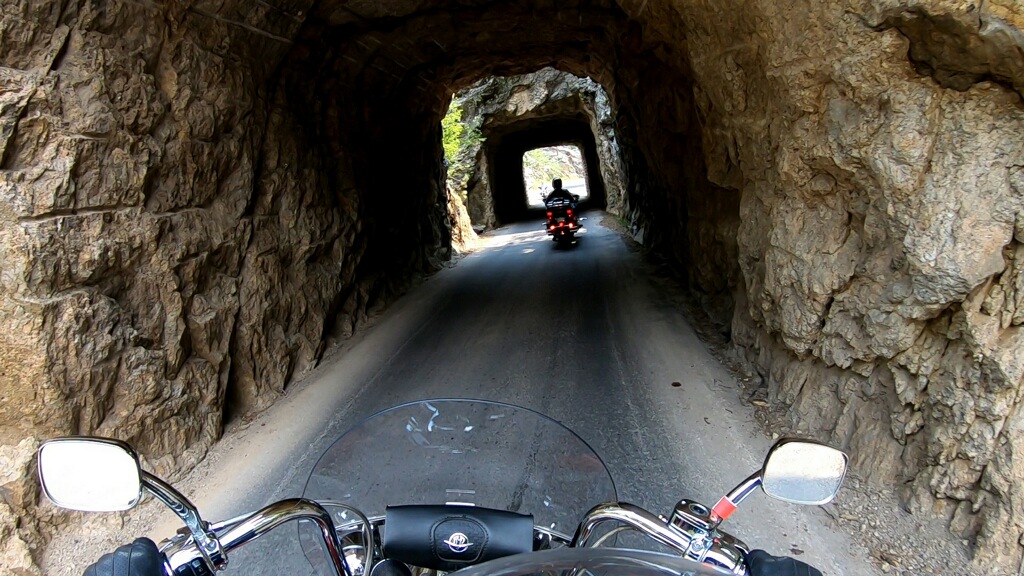
The 14-mile-long Needles Highway attracts about 300,000 people every year, many during Sturgis Rally Week. Seems like 295,000 of them are here today.
Because of snow, the Needles Highway is closed during the winter, and re-opens for driving and riding (if you’re on a motorcycle, it’s called riding) every year in early April. It would be difficult to imagine a trip to the Black Hills that didn’t include this roadway.
***
We continue south on Highway 87, and eventually turn east on Wildlife Loop Road, one of the highlights of Custer State Park. Wildlife Loop Road travels through 18 miles of open grasslands and pine-speckled hills that much of the park’s wildlife calls home.
On Wildlife Loop Road, you might see bison, pronghorn, whitetail and mule deer, elk, coyotes, burros, prairie dogs, eagles, hawks, and a variety of other birds.
Traffic is congested and the pace is slow, rarely over 20 miles an hour.
The free-roaming buffalo herd in the park numbers about 1,300. Most safety guidelines suggest you stay in your vehicle when buffalo are approaching. We’ll see how that works on a Harley.
We slowly follow Wildlife Loop Road through the park until it meets up with US Highway 16A near the State Game Lodge at Custer State Park Resort. The lodge, built in 1920 from native stone and timber, is listed on the National Register of Historic Places. It served as the summer White House for President Calvin Coolidge in 1927, and was visited by President Eisenhower in 1953.
The Wildlife Loop Road is open year-round, subject of course, to the predictably unpredictable weather in the Black Hills. When the snow falls, it’ll be plowed off the road, just as soon as the buffalo get out of the way.
***
We join Highway 16A and head northwest. The highway is more familiarly known as Iron Mountain Road. It’s a 17-mile stretch of paved paradise featuring 314 curves and 14 switchbacks. Your speed seldom exceeds 20 miles an hour on Iron Mountain, all the better to make the leisurely ride utterly enjoyable.
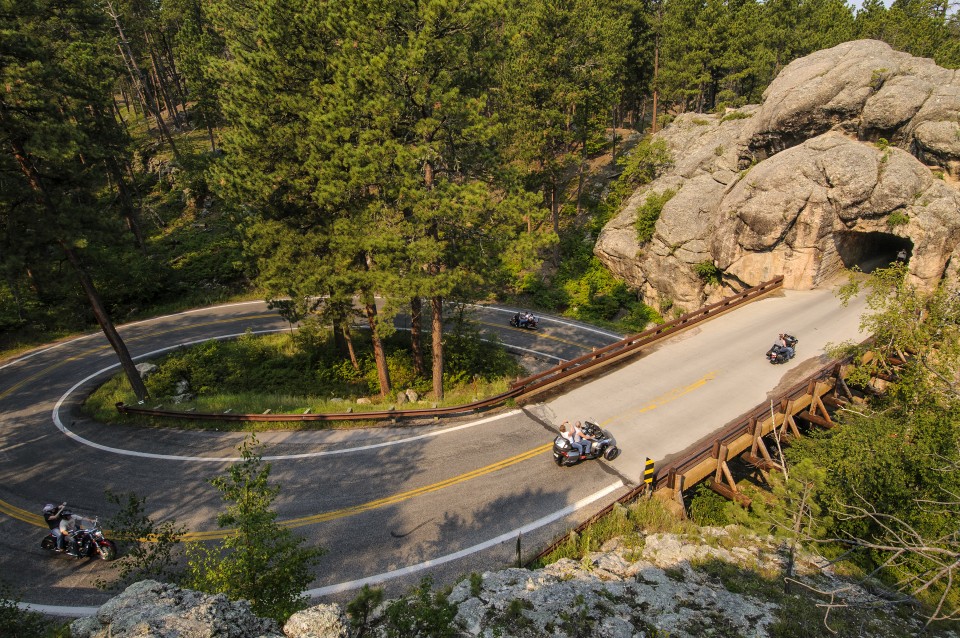
One of Iron Mountain Road’s unique features is the three “pigtail” bridges which spiral the rider back over the road they just went on in one massive sweeping turn. The result is a corkscrew shape. Most of these so-called pigtail bridges in the US were made of wood, and built by the Civilian Conservation Corps in the 1930s.
The 17-mile-long Iron Mountain Road also has one-lane rock tunnels that offer spectacular views of Mount Rushmore as you exit the tunnels. The tunnels were blasted through sheer granite walls when they were built by the Civilian Conservation Corps.
The first tunnel we come to is Scovel Johnson Tunnel, named for the man who led the construction of the Needles Highway. Johnson also did survey work on Iron Mountain Road, and contributed to the layout of Sylvan Lake. This tunnel with his name on it is 8’9” wide by 9’8” high, making it the narrowest tunnel in South Dakota.
The second tunnel on Iron Mountain Road is the CC Gideon tunnel, named for Cecil C. Gideon, who designed and built many local structures in the Black Hills, Among Gideon’s legacies are the Custer State Park Game Lodge and the famous pigtail bridges on Iron Mountain Road. The CC Gideon Tunnel is a little roomier, giving riders 11’ 6” of width and 10’ 9” of height to work with.
The third tunnel is the Doane Robinson Tunnel. It perfectly frames the faces on Mount Rushmore, as you ride through the tunnel. Robinson was the state historian of South Dakota in the 1920s, and is best known for dreaming up the idea for the Mount Rushmore National Memorial. The Doane Robinson Tunnel is the roomiest of the three. It’s 12 feet wide, and 11’ 4” high.
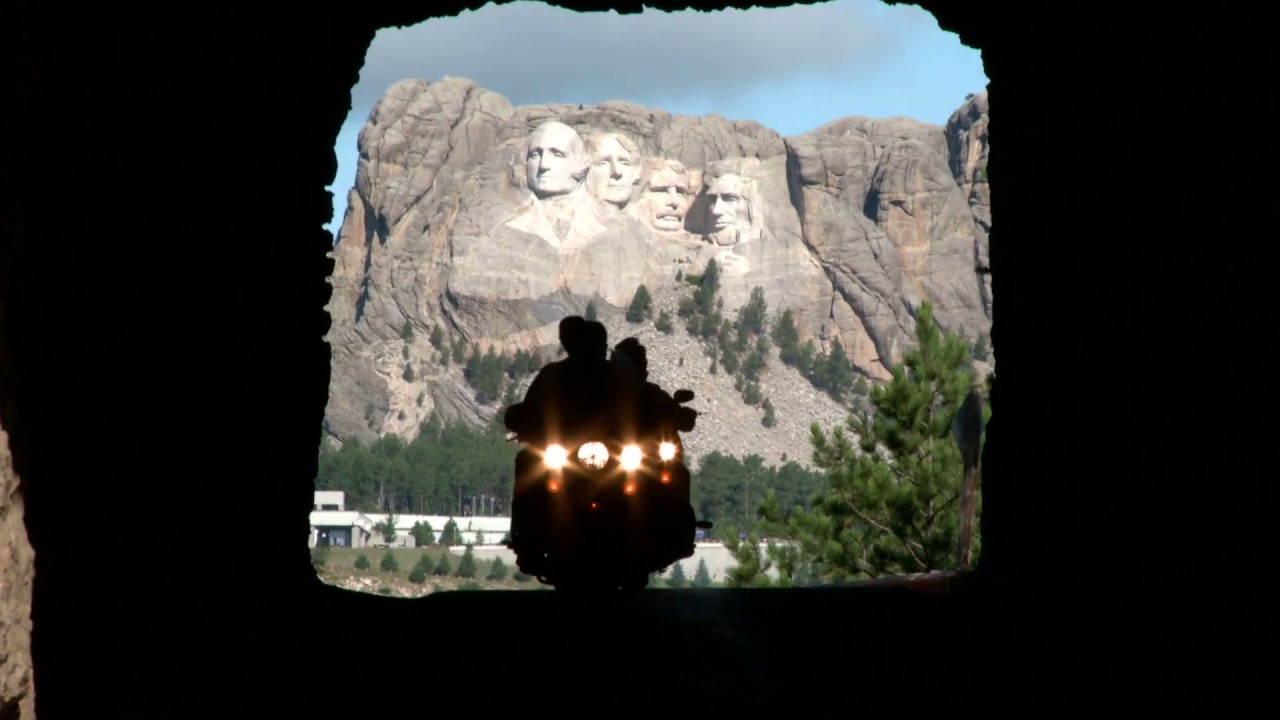
If you want to enjoy the pigtails and tunnels over and over again, you can do that year-round. The Iron Mountain Road is open throughout the year, barring a big dump of snow in the Black Hills. After the snowfall, the road will be plowed, and you’re free to continue your joyride.
***
From the time we exit the Iron Mountain Road’s final pigtail, it’s only about a mile until we arrive in the historic town of Keystone – considered the home of Mount Rushmore, only two miles away.
In Keystone, there are two distinct parts to the town – the “New” Keystone, a mile-long retail district along US Highway 16A, and the “Old” Keystone, the original gold mining settlement along east-flowing Battle Creek.
Keystone, which got its name from a local mine, was once a boomtown after the discovery of placer gold two miles east of the town’s current location. Placer gold is still thought to exist here in abundance, but the great depth of the deposits makes it difficult and impractical to reach.
With a population of a little more than 300, Keystone comes to life each summer during tourist season, never more so than during Sturgis Rally week. For such a small town, Keystone has a thriving food scene, with nearly two dozen restaurants.
Leaving Keystone, it’s a 20-mile ride back to Rapid City, where we park the bikes and relax after a day of exploration in the Black Hills.
***
Day Thirteen Summary: 125 miles. Mount Rushmore, pigtails, wildlife.
Click here to see today’s complete route from Rapid City, South Dakota, to Mount Rushmore, through the Black Hills and back to Rapid City.
Today’s fun facts, favorite foods, funky place names and famous folks:
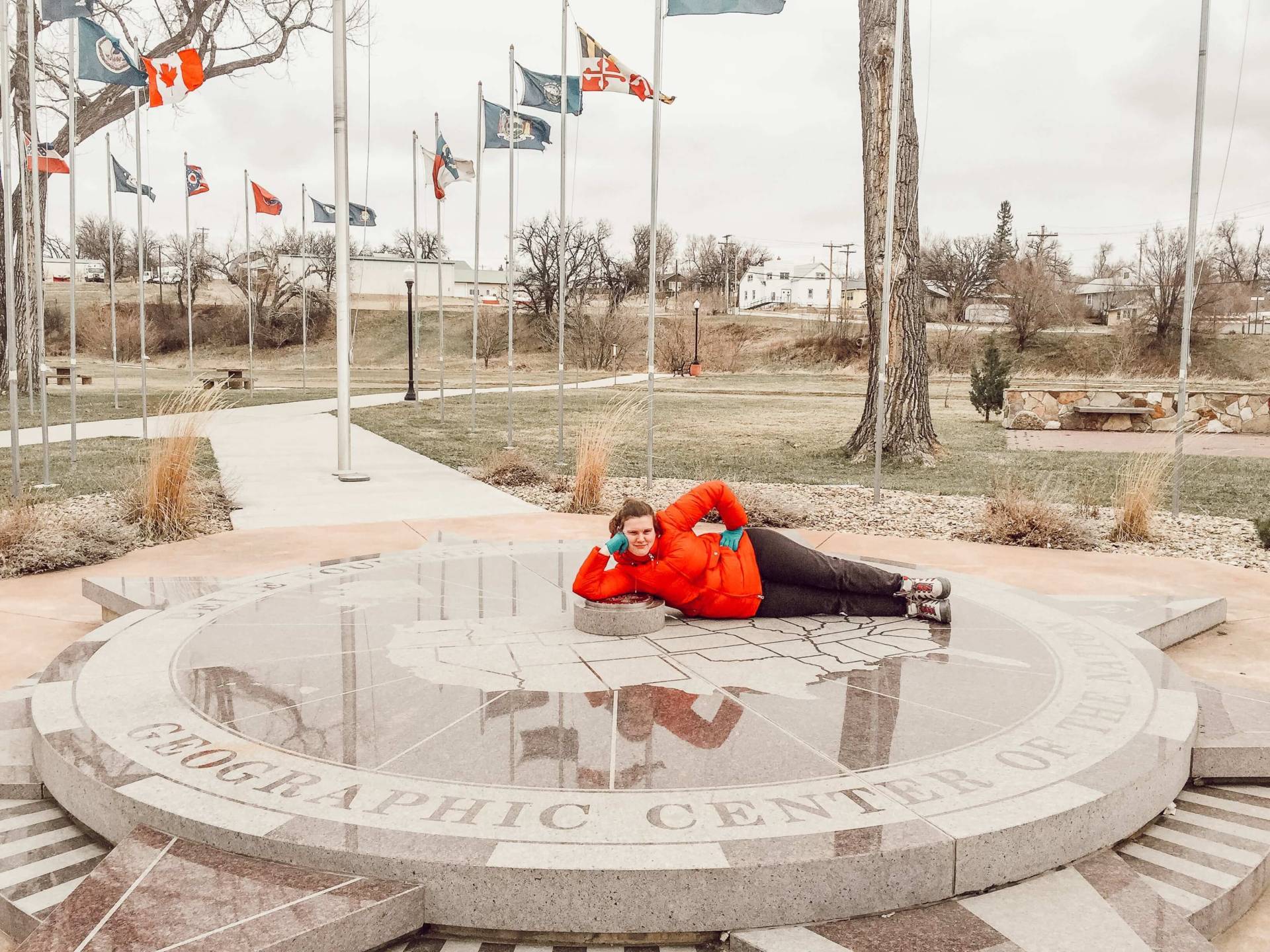
South Dakota fun fact: Belle Fourche, about 55 miles northwest of Rapid City, is the geographical center of the United States of America. In 2008, a large granite compass rose was installed in Belle Fourche, and called the “Center of the Nation” monument. The actual geographic center is 20 miles north of Belle Fourche on private farmland, but Belle Fourche is the closest town and a good place for the monument and visitor center.
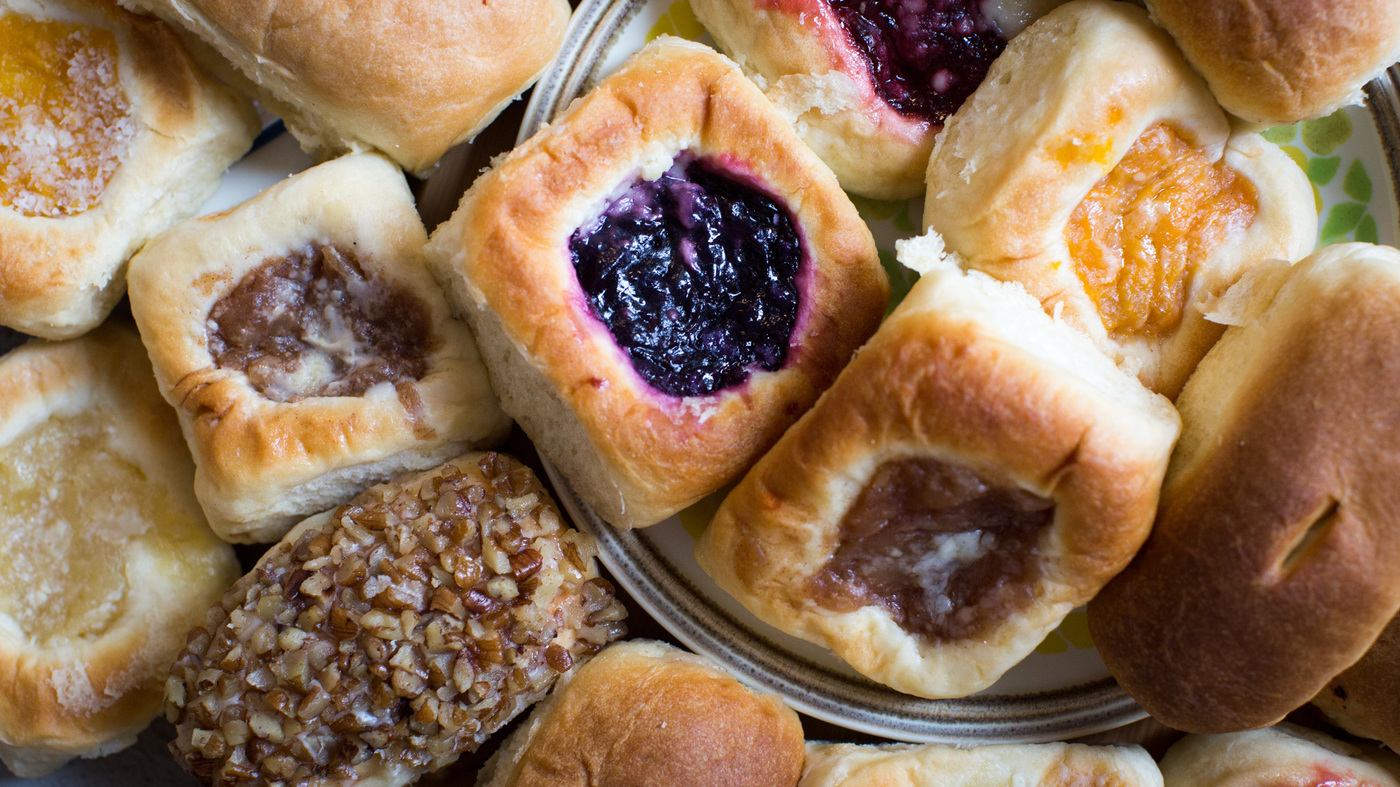
South Dakota favorite food: Kolache, which originated in Central Europe, is a delicious pastry topped off with candied fruit or cream cheese. Kolaches are similar to tiny pies. One of the best places to get your hands on kolaches is in Tabor – the unofficial Czech capital of South Dakota. Great place for kolache: Czeckers restaurant in Yankton.
South Dakota funky place name: The town of Volin looks like “violin” but clearly isn’t. With a population of 161, it’s one of the smallest towns that has an Interstate exit. It’s 20 miles west of I-29, it was the only town directly off the Interstate near Union Grove State Park, so it got an exit.

South Dakota famous folk: Tom Brokaw, former NBC Nightly News anchorman, grew up in Yankton, South Dakota, and graduated from the University of South Dakota in Vermillion. During the heyday of network TV news, Brokaw competed against Peter Jennings (ABC) and Dan Rather (CBS). He’s also written a number of best-selling non-fiction books, including The Greatest Generation and The Fall of Richard Nixon. Today, at age 81, Brokaw is still actively engaged in reporting on the American experience.

Sturgis, anyone?
Vroom.
A look ahead @ tomorrow: Badlands and Wall Drug.
 Riding With Gary
Oh Gary, did not enjoy the shot from Scott’s go pro camera! Jeeps, daughter, brother and son? Yes, you too! Better for me to worry from a distance! Have fun (even at my expense! LOL). Keep blogs coming as I do enjoy MOST of your info. Hugs and safety!
LikeLike
Not to worry, Lynn. We are all about safe travels. Good to hear from you. We’re busy keeping ourselves out of trouble. More fun tomorrow. Vroom!
LikeLike
The pigtails and tunnels are my FAVORITE when riding in the Black Hills. And the buffalo. 🥰
LikeLike
It’s especially exciting when pigtailed buffalo 🦬 are in the tunnels with us. Vroom!
LikeLiked by 1 person
Hehe
LikeLike
Interesting blog today. I find it hard to believe that the geographical center of the US is in SD. It seems to me (eyeballing it admittedly ) it should be somewhere in NE. Perhaps even IA or Ks or the point of all 3 intersecting ! I do remember a dispute on the geographical center of North America when we lived in MN as it was an argument between cities in the Dakotas (MN neighbours). In any event it makes a great tourist attraction just like the monument at The Four Corners. You should have titled today’s blog: “Journey to The Centre of America”😂. Safe travels and when does Sarah join you?
LikeLike
We’ll, if I’d called the blog post, “Journey to the Centre of America,” I would have gotten grief for misspelling Center. Can’t win 😢😢😢
As to Sarah’s arrival, did you read the blog? Near the beginning, I expressed my Am disappointment for her not being able to join us, due to interstate highway closure between Carbondale and the airport. So, there’s an open and available spot on the back of my Harley, Judith. Just sayin …
LikeLike
Great blog, as usual, Gary! Glad Gail was able to join but sorry that Sara wasn’t – that sucks. I’ve never been to Mt.Rushmore before but will add it to my bucket list. Happy Anniversary, Bowmans!! Take care all!!
LikeLike
Party on, Mo. 🎉🎊🎈Big celebration tonight for Bowmans. Not too late to grab a flight to Sturgis International Airport!
LikeLike