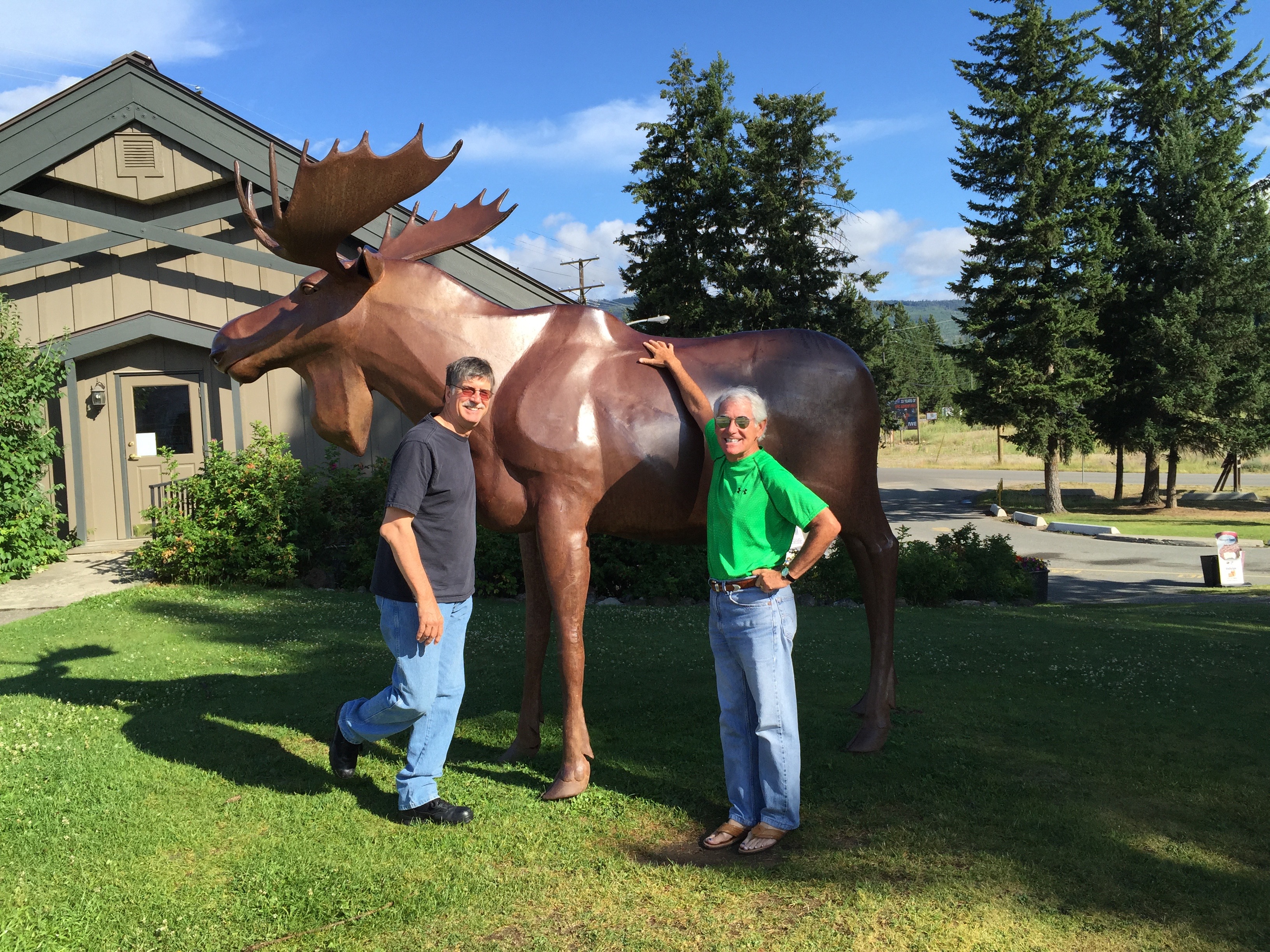
Our day begins with breakfast at the Strawberry Moose Snackery, a three-minute walk from our hotel. The Snackery is full of locals. We appear to be the only tourists who’ve discovered the place. The sun’s out, a good omen after yesterday’s ride in the rain.
So enamored with the story about how the Yellowhead Highway got its name (think of a blond guy), we decide this morning to follow the road north to the entrance of Mount Robson Provincial Park.
The Southern Yellowhead Highway traces the gentle curves of the North Thompson River most of the way to the village of Valemount, a railway station that’s home to 1,000 residents. Ten miles north of Valemount, we arrive in Tête Jaune Cache, which sits on the Fraser River.
Tête Jaune Cache is at the intersection of the Southern Yellowhead Highway, and the Yellowhead Highway – Canada Highway 16. This settlement of 500 residents is also named after fur trader and trapper Pierre Bostonais (remember him from yesterday’s blog post?). Bostonais was nicknamed Tête Jaune by French explorers because of his blond hair; Tête Jaune is French for yellow head. Cache means “hiding place.”
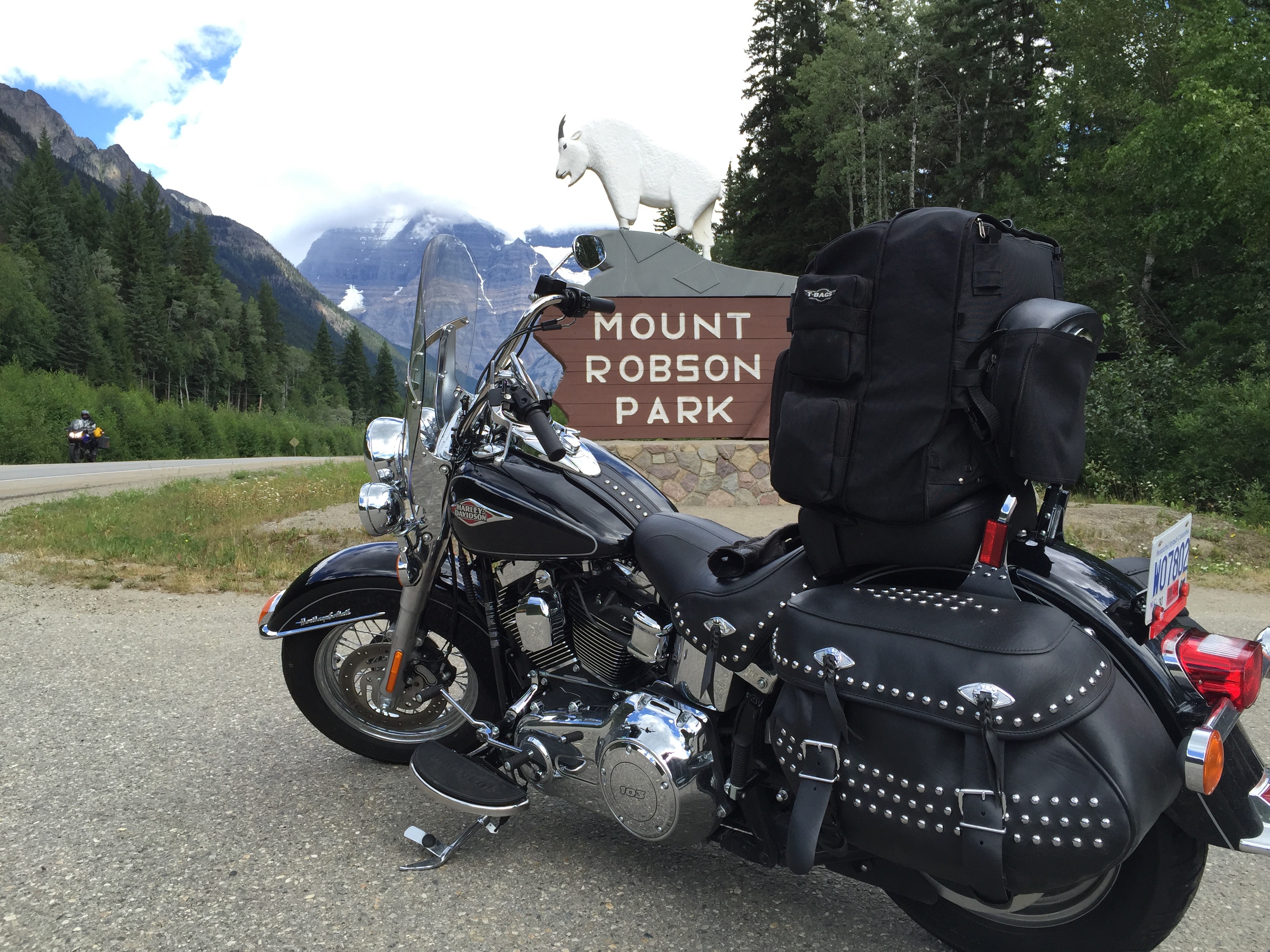
And with that, we turn east onto the Yellowhead Highway. We are in Mount Robson Provincial Park, named for Mount Robson, at 12,972, the highest point in the Canadian Rockies (the highest point in Canada is Mount Logan, 19,551 feet high in the Yukon Territory). Mount Robson is one of the most photographed features in the Canadian Rockies. Mount Robson Provincial Park is included within the Canadian Rocky Mountain Parks World Heritage Site, a designation noted by the United Nations.
We will spend the next few days exploring the Canadian Rockies, a mountain range that looks unlike any you’ve ever seen. Unless of course, you’ve been to the Canadian Rockies. First time for me.
The Canadian Rockies span the provinces of British Columbia and Alberta. With jagged, ice-capped peaks, it’s a region of dramatic wilderness, alpine lakes, diverse wildlife and many outdoor recreation sites. National Parks include Yoho, home to Takakkaw waterfall; Jasper, famed for its Athabasca Glacier; and Banff, site of glacier-fed Lake Louise.
This week, we’ll visit all those places, and many other Canadian national and provincial parks.
***
We continue along the Yellowhead Highway, following the Fraser River past Moose Lake and into the province of Alberta. Shortly, we arrive in Jasper, the commercial center of Jasper National Park. Jasper National Park and Robson National Park border each other; it’s a seamless transition between the two.
Jasper, established in 1813, is a Canadian National Historic Site. There’s much to do here in the summer – whitewater rafting, rock climbing, hiking, fishing, golf, bicycling, wildlife viewing. Then, in the winter, Jasper is known for ice climbing, cross-country skiing, ice skating, skiing, snowboarding and other activities taking advantage of the winter whiteness.
There are more than 50 hotels, motels, chalets, and bed and breakfast inns in Jasper – among them the famed Jasper Park Lodge and Fairmont Jasper. Jasper is a very popular place for tourists from all over North America – and across the globe. In all, thousands of rooms are available. Except when they aren’t. We thought we may have found the last available room in town, at the Lobstick Lodge.
Join the crowd if you don’t know what a lobstick is. It’s a little-known traditional marker found in the boreal forests of Canada by removing the lower branches of a pine tree. The remaining tuft on the top of the tree makes it conspicuous from a distance. Lobsticks mark trails, portages, sources of food or hunting grounds. Canada loves its lobsticks. At least 18 places across Canada are named after the lobsticks that once stood there – including towns, bays, creeks, islands, lakes and rivers. Woo-hoo, eh!
Historically, Canadians have also used lobsticks as cultural markers, to signify meeting places, burial grounds, ceremonial sites or as personal totems. In 2012, Saskatchewan historian and writer Merle Massie called for the lobstick to be added to Canada’s list of biopolitical symbols. In her words, “I like how the lobstick is both natural (a tree) and culturally modified (shaped, changed, adapted, marred or scarred) – in many ways, a fitting symbol of Canada itself.”
Here’s some late-breaking news: at the last minute, a less expensive room has just opened up at the nearby Maligne (“muh-LEEN”) Lodge, a block from the Lobstick Lodge. As this is a guy trip, we settle for the cheaper room at the Maligne Lodge and cancel our lobstickness, so all the explanation about lobsticks, as it turns out, may have been unnecessary. But the process of the Lobstick Lodge booking taught me a new word. Bottom line: we saved money and increased our vocabulary. What could be better?
Maligne Lodge, by the way, is named after Maligne Lake, not far from here in Jasper National Park. Finally, you need to know where the word maligne comes from. It comes from the French word for malignant, or wicked. The name was used by Father Pierre-Jean de Smet in the mid-1800s to describe the turbulent river that flows from the lake in the spring. The name soon spread to Maligne Lake, Maligne River, Maligne Canyon, Maligne Pass, Maligne Mountain and the Maligne Range. How wicked!
Yours in all things lobstick and maligne,
Gary and Randy
 Riding With Gary