Today, when we arrive in Hurricane from St. George, we continue east on UT-9, rather than turning south on UT-59.
We roll through Springdale, just outside the entrance to Zion National Park. Like so many other towns in Utah, Springdale, elevation 3,900 feet, was originally settled as a Mormon farming community. Today, because of its proximity to Zion National Park, Springdale’s economy is based around tourism.
In no time, we are in Zion National Park, which is at the junction of the Colorado Plateau, Great Basin and Mojave Desert regions. Zion was established as a National Park in 1919, and expanded in 1956 to include the Kolob Canyons area.
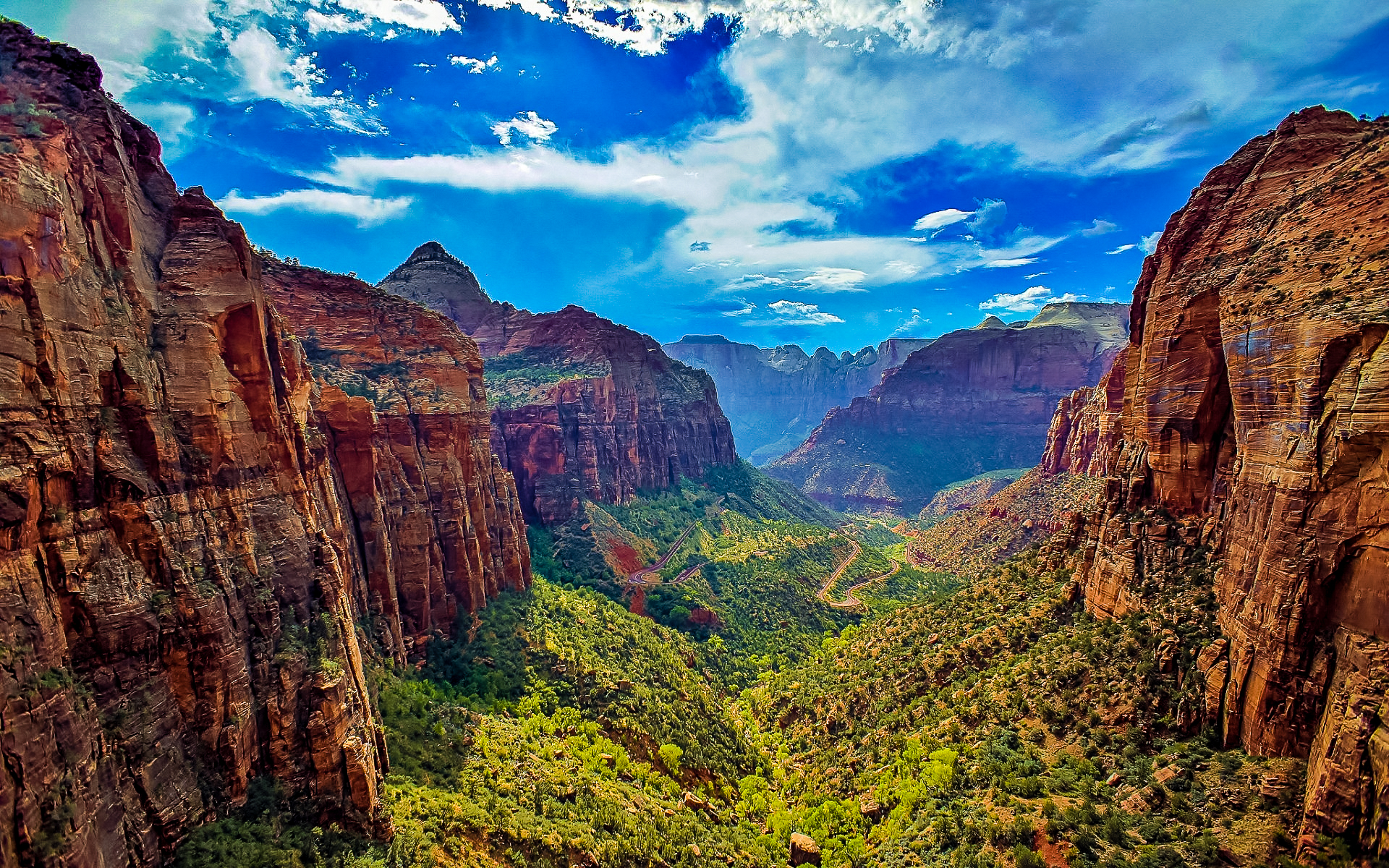
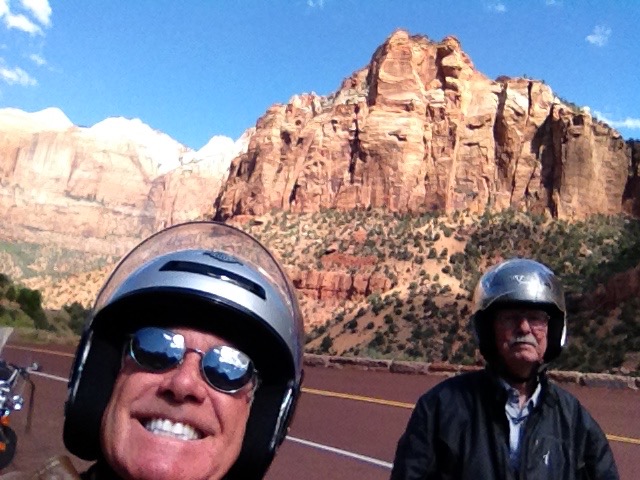
With nearly three million visitors a year, Zion is the most heavily used of Utah’s five National Parks. It seems most of the three million visitors have chosen to see the park today. The place is filled to the rafters, though it’s difficult imagining rafters in Zion.
We can’t find a single parking space at the visitors center, and the main road through the park, UT-9, is wall-to-wall cars. Traffic, when it does move, plods along at about 10 MPH.
The crowding is unfortunate, but hey, it’s Memorial Day weekend. I should have seen that one coming. Still, the hordes of tourists do little to diminish the overwhelming beauty of Zion National Park.
Click here to learn more about Zion National Park.
We leave the park, continuing east on UT-9 to US-89, where we turn north. We’re on US-89 for about 43 miles. Just a few miles south of Panguitch, we turn east on UT-12, considered one of the top motorcycle roads in America. It’s officially a Scenic Byway, an All-American Road that takes us through canyons, plateaus and valleys, ranging from 4,000 to 9,000 feet above sea level.
Highway 12 is often listed as one of the top scenic drives in the U.S., alongside California’s Highway 1 (the Pacific Coast Highway), New Hampshire’s Kancamagus Highway (which Ray and I rode in 2012) and the Blue Ridge Parkway (which Ray and I have ridden twice, once in each direction).
Also on the gotta-go-ride-it lists: Trail Ridge Road and the Million Dollar Highway, both in Colorado’s Rocky Mountains. We’ll ride them next week.
Parts of UT-12 were built by in the 1930s by the Civilian Conservation Corps, a work relief program that operated from 1933 to 1942 as part of FDR’s New Deal. It provided unskilled manual labor jobs related to the conservation and development of natural resources in rural lands owned by federal, state and local governments.
When the Civilian Conservation Corps built UT-12, the new road provided the first year-round access for cars to this once-isolated part of southwestern Utah.
***
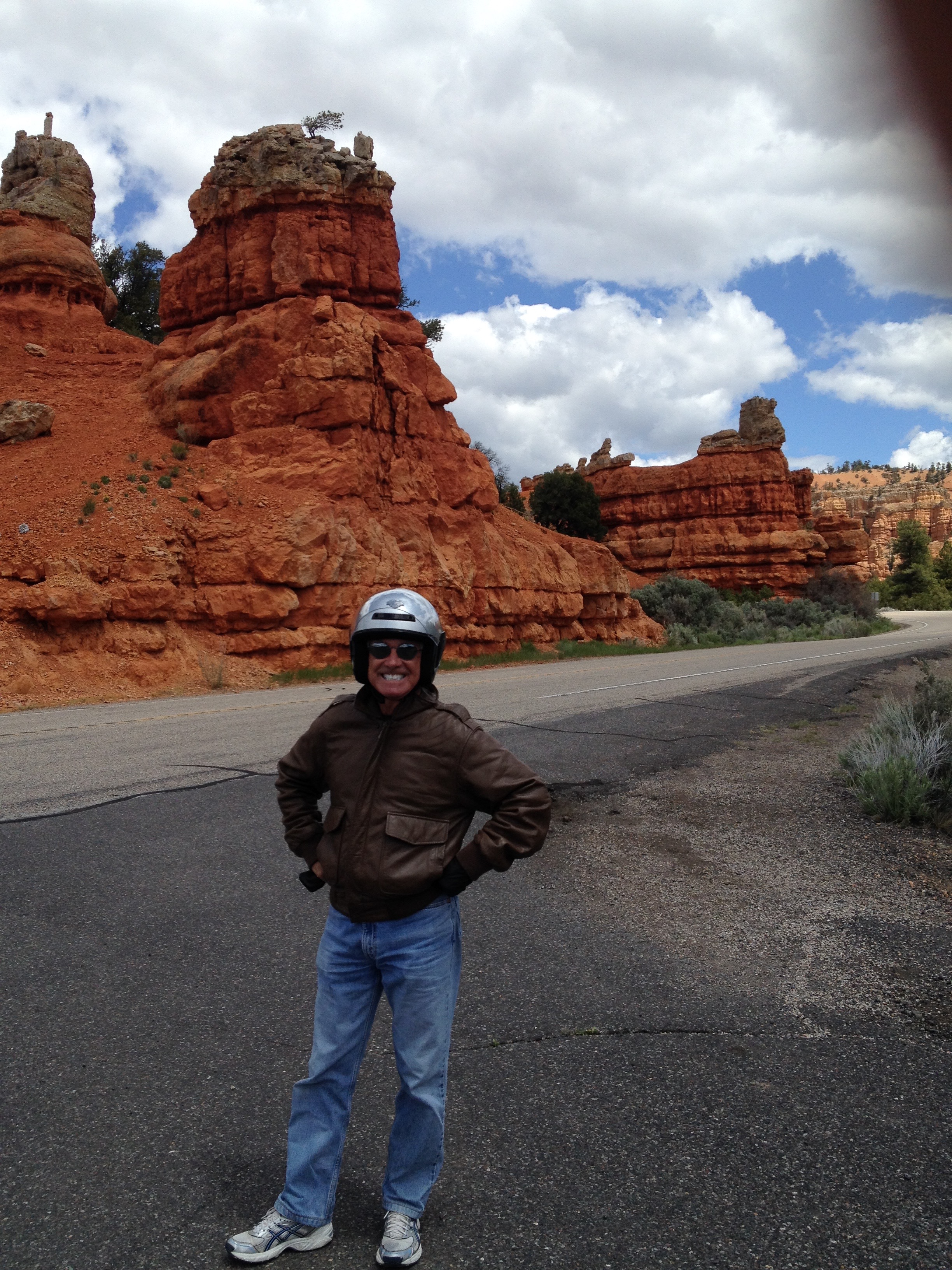
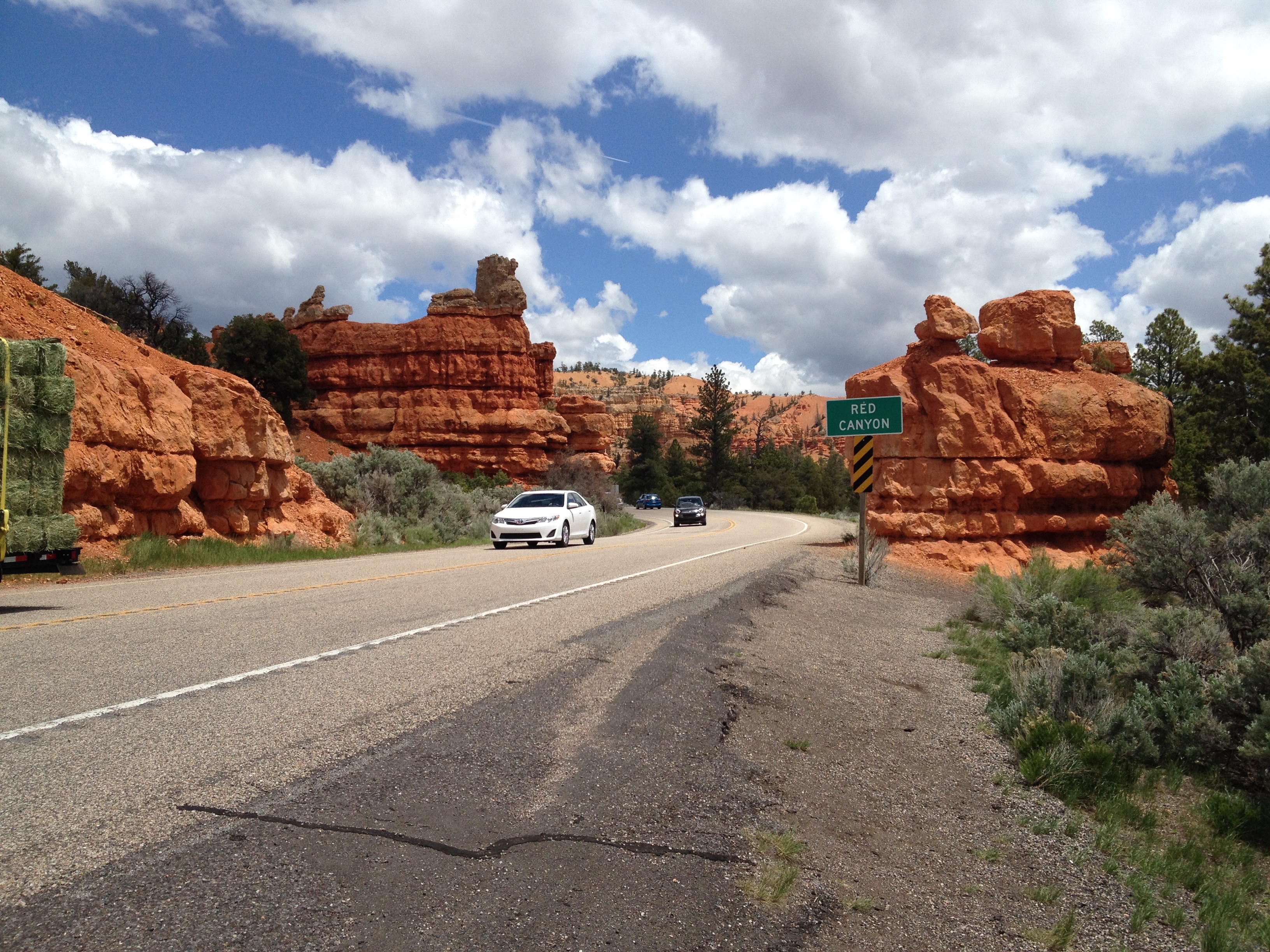
There’s red rock everywhere you look. The colors come from the presence of iron oxide, or hematite. Exposure to the elements caused iron minerals to oxidize, or rust, resulting in red, orange and brown-colored rocks. And voila, you have the Red Canyon area of Dixie National Forest we’re now riding through.
We arrive in Bryce before long and gas up; I’m getting about 50 MPG on the trip. We’re right on the edge of Bryce Canyon National Park, but we’ll skip The park for now and instead return tomorrow.
Our destination is Torrey, just west of the entrance to Capitol Reef National Park. With five national parks, Utah has more than any other state except California (nine) and Alaska (eight). We’ll visit four of Utah’s five National Parks on this trip, and two of the four in Colorado.
One thing you notice in the parks is the absolute absence of typical city noise. Other than an ooh or ah from gobsmacked tourists, these places are eerily silent.
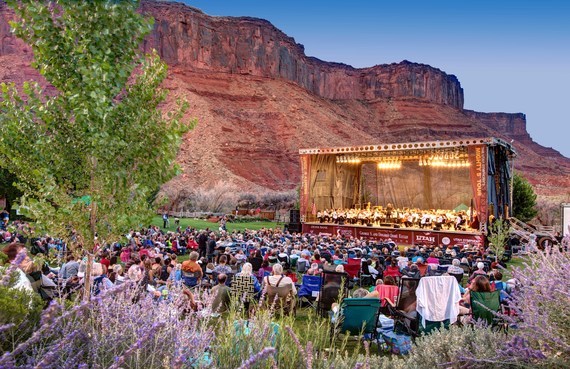
But this summer, all five of Utah’s National Parks will have some special sounds. The Utah Symphony is performing in mid August, at or near all five of the parks during a weeklong tour. It’s part of the orchestra’s 75th anniversary celebration, and a lead-up to the 2016 centennial celebration of the National Park Service. The concerts, which will take place at sunset, will be free.
“The concerts are a way to combine the different energies we are surrounded by,” said Utah Symphony Music Director Thierry Fischer, an outdoor enthusiast. “Nature creates sound, and sounds are nature.”
***
There are 59 National Parks.
- The largest, at 8,323,148 acres, is Wrangell-St. Elias, in Alaska; the smallest, at 5,550 acres, is Hot Springs, in Arkansas.
- The first National Park, Yellowstone, was created in 1872, and is spread across Wyoming, Montana and Idaho.
- The newest National Park, Pinnacles, is in California, about 80 miles south of San Jose. It was upgraded from National Monument to National Park status in 2013.
Some parks are easier and more convenient to visit than others. One that would seldom be visited is the proposed Apollo Lunar Landing Sites National Historical Park – on the moon. A bill introduced into Congress to make these sites a park is designed to preserve and protect the lunar surface. The bill’s sponsor, Rep. Donna Edwards of Maryland, says giving the moon Park status would “ensure that the scientific data and cultural significance of the Apollo artifacts remains unharmed by future lunar landings.” So far, her proposal hasn’t received much support.
To find a park near you, click here to visit the National Park Service’s website.
***
UT-12 connects Bryce Canyon and Capitol Reef National Parks.
We continue toward Torrey on UT-12 for 123 miles, passing through, or near, Escalante Grand Staircase National Monument, Carcass Canyon Wilderness Study Area, and Anasazi State Park.
On UT-12, we cross a 9,600-foot pass on our way to Torrey. Clouds hide the sun for much of our ride, and it is really, really cold. Can’t imagine what it’ll be like in Colorado next week when we’re at 14,000 feet!
Torrey, elevation 6,830 feet, was established in the 1880s by, you guessed it, Mormon settlers, and was initially known as Youngtown, after John Willard Young. He’s one of the few individuals to have been an apostle of the LDS Church and a member of the First Presidency without ever having been a member of the Quorum of the Twelve Apostles. Glad you asked?
The town of Torrey was named after one of Theodore Roosevelt’s Rough Riders, Col. Jay Torrey.
Other famous people with connections to Torrey include:
- Butch Cassidy, whose real name was Robert Leroy Parker. His boyhood home in Circleville, Utah, was not far from Torrey. He was glamorized in a Hollywood movie as a train robber, bank robber and leader of the Wild Bunch Gang.
- Zane Grey, an author best known for his popular adventure novels that presented an idealized image of the American frontier. His best-selling book was Riders of the Purple Sage. Southern Utah was often the focus of his writing.
- Wallace Stegner, a historian, novelist, short story writer and environmentalist often called the “Dean of Western Writers.” Like me, Stegner received his Bachelor’s degree at the University of Utah, though I’ve never been called the Dean of anything.
***
Tonight, in an unusual move, we stay at a non-national brand motel – the Red Sands Motel ($105.79 per night, including tax, for two queen beds). There’s little about Torrey that’s franchised. It’s a welcome change. Most of the other lodging on this trip is at national chains, where I can add to my already substantial collection of hotel soap and shampoo.
Day Four Summary: Hanging out in the land of Zion, iron oxide everywhere, an All-American road, Rough Riders in Torrey.
Click here to view today’s route from St. George to Torrey.
What will tomorrow bring?
 Riding With Gary